

Fried Chicken Vs Chicken-Fried Chicken: What's The Difference?

Perhaps you've seen them on the same menu, fried chicken and chicken-fried chicken, and wondered if it was some sort of misprint or mistake. After all, what even is chicken-fried chicken, and how could it possibly differ from regular old fried chicken? While there are some clear similarities between the two — both dishes consist of breaded and fried chicken — there is actually quite a bit that divides these two poultry-based dishes, including origin and toppings. So let's get into the meat of things.
Perhaps the biggest dividing line between these two is the preparation. While fried chicken tends to be bone-in, chicken-fried chicken is served as a boneless cutlet that's been pounded flat, breaded, fried, and served with white gravy. Fried chicken can be served with gravy also, but is more often served simply breaded and fried, or entirely coated in a specific sauce. In terms of culinary genealogy, it does appear that chicken-fried chicken is derived from fried chicken, but there is another, beefier ancestor that we must recognize if we are to fully understand and appreciate the delicious and confounding chicken-fried chicken.
A little bit about chicken-fried chicken
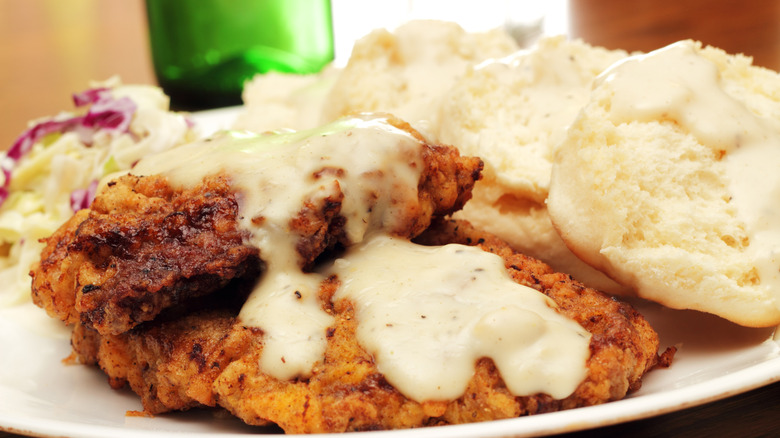
If you're unacquainted with chicken-fried chicken, but the name sounds familiar, it's probably because you've eaten its direct ancestor, the chicken-fried steak. Yes, chicken-fried chicken is a direct descendant of chicken-fried steak, thus explaining the circular logic of its name. Chicken-fried steak is itself a descendant of fried chicken, and a 20th-century invention that has become somewhat of a Texas icon. Legend has it that the dish came about via German immigrants, who used cuts of beef in place of veal for schnitzel, though there is little to back this up. Another apocryphal story suggests that the dish was named after a mix up between a server and a cook, who mistakenly combined two separate orders, one for steak and one for fried chicken.
Chicken-fried steak consists of pounded beef (usually cube steak) that has been breaded, fried, and smothered in gravy. It's a delicious blend of beefy flavor and crispy, fried chicken goodness. Like chicken-fried steak, chicken-fried chicken is pounded flat, breaded, and so forth. It's a kind of like the culinary version of the telephone game. Every communication is a transformation, a bit of an echo calling out across the world of food — thus the double chicken in its title. What makes it truly a chicken-fried chicken is not the fact that it is fried poultry, but that it is prepared and served in a certain way, no different than chicken-fried steak or chicken-fried pork chops. The protein is interchangeable, it's the chicken-fry technique and serving style that defines it.
The defining qualities of fried chicken
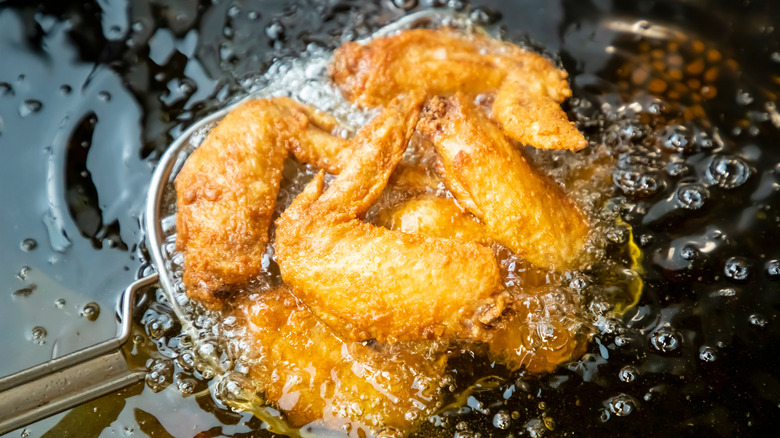
Fried chicken, on the other hand, is a more solidly Southern classic. The origins of the crispy dish are a bit muddy, but it likely has some roots in Scottish cooking. Regardless, it has become a Southern staple. Making fried chicken involves breading and frying up pieces of bone-in meat until perfectly crispy and golden. Often, home cooks will brine their chicken in buttermilk or another liquid, such as pickle juice, for more flavor and a more tender texture. Unlike chicken-fried chicken, which has a bigger breading to meat ratio (thanks to its flat, thin format), fried chicken lets the meat have just as much attention as the crispy breading.
What really shines is the taste of the chicken and the contrast of its juicy flesh with the crispiness of that fried exterior. This is not to say that fried chicken can't get gussied up — there are plenty of ways to dress up this dish. Think of Nashville Hot chicken or Buffalo-style chicken. But at the end of the day, it isn't the toppings or sauces that make it what it is. All fried chicken needs to be is bone-in, breaded, and fried in fat. Everything else is just window dressing (delicious, delicious window dressing).