

What Makes Store-Bought Ketchup So Thick?
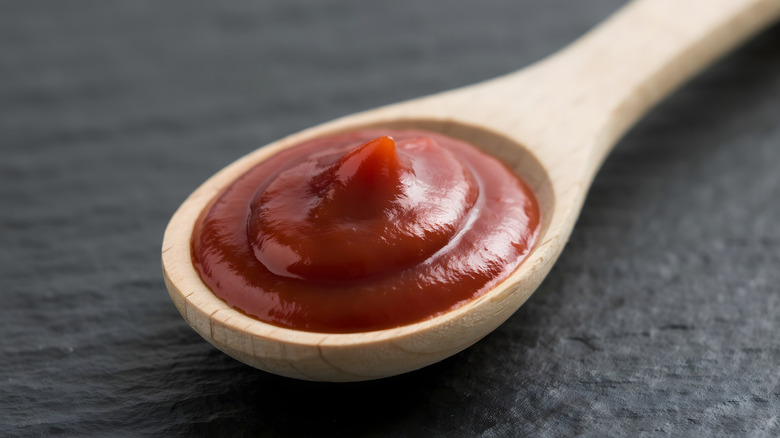
If you've ever tried replicating store-bought ketchup at home, you've probably found it tough (if not impossible) to get the ketchup to form those perfectly thick, rounded globs that come out of the bottle. That's because manufacturers are drawing on a few different food chemistry tricks to get that texture just right.
Some of their tricks are all natural: The first is that commercial ketchup makers cook tomatoes down into a dense paste (or just start with paste), making it far less watery than juice or puree. Then, there's something called pectin, a compound found in tomato cell walls that helps gels form (it's also used for making jams and jellies). The key is to stop the pectin from being broken down by enzymes that it has contact with after you crush the tomatoes. To do this, factories heat crushed tomatoes to around 200 degrees Fahrenheit right after they're crushed, which deactivates those enzymes, keeping the pectin intact and allowing it to prevent your ketchup from getting watery.
However, these aren't the only tricks up industrial manufacturers' sleeves. They'll typically lean on added thickeners, which can include corn or potato starches, tomato pulp powder, and so-called "hydrocolloids", which, like pectin, help liquids form a gummy texture. If you've ever seen "xanthan gum" on an ingredients label, it's one of these. Tapioca starch is a particular industry favorite, as it holds up well under heat and acidity.
Additives and legal requirements for ketchup thickness
There's no need to fret about these thickeners in ketchup, as even the starches are natural. As their names imply, they're extracted from corn, potato, or tapioca. While they're treated to make them heat- and acid-resistant, they're not synthetic. Then, xanthan gum is made from a fermented sugar, and major food safety authorities from the FDA to the European Food Safety Authority consider them totally safe; restaurants also regularly use this thickening ingredient in their cooking.
Homemade ketchup will sometimes skip these thickeners and just reduce tomatoes or tomato paste with vinegar, spices, and sugar — so if you're really trying to replicate popular store-bought ketchups, you'll probably want to add them. The good news is that they're mild to flavorless, and tapioca starch is particularly beloved for giving a smoother texture. The starches are easily found in grocery stores, while xanthan gum is sometimes found in baking or gluten-free sections.
There's one final reason supermarket ketchup is so thick: The government. The FDA actually spells out a requirement for how thick it should be based on how far it can be poured in 30 seconds. If it's too thin, it has to be marked with a "low consistency" label. This dates back to the early 1900s, when ketchup makers were accused of using chemicals to cover up watered-down products, so the FDA imposed uniform standards on ketchup and many other products.