

The Major Advantage Of Buying Blueberries At Local Markets Vs Big Stores
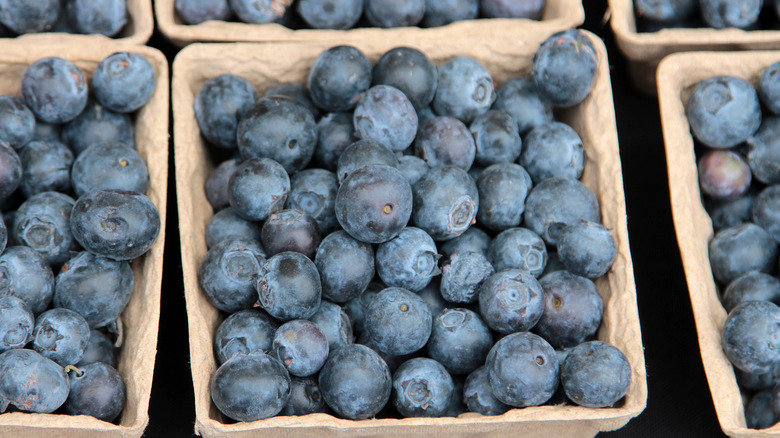
It's always good to stock up on fresh fruits, and one of the most irresistible and versatile of the bunch is a bowl of blueberries. Blueberries might hold a high place on the list if you like to alternate between fresh or frozen blueberries for pies, smoothies, or muffins or to enjoy them as they are. In case you didn't know, though, it does make a difference whether you opt for store-bought blueberries from a large grocery chain or berries from a local market. To ensure that you get the absolute freshest blueberries within your area, you're best off buying them at your local market.
While scooping up a box of blueberries during your grocery store run might feel convenient, you'll miss out on the potential benefits of loading up on market blueberries — namely, the taste. Blueberries at local markets are more likely to have been grown close by, particularly if it's a producer-only market. The berries are allowed to ripen to a fuller extent before they're picked, which means the sugar-acid balance is more prominent, leading to more intense flavor. The nutritional profile is stronger, too, as produce begins to lose nutrients after picking.
Shopping at local markets also ensures that you're getting blueberries when they're actually in season (from May through August), which is beneficial for connecting with the natural cycles of your local area and enjoying the fruit at its freshest. Your purchase can also help financially support farmers in your area. Plus, shopping at local markets cuts out the excessive air miles, creating fewer carbon emissions along the way.
Other advantages and considerations when buying blueberries locally rather than at big stores
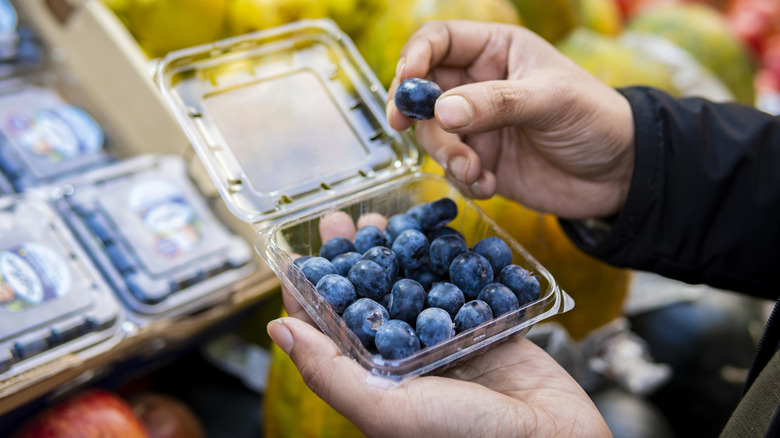
Farmers markets in the United States date back to at least the 18th century, and the hype hasn't died down. At farmers markets and other local spots, you can often find wider varieties of fruits beyond what you'll see at big box grocery stores. The most common commercial variety of blueberries, the one you'll most likely find in grocery stores in North America, is bluecrop. These are also commonly sold at farmers markets, but you're also more likely to find local varieties there. If you're in the southeastern United States, for instance, local farmers might be selling rabbiteye blueberries like the Brightwell, which has a good, sweet flavor.
There are a few tips and tricks for choosing the tastiest pint of blueberries when shopping, and these hold true for local markets as well. Go for plump berries with a deep color (the exact hue can vary based on berry variety), and with a silvery bloom on the skin. Alternatively, you can opt for pick-your-own farms (aka you-pick farms), where you cut out the middle man and head straight to the farm to pick your fruit yourself. This method offers a more intimate understanding of the origins of the berries and farming conditions and lets you choose every berry that ends up in your bucket. Not all farmers markets hold the same standards across states and vendors, so quality control and options may vary. Pick-your-own farms offer you proximity to the farmers to avoid knowledge gaps.