

Steal Gordon Ramsay's 2-Step Technique To Make Chopped Herbs 10x More Flavorful

Fresh herbs introduce flavorful color to all manner of dishes. You'll see as much mint, lavender, and other fresh herbs paired with sweet treats like chocolate as you'll find classics like rosemary and thyme covering a wide variety of savory roasts. And, considering you've gone through all the trouble of sourcing, washing, and, just as importantly, drying said botanicals, you may as well know how to properly chop them, too. It may sound a little arduous than, you know, just running a knife through the stuff, but there's a more precise way to get those tasty springs and leaves into ideal cooking condition. Celebrity chef Gordon Ramsay lays out a two-step process for what he calls "the proper way to chop fresh herbs to get maximum flavor" in an Ultimate Cookery Course clip on YouTube. It involves first stacking the herbs, then rolling them into a bundle before slicing through like they're a single unit.
"The secret is to chop them, not bruise them," Ramsay asserts. Bruising has its place, but it can let precious flavor and fragrance escape. A chopped herb is exemplified by clean lines like lovely bits resembling ribbons or confetti. It looks professional when topped on your plates. On the opposite end of the spectrum, a totally bruised herb is more like the mint you'd find muddled at the bottom of a mojito glass; a swampy tangle of pummelled plant cells. Ramsay achieves the former effect with his neat two-step technique. This better creates a uniform finish and ensures that your herbs retain maximum flavor as opposed to the less elegantly pulverized and bruised outcome one might get by simply hacking away and hoping for the best.
The two-step technique for a more polished chop
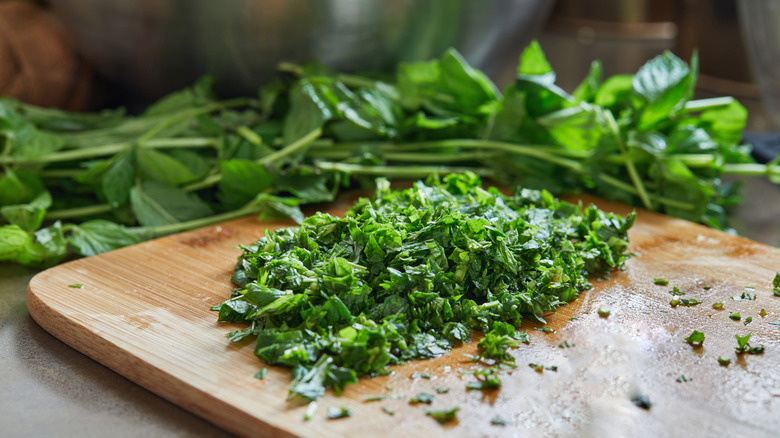
Gordon Ramsay's brief tutorial begins with basil leaves, which are probably among the easiest to work with when you're only beginning to tinker with this technique. He simply stacks several leaves on top of one another, with the largest leaf at the bottom. He then forms them into a tube. "It's almost like rolling a cigar," he says in the clip on YouTube, before slicing them into what will soon unfurl into thin strips, nary a bruise in sight.
Not every herb is going to be as easy as basil. The coriander leaves that Ramsay also chops must not only be plucked from their stems, but they're too dainty to approach quite like the basil. You can de-stem plenty of herbs with a box grater trick that runs them through the metal holes when you don't have the time to pluck them one by one. You'll then roughly roll them up into a bunch in a more freestyle fashion that won't stay together as tightly as the basil, but which will still give you a nice, unbruised final product.
One of these two methods will generally work depending on the surface size of the herb you're working with. You want your cutting board to remain somewhat clean in any case, too. "You can always identify when you've bruised the herb when you've removed the herbs off the board and there's a big green patch," Ramsay says. You'll know you've succeeded when, as he observes, "none of the goodness is left on the chopping board."