

Where Does Trader Joe's Milk Come From?
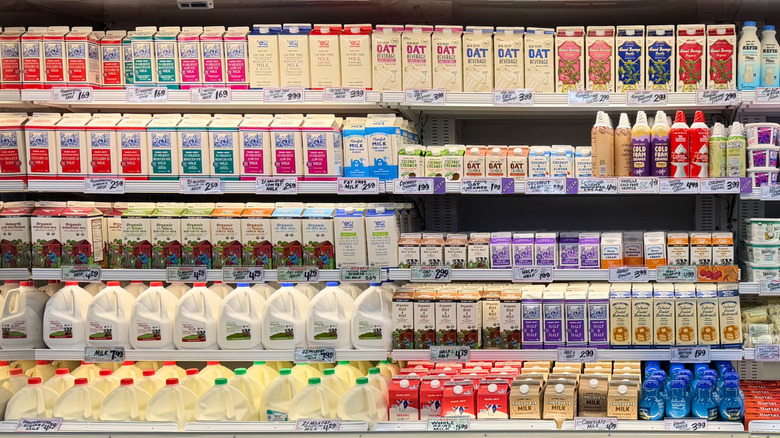
While there are more than 650 Trader Joe's locations in the United States, the company is largely viewed as the anti-chain grocery store. It claims to buy directly from suppliers whenever it can and to focus on delivering quality rather than brand names. One way to test if this is true is to ask where its milk comes from. It turns out that the answer depends on where your Trader Joe's is located. When you first pick up a carton or gallon of Trader Joe's milk, you won't see the milk's source listed straightaway on the container. The milk is store-branded and includes nutritional information along with a Trader Joe's blurb about the quality of the milk, but it doesn't actually list the farm that processed it. To find where it comes from, you have to know where to look.
Every milk carton sold in the United States has a code printed on it beginning with two numbers, and usually a dash, followed by more numbers or letters. In the case of Trader Joe's milk, you'll see that number with a helpful message that reads, "filled at plant:" preceding the code. You can enter that code at the Where Is My Milk From website to get the name and location of the dairy farm that processed that carton. The farm your milk comes from will depend on which Trader Joe's you visit.
Trader Joe's milk is regional
Living in Southern California, the code on the milk of my local Trader Joe's pointed to Rockview Farms. This is a family-owned dairy farm that began in 1927 in the city of Downey, California. The farm claims that it prides itself on its history and regards its cows, employees, and customers as extended family — but not all Trader Joe's milk comes from a small farm. For example, some shoppers online have noted that their Trader Joe's milk came from Kemps LLC. This company operates multiple farms around the country and while not a small farm, it is part of the Dairy Farmers of America, which calls itself "a cooperative of family dairy farms" on its website. A few taps on your phone will help you identify the source of the milk at your local Trader Joe's so you can decide if it's a farm you wish to support.
Identifying the source of the products you buy at a grocery store is not always easy. One company can supply its product to Trader Joe's, Costco, and more. When it comes to dairy, using regional farms ensures fresher milk on the shelves and also helps keep prices competitive by reducing storage and shipping costs. You can also use the dairy code to identify where Trader Joe's turns to for ice cream (especially useful if you want to take a dessert to this weekend's cookout). While the friendly neighborhood milkman is a thing of the past, you may still be able to get at least some of the benefits of those old days if you find that your nearest Trader Joe's sells milk that's supplied locally.