

Why Some Salmon Look Red, While Others Look Pink
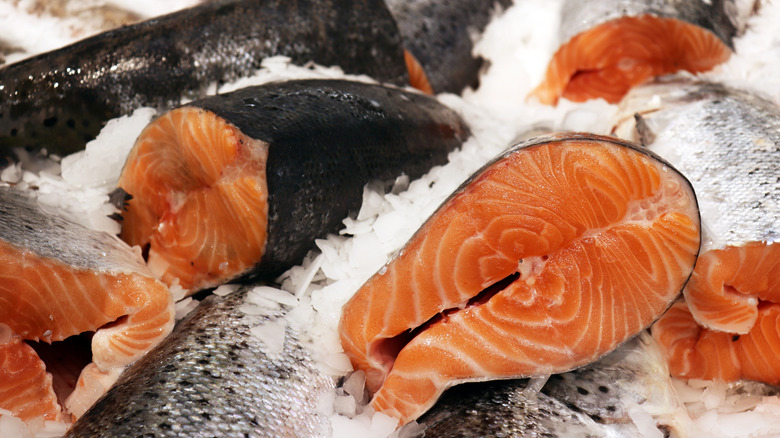
There's a reason salmon is one of the world's most popular and prized fishes. It's fatty, meaty, rich in umami, and loaded with flavor. It's also an excellent source of heart-healthy omega-3 fatty acids and protein. But have you ever wondered why some salmon is deep red or orange, and other salmon is pale pink? Well, it turns out that the variations in flesh color are largely determined by salmon's diet, species, and even their age and genetics.
First thing's first: salmon gets its signature color from astaxanthin, a carotenoid pigment produced by microalgae. Remember how Violet Beauregarde turned blue after chewing a blueberry gum in Charlie and the Chocolate Factory? That's actually not too far from what happens with salmon. The fish prey on krill, shrimp, and other small crustaceans, which in turn, feed on these astaxanthin-rich algae. Once ingested, the pigment builds up in the salmon's muscle tissue, thus giving its flesh its unique color.
That said, not all salmon consume the same amount of the astaxanthin. Wild salmon typically has higher levels of the pigment than farmed salmon. That's why its color is often deeper. Farmed individuals are fed with dry pellets that are supplemented with astaxanthin to give the meat some color, but it's typically a lighter shade of pink than wild salmon. That's one way you can spot a salmon's source just by looking at it. But not everything comes down to diet.
Not all salmon species have the same flesh color
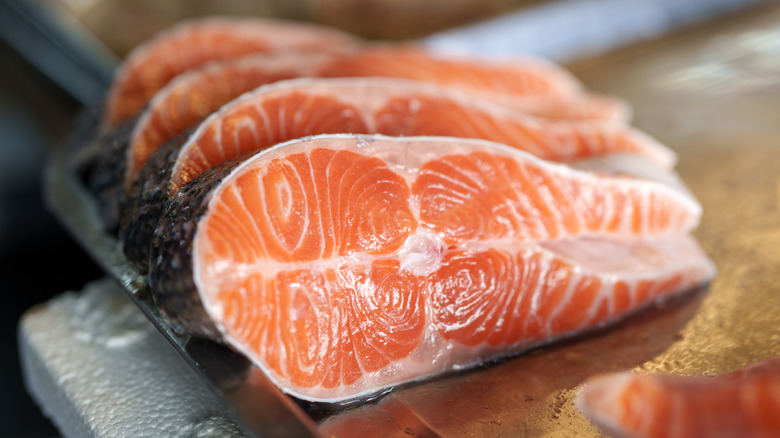
As it turns out, genetics also influences flesh color. A 2019 study published in Scientific Reports identified that the bco1L gene (short for beta-carotene oxygenase 1 like) could affect flesh color in Atlantic salmon. The gene regulates carotenoid metabolism, or how salmon processes the pigments it gets from the diet, as well as how much it can store. Simply put, that means different species of salmon can eat the same amount of krill and crustaceans and still end up with different flesh colors.
For example, sockeye salmon is known for its deep red flesh, as it feeds heavily on astaxanthin-rich zooplankton and krill throughout its life. As a result, wild sockeye salmon individuals can contain up to 4 milligrams of the pigment per 100 grams of flesh. At the same time, king (chinook) salmon eats more fish and shrimp instead. These provide less astaxanthin than sockeye's diet, which makes king salmon lighter than sockeye salmon. For comparison, a 100-gram serving of wild king salmon contains up to 3 milligrams of astaxanthin. However, some king salmon have an ivory color. That's because some king salmon lack the ability to store astaxanthin in their cells. This variety of fish has a recessive gene that blocks carotenoid buildup in the muscles. About one in about 20 wild king salmon carry this genetic trait.
There are also differences between freshwater and saltwater salmon when it comes to color. The fish return to freshwater to spawn, and during that time, the pigments stored in their muscles gradually move into the skin, resulting in flesh that's a lighter shade of pink.