

You Can Spot A Salmon's Source Just By Looking At It. Here's How
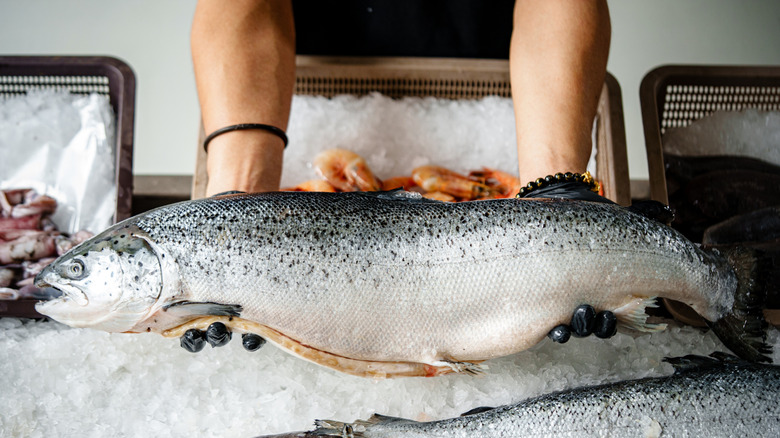
If you've ever bought salmon from your local fishmonger, you know the beautiful colors are eye-catching. But they're also clues to whether the fish was wild-caught or farm-raised. Once you know what to look for, you can tell the difference with just a quick glance.
Along with its standout flavor, salmon is known for its brilliant range of hues from red to pink, along with plenty of orange shades. Those vibrant hues, as well as the fat marbling that runs through the flesh, are tell-tale signs. Salmon's color comes from carotenoids (specifically astaxanthin), which are pigments found in the food it eats — small crustaceans, like shrimp and krill, which are high in the astaxanthin that creates the trademark pinks, oranges, and reds. The white marbling in salmon reflects the fat content, which is influenced by how active the salmon is.
Wild salmon are at the mercy of nature — they eat what they can find, when they can find it. The more marine creatures salmon eats, the more astaxanthin colors its flesh, resulting in stronger red or orange hues and thinner strips of fat marbling. Farm-raised salmon are fed a diet of dried pellets made from plants, grains, and fishmeal enhanced with artificial pigments that ensure consistent coloring to improve marketability. And since they are fed grain and don't get to move around as much to search for food, fat is more pronounced. So, if you see salmon with a consistent peachy coloring with plenty of even marbling, there's a good chance it's farm-raised, as opposed to wild salmon, which will likely have less and sporadic marbling and more variations in flesh hue.
Color variations are enhanced by salmon's genetics
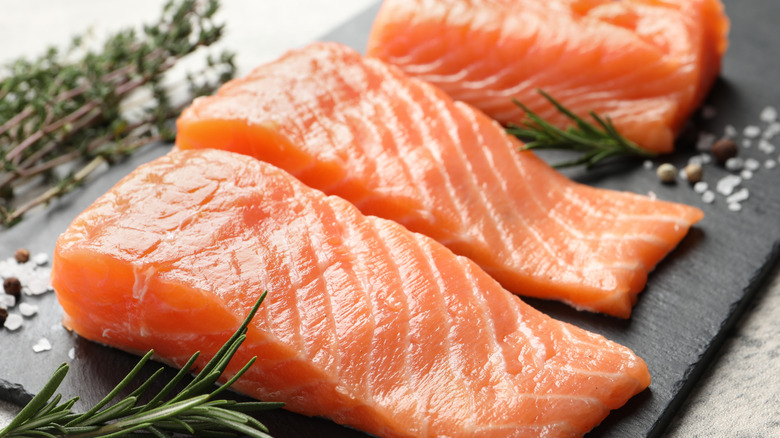
Genetics plays a role in salmon's coloring. Different kinds of salmon process astaxanthin better than others, resulting in the various shades we see. Sockeye salmon, for example, can easily process the astaxanthin, absorbing tons of color from the food it eats. This results in the signature ruby red of the meat, which not only lets you know the salmon is a sockeye, but most likely wild-caught.
Should you happen to see salmon with white flesh, fear not. Consider yourself lucky, since white salmon, also known as white king salmon or ivory salmon, is a rare type that simply cannot process the astaxanthin. But while white salmon is short on color, it isn't short on flavor or nutritional value. The flesh is a creamy, buttery treat that makes for incredible dishes from sushi to grilled salmon.
Traditionally, white king salmon was considered less commercially desirable than its pink-hued brethren, which is also the reason farmed salmon is fed enriched food to brighten the color of its flesh. But the genetic variation that prevents some salmon from processing pigments from the food they eat is found in only about one in 20 salmon. Given salmon has a predestined ability to process astaxanthin, no matter how much of it you feed to certain types (like Atlantic farmed or white salmon), its color will only get as strong as its genetics allow.