

America's Favorite Soy Sauce Brand Is Just As Iconic In Japan
When you sit down to your next sushi or sashimi meal, take a look at the bottle of soy sauce on your table. If you're in the United States, there's a good chance it's a Kikkoman bottle. But Kikkoman is authentically Japanese and just as iconic there as it is here. While soy sauce originated as a jiang paste in China 2,000 years ago and reached Japan in the 13th century, the blueprint for modern soy sauce dates back to the 1600s in Japan. By 1917, three families in the town of Noda produced the majority of soy sauce. The Mogi, Takanashi, and Horikiri families joined to form Noda Shoyu, the company that would eventually become the Kikkoman Corporation.
Ask chefs who specialize in Japanese cuisine which soy sauce they use in both their professional and personal lives, and the answer will most likely be Kikkoman. Even some patrons understand Kikkoman offers the best combination of availability, consistent flavor, and price. Soy sauce consists of three key ingredients: soybeans, wheat, and salt. That's how you get consistent, quality flavor (along with a long shelf life as a bonus). This tradition is how it became a leader in Japan, while its popularity in the United States began after World War II. Kikkoman was already exporting soy sauce, but when soldiers and other personnel previously stationed in Japan came back home seeking out the flavors of Japanese cooking, it was Kikkoman that provided that then-unnamed umami flavor.
Looks matter when it comes to soy sauce.
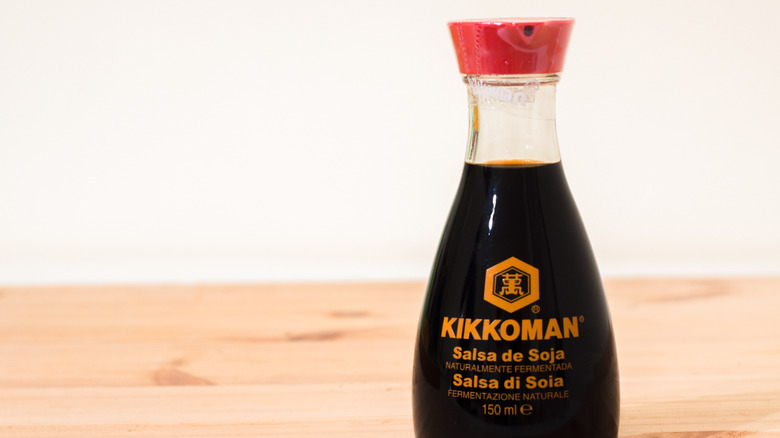
With production plants in Japan, the United States, and elsewhere, Kikkoman had the capability to distribute soy sauce around the world. But to be recognized and reach iconic status, you have to work on the outside image of your product. That's why Kikkoman worked with designer Kenji Ekuan in 1961 to design a bottle unique to the brand. Ekuan developed a teardrop-style bottle that fit easily in one's hand with an innovative cap that was more than just looks. That's right, the two holes at the top of the Kikkoman bottle have a real purpose, and the feature is known as the control hole. So while not everyone may know how to properly dip sushi in soy sauce, they can certainly spot Kikkoman soy sauce just by looking at the bottle.
The iconic Kikkoman bottle won the Lucky Strike Design Award in 2003, and it even sits in museums as evidence of its success. But beyond the bottle, even the company's logo is more than just a logo. The hexagonal shape of the logo represents a turtle shell, or "kikko" in Japanese — and turtles live long lives. The kanji character inside the hexagon represents the number 10,000, or "man" in Japanese. Together, the very name and logo of the company represent longevity, and Kikkoman has proven that sentiment true by becoming the best-known soy sauce company in both the United States and Japan.