

How To Cut Beef Tenderloin Into Filets Like A Pro
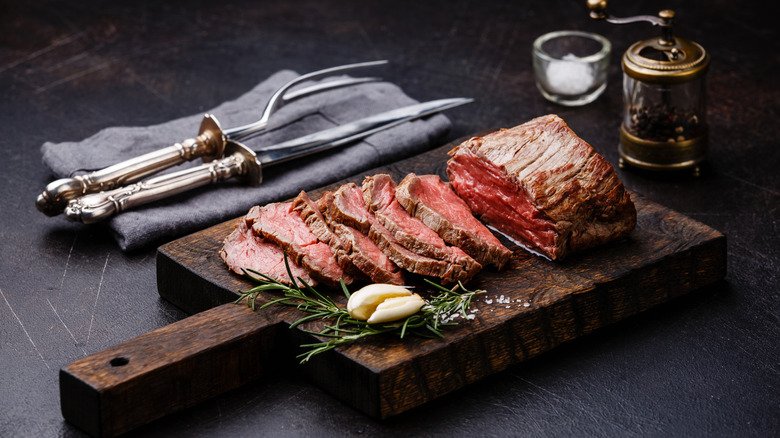
Wonderfully delicate and known for its melt-in-your-mouth texture, beef tenderloin comes from the cattle's loin (hence the name). Because this muscle sees little movement, it's the most tender cut of beef. It's also the part where filet mignon comes from. Now, there are a few important details to know to buy beef tenderloin like a pro. However, that's only half the battle. Knowing how to properly cut it into filets is just as important. Katie Flannery — COO of Flannery Beef, a Californian butcher shop famous for its premium dry-aged prime steaks — revealed in an exclusive conversation that the secret to perfect filets is technique and attention to detail.
It all starts with the right knife. "You want a long, thin, flexible boning knife. Not a chef's knife. The blade is too wide, and you'll fight the meat the whole time," Flannery told Chowhound. Choose a sharp knife that separates the silverskin (a thin membrane of connective tissue) and makes clean, single cuts without tearing the meat.
Speaking of the silverskin, Flannery said it's the first thing that should be trimmed away. As it doesn't break down with heat, leaving it on can make the filets curl and cook unevenly. Removing it, though, requires patience. "Slip the tip of your boning knife just under the silverskin at one end, angle the blade slightly upward, and use long strokes to peel it away from the muscle," she said. The chain is another piece that should come off. It's a long, narrow strip of meat attached by fat and connective tissue. "You can do this mostly by hand; it pulls away with a little assistance from the knife," the COO stated.
Pay close attention to the thickness of the filets
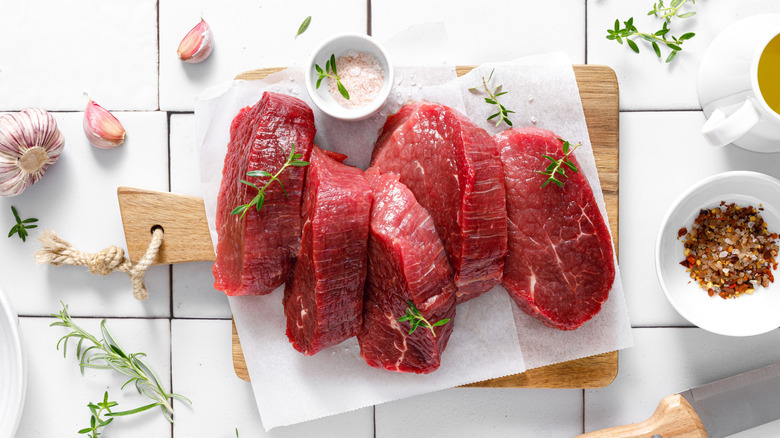
The tenderloin is naturally lean and low in fat, which largely explains why filet mignon pairs well with a sauce or compound butter. It actually lacks the intramuscular fat found in a ribeye. It is, however, still one of the best cuts of steak, according to chefs. Still, you need to treat it with reverence, or at least that's what Gordon Ramsay suggests for perfect filet mignon. That's why cutting each filet to the right thickness is crucial.
A standard filet mignon is approximately eight ounces and one and a half to two inches thick. "Thinner than that and you'll overcook them before you get a proper crust," Katie Flannery pointed out. "Thicker than two inches and you'll need to finish them in the oven to get the center to temperature without burning the outside." That said, even though you should make sure to trim the large exterior fat deposits, don't overdo it. Fat is a natural flavor carrier, and filet mignon already has minimal marbling. "You want a little for flavor, and on a lean cut like this, you have very little margin," she continued.
The most uniform filets come from the tenderloin's center. They cook evenly and have a neat, round shape. "The butt end (the thicker side, closest to the sirloin) is excellent as a roast, or it can be cut into slightly larger medallions," Flannery explained. On the other hand, the tail is too thin and tapered to make a decent filet. That's why it's better suited for beef tips and stir-fries. It can even be used raw as beef tartare.
Freeze your filets, but never thaw them at room temperature
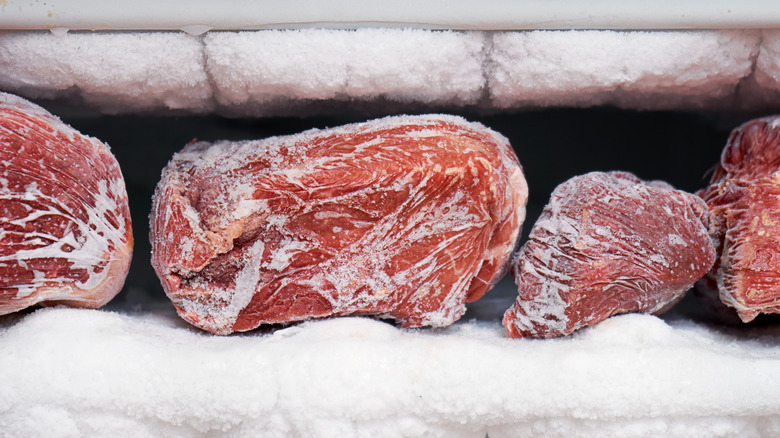
At the same time, buying a whole beef tenderloin is also much cheaper than getting individual filets. Untrimmed tenderloin costs about $6 per pound. For comparison, filet mignon starts at around $18 per pound at discount grocers. "But beyond cost, you get control. You decide how thick to cut each steak," Katie Flannery stated. Considering that one tenderloin can yield up to 10 steaks, you'll most likely end up with more than you can cook at once. That's where proper freezing comes in. To prevent steaks from going bad in the freezer, wrap each filet tightly in plastic wrap, and press out as much air as possible.
"Then put the wrapped filets into a zip-top freezer bag and press the air out of that too, or vacuum seal them if you have a sealer," Flannery said. Vacuum sealing can actually keep the steaks fresh in the freezer for up to three years. Even so, she recommended enjoying them within two to three months, as their quality will gradually begin to decline after that. Before freezing, make sure to write the date and thickness on each package and then simply freeze the filets flat. This will help them freeze evenly and hold their shape.
When you're ready to cook the filets, put them in the fridge overnight to thaw. "Not on the counter. Not in warm water. Refrigerator, overnight, and then bring to room temperature for 30 to 45 minutes before cooking," Flannery emphasized. This will keep the meat safe and out of the so-called "Danger Zone," where bacteria thrive.