

This Vegetable Was Once A Status Symbol On Victorian-Era Dinner Tables
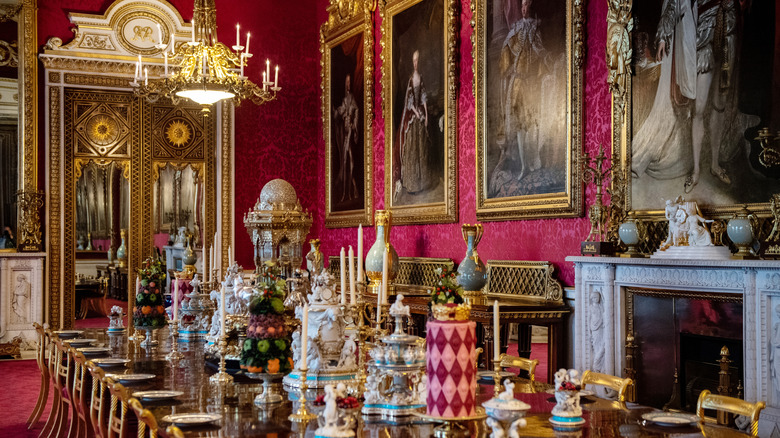
If you've ever served up a platter of veggies and dips and been dismayed to find that not a single guest touched your carefully sliced sticks of celery, you may be surprised to learn that celery used to be the star of the dining table. Throughout England in the Victorian era (roughly the early 1800s until the end of the century), celery was a status symbol.
Although it's originally Mediterranean, celery tended to be grown in the cool wetlands of East Anglia, northeast of London. It was finicky to cultivate, and needed thick, wet soil. Then, to get a tasty stalk, the celery had to be "blanched," either buried in specially dug trenches or wrapped up in paper to block out light. This would bleach the celery, eliminating a natural, off-putting bitterness. Getting the right soil and wrapping or burying celery was difficult and long-winded, meaning celery was a high-priced rarity — and therefore, a coveted item.
For wealthy families, it could be the star of a formal dinner. Cookbooks from the era feature all manner of celery dishes, from being served raw and stuffed with other ingredients to a cheesed-up au gratin to being tossed in gravies and sauces. Far from being just a garnish on a bloody Mary, it could be a course in its own right.
Celery was made an accessory, and then fell from grace

Celery was such a status symbol that it wasn't just served for eating, it would be prominently displayed on dining tables — apparently to prove the hosts' ability to afford such a luxury. Specially designed celery vases were a thing. Richer families would have such vases made from cut glass, while middle-class homes might have pressed glass versions (cut glass vases tended to be more detailed and customized while pressed glass was made in molds). Celery vases were their own specific category of glassware, and were a popular wedding gift.
As anyone living in the 21st century knows, celery did not remain a luxurious vegetable. Part of the reason it was able to enjoy some degree of prominence was that new varieties of celery had been bred, and new technologies developed, which allowed for enough celery cultivation to propel it into its status symbol position. However, as cultivation techniques continued to improve, and as mass production became easier, celery became just another part of the produce section. Its demise wasn't immediate, though; for example, it was still a classy enough vegetable to be served to first class passengers on the Titanic in the 1910s.