

The 2-2-2 Ratio For The Absolute Best Aperol Spritz
We may receive a commission on purchases made from links.
While the old saying, "cooking is an art; baking is a science," may be debatable, one thing that can make both cooking and baking easier is a nice, easy-to-remember mathematical formula. Whether that be the 3-1-1 ratio for mixing marinades (three parts oil to one part each of vinegar and seasoning) or the 4-2-1 ratio for savory soups (four parts stock, two parts veggies, one part protein), these foolproof formulas can help you feel like a pro. And they can be particularly helpful when it comes to mixing cocktails, allowing you to vary the volume of your beverage without requiring any difficult calculations. We spoke with Fred Siggins, author of the forthcoming book "Equal Parts Cocktails: The Simple Ratio for Spectacular Drink," to learn more about how to create the ideal Aperol spritz, which he describes in the book as "one of the most crowd-pleasing cocktails ever created."
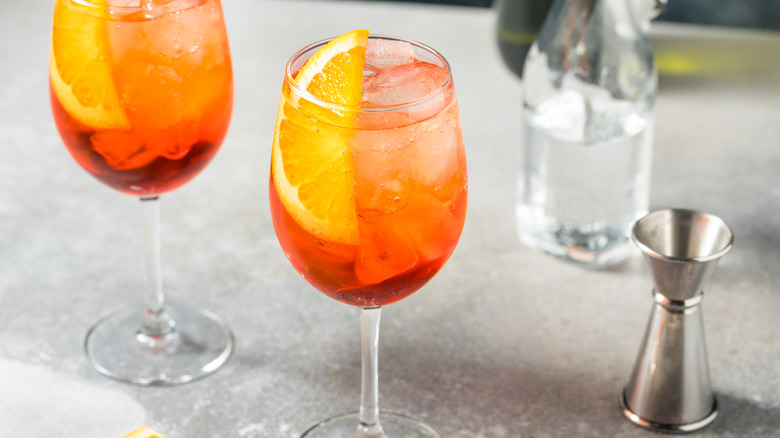
Siggins' Aperol spritz recipe uses two ounces each of Aperol, sparkling wine, and soda water — a variation from the standard 3-2-1 ratio. The wonderful thing about making an "equal parts" Aperol spritz is that this cocktail can be easily adapted for a crowd, as you simply mix all of the ingredients together. Instead of 2 ounces, use 2 cups of each ingredient, adding them to a large pitcher instead of directly into your glass. In either case, you'll want to serve the finished beverage in a glass topped with a generous portion of ice, along with an attractive garnish.
Consider your components and garnishes
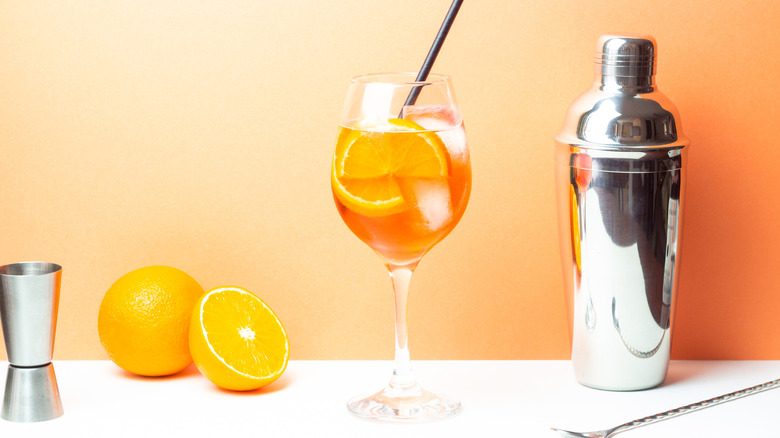
But the formula is really just the foundation — Fred Siggins has a few other tricks and tips to truly take your Aperol spritz to new heights. "The best type of sparkling wine for an Aperol spritz is a dry Prosecco," he says, noting that it's fairly inexpensive, widely available, and provides a good balance of flavor in contrast to the sweet Aperol. When it comes to the ice you add to the drink, he recommends large, solid cubes — however, in this case, quantity matters more than quality. "Use the largest wine glass you can find and fill it right to the top with ice to make sure your spritz stays nice and cold," he says. "A couple of bits of ice floating in your drink will melt very quickly, leaving you with a tepid, watery cocktail."
Siggins' recommended garnishes are an orange wedge and an olive — and, if you're feeling fancy, a spring of fresh herbs such as mint, thyme, or rosemary. However, garnishes are often prime areas to express your creativity, and Siggins says that if you choose to forego the traditional orange, "Pretty much any seasonal, brightly flavored fruit you have on hand will be lovely in an Aperol spritz." Of course, you could swap out the orange for a different form of citrus, like a grapefruit; but he also points to berries, peaches, melon, and pineapple as being worthy candidates.