

How To Cut A Whole Ribeye Into Multiple Steaks Like A Pro
We may receive a commission on purchases made from links.
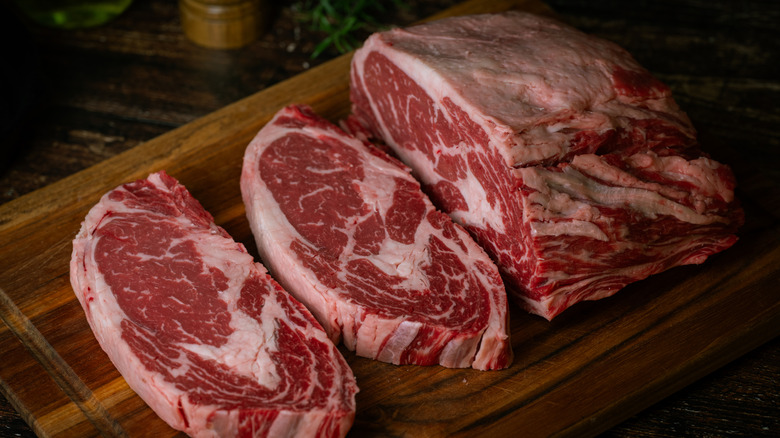
Out of the many steak cuts available, ribeye is one of the best, thanks to its versatility, rich flavor, and (when cooked properly) ultra-tender texture. But there's a reason it's often associated with fine dining: it isn't cheap. One way to lower the cost while still enjoying this meat is to purchase a whole ribeye and cut individual steaks yourself. Chowhound spoke with Brad Baych, a professional butcher and author of "Primal Cuts: A Butcher's Guide to Selecting, Preparing, and Perfecting Beef," to learn more about best practices for cutting a whole ribeye.
One of your first considerations will be the knife you use. Baych recommends a 10-inch breaking knife or a larger chef's knife. "Look for a stainless steel knife, that way it is very durable and easy to keep sharp," he says. Before cutting, also double check that your knife is sharp. "A sharp knife is essential to cut nice looking steaks," Baych says. "If you are trying to saw through the meat, you will be left with jagged uneven cuts." The ends of your whole ribeye may be uneven as well, so start by squaring them with your knife so that each steak is flat on both sides — an essential step for the steak to cook evenly.
Considerations from there, are up to individual preference. You may want to trim more or less fat from the steak (Baych prefers to remove quite a bit); and different people prefer different thicknesses in their steak. But as a general starting point, Baych recommends 1 ¼ inches. A whole ribeye can vary in weight, from 8 to over 15 pounds. The number of steaks you'll end up with largely depends on the thickness of the cuts; however, you could be getting about 10 to 12 steaks on average.
Additional considerations
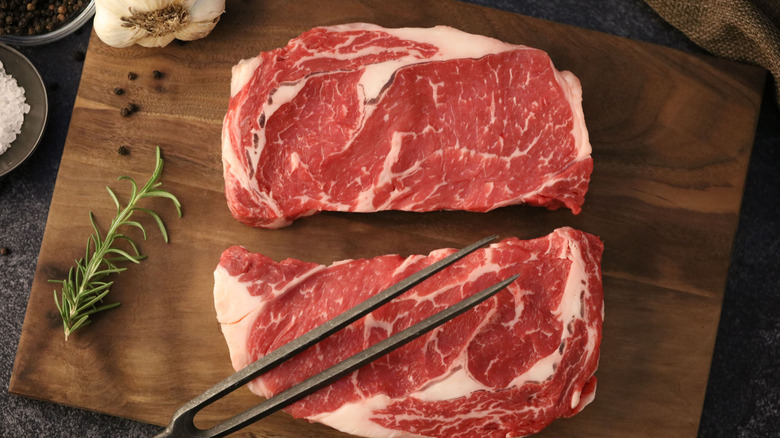
Once you've scored the best ribeye and acquired a knife, you need to prep your work station, beginning with a cutting board. Brad Baych recommends a 20x15-inch wooden cutting board. "Remember to place a wet paper towel under the board to keep it from sliding around," he suggests. Baych also recommends keeping a roll of paper towels at hand so you can clean as you go.
If you're struggling with the meat, freezing the uncut ribeye for about half an hour before beginning will firm it up, making it easier to handle. Additionally, if you plant to save your steaks after they are cut to keep them for later, you can freeze them. In this case, Baych recommends using a vacuum sealer to seal out any oxygen. This will greatly extend the shelf life of your frozen steaks.
Overall, ribeye's popularity means it is also one of the priciest steak cuts out there, but buying a whole slab and cutting your own steaks from it can save you some money. Furthermore, this allows you to customize the steaks to your exact preference; for example, if you prefer a thicker versus a thinner steak, one with more fat or less — you've got control over your meat.