

The Controversial Ingredient Hiding In Most Restaurant Pizza Dough (And The Reason It's There)
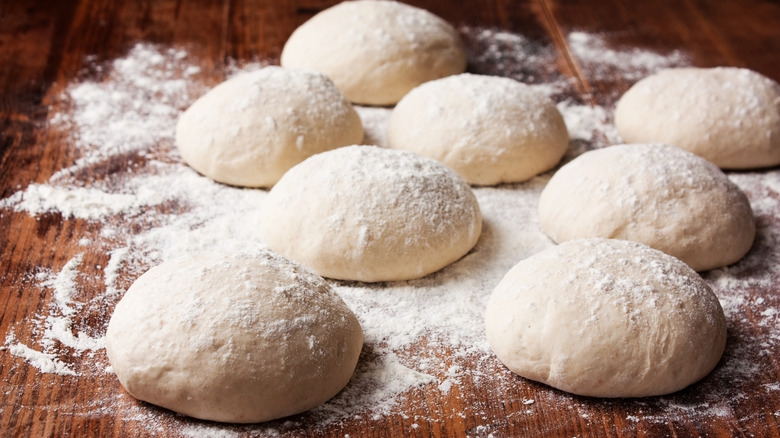
Everyone loves a good pizza, whether it's a classic Neapolitan-style Margherita or a rich Chicago deep dish. But have you ever wondered why restaurant pizza dough often tastes better than homemade? Even with all the tips for making the best homemade pizza, recreating that soft, pillowy texture is practically impossible on your own. So, what is it that restaurants do differently? Naturally, they use high-quality ingredients, traditional techniques, and have years of experience. Some, however, often turn to a controversial additive that makes the dough puffier and more elastic: potassium bromate.
In an exclusive talk, Dr. Kezia Joy, a registered dietitian nutritionist and medical advisor with Welzo, stated that "Potassium bromate is often added to pizza dough for its ability to improve gluten strength as well as help with the elastic properties of dough to create a better chew and lightness when baked." This inorganic compound further helps the dough trap CO2 during leavening, improves its volume, and makes its appearance fluffier. It has been used as a dough additive for more than a century.
At the same time, Bryan Quoc Le, PhD, founder and CEO of California's Mendocino Food Consulting, told Chowhound that potassium bromate acts as an oxidizer. It speeds up the process in which the gluten proteins form strong crosslinks with one another. "Normally, oxygen in the air initiates this process, but potassium bromate simply does it faster," he stated. "This helps create the stretchiness, stiffness, and body of dough."
Potassium bromate is added to dough in small amounts

Apart from pizza dough, potassium bromate can also be found in most baked goods, such as pretzels, rolls, and bagels. You can literally find it anywhere dough density, elasticity, and pliability matter. In addition, potassium bromate is present in bromated flour. The reason behind its disputed reputation? Many studies have identified it as a potential human carcinogen.
According to Bryan Quoc Le, excessive use of this additive and any remaining residue could potentially cause harmful effects. Apart from cancer, these include thyroid disorders, kidney damage, digestive irritation, and reproductive issues. "In terms of regulation, the upper limit for use in baked goods is 75 milligrams per 1 kilogram of flour, where potassium bromate is deemed safe for human consumption and is thoroughly destroyed during the baking process," Quoc Le said. He added that the compound eventually breaks down into potassium bromide, an inorganic salt, mostly used in pharmaceuticals. "Potassium bromide is an essential nutrient found in seaweed, and it is generally harmless," Quoc Le continued.
Still, Dr. Kezia Joy highlighted that plenty of restaurants avoid using potassium bromate. Additionally, many restaurants that once used it have since switched to unbromated flour and alternative dough conditioners. "Asking your restaurant for information regarding where they source their ingredients tends to be a much more effective method to determine if a product is safe than simply assuming it is," she said.
California and New York move closer to banning potassium bromate for good

In general, potassium bromate is used in extremely small amounts, or roughly 1 teaspoon per 800 cups of flour. Once baked, potassium bromate levels are reduced to about 20 parts per billion, in line with regulations set by the U.S. Food and Drug Administration. Still, a few U.S. states have already introduced stricter measures targeting this ingredient. California, for example, has enacted a ban on it under the California Food Safety Act.
Once it takes effect, manufacturers will no longer be allowed to produce or sell foods containing potassium bromate. At the same time, New York has passed a similar bill. "Given that California is on its way to ban potassium bromate, with New York following suit, it's likely that there will be increased mandates for restaurants to disclose their use of potassium bromate in their products in the next few years across other states, or we'll be seeing more outright bans," Bryan Quoc Le said.
As for alternatives to potassium bromate, although few can match its speed and efficiency, producers still have several options available. "Modern commercial baking techniques and alternatives, such as ascorbic acid, enzymes, and malted flour, allow for strong dough and quality products," Dr. Kezia Joy concluded. "Most consumers will be unable to tell if a product was produced with potassium bromate, except that they may see a slightly different cost of manufacturing."