

Why You'll Never See A Create-Your-Own Pasta Option At A Restaurant In Italy
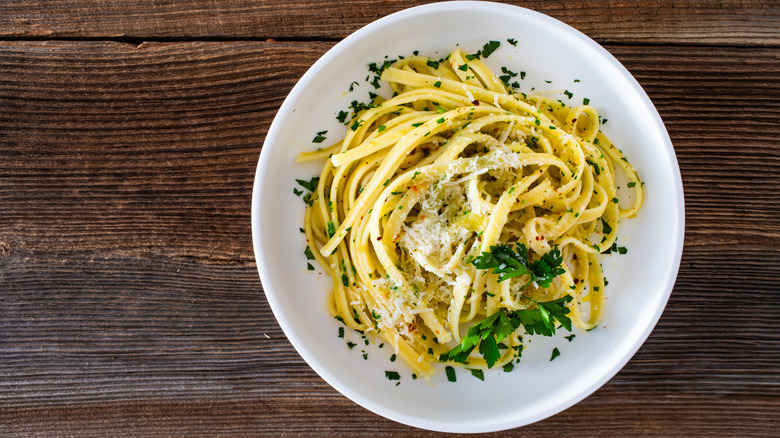
It's no secret that, generally speaking, Americans love customizing their food. From Starbucks lattes to Chipotle burrito bowls where customization is king, customers often expect some control over their meals. But this isn't always the case in all cultures. In Italy, for instance, visitors shouldn't expect to mix and match various pasta shapes and sauces, and we spoke with two pasta experts to learn why that is so.
When it comes to sauce and pasta, there are good reasons behind some classic pairings. A key consideration, explains Alessio Magliozzi, a private chef and cooking class host based in Montepulciano (Tuscany, Italy), is the shape of the pasta — in particular, how many grooves it has, because those grooves basically translate to more sauce per bite. Rosario Del Nero, chef and culinary expert at the National Pasta Association, agrees, saying that, while grooved pasta is ideal for getting more sauce, for that same reason, smooth pasta (like fettuccini or pappardelle) works better with richer sauces. Pairing a butter- or cream-based sauce with a grooved pasta might feel like an overload. That's why pasta shapes and sauces are paired carefully, and why it's rare to find restaurants in Italy that allow customers to create their own combinations.
While having some control over your meal is nice, sometimes it's best to trust the experts. And in fact, that is the general expectation when ordering food in Italy — asking for substitutions or other alterations isn't common in Italian culture. Magliozzi says that "an important part of experiencing Italian cuisine is trusting your chef." Be willing to try new things based on their expertise. He recommends approaching new foods with a mindset of curiosity; for example, "why and how was this pairing made?"
Regional pasta pairings
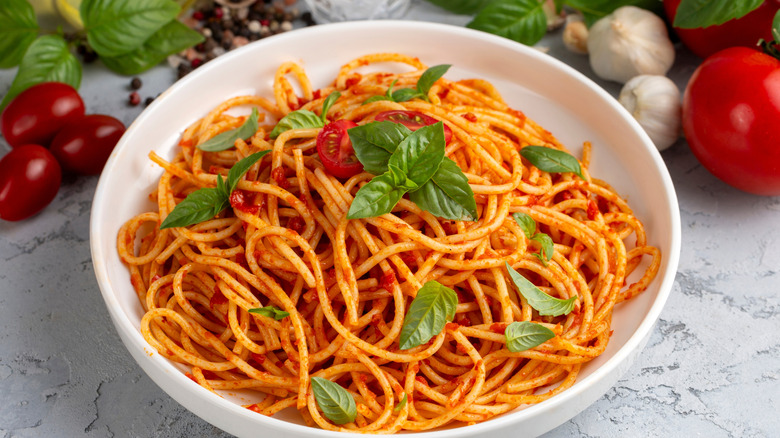
According to Rosario Del Nero, "Italy has as many pasta shapes and kinds as its provinces and the towns that compose them." The reason for this is that pasta shapes (and sauces) are very tied to their region of origin, influenced by both nature and history. Furthermore, Italy has a varied geography with various climates, so what grows well in one region may be less common in another. This influences which ingredients become the stars of local dishes. On the other hand, he says, tomato-based sauces with garlic, olive oil, and basil are fairly popular across the country during the summer, when tomatoes are in season. And pasta with butter and Parmigiano-Reggiano is a staple almost everywhere.
So, in Italy, pasta shapes, sauces (including these underrated sauces), and other ingredients are fairly distinct to the region you're dining in. In America, Del Nero says, where there's been more of a melting pot of Italian cuisine, the regional distinctions are less defined, which contributes to why make-your-own pasta is more common.
If you're cooking pasta at home (don't forget that the shape of your pasta also determines how to cook it) and all this seems a little overwhelming, a little research may be in order. "The best way to pair a pasta shape with a sauce is to use the sauce typically associated with the regional cuisine of the chosen pasta," says Del Nero. So, perhaps it would help to pick your pasta first, and look up which sauce it's most often served with in Italy and pair those together.