

Why Jack Daniel's Makers Set Massive Fires To Perfect Its Whiskey
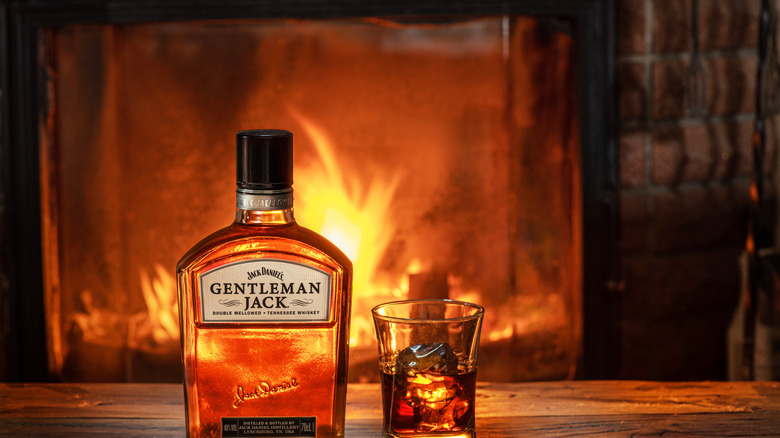
Did you know legendary whiskey maker Jack Daniel's burns stacks of hard sugar maple wood in bonfires to perfect its product? It's called the "Lincoln County Process," and the company completes it nine times a week at its distillery in Lynchburg, Tennessee. Piling wooden pallets several feet high, the crew soaks them in whiskey and lights them on fire. While that may sound like heresy, there's a method to the madness. The dumped whiskey is raw and unaged, unlike the beverage you sip. The alcohol-drenched coals play a crucial role in the filtration process that turns the brand's distilled bourbon into its signature Tennessee whiskey.
It started back in 1864. Jack Daniel, who was a real person, learned the Lincoln County Process from an enslaved Black man named Nathan "Nearest" Green while working for Reverend Dan Call, who took in Daniel after his father died. Eventually, it became state law that all products bearing the name "Tennessee Whiskey" had to adhere to the same process for quality control. To read the rest of the story, check out 10 Jack Daniel's whiskey facts very few people know.
Here's how it works: Once the fire's out and the sugar maple embers have cooled, they're placed in huge vats. Then, the bourbon is poured in and slowly drips through 10 feet of charcoal to absorb more flavor and remove flaws and impurities, a step known as mellowing that takes several days. Once that's complete, the whiskey is ready for storage in oak barrels until it matures sufficiently to be bottled for sale — typically four to six years, though the Jack Daniel's whiskey that's aged the longest is aged for 14.
The science of the Jack Daniel's burning & filtering process
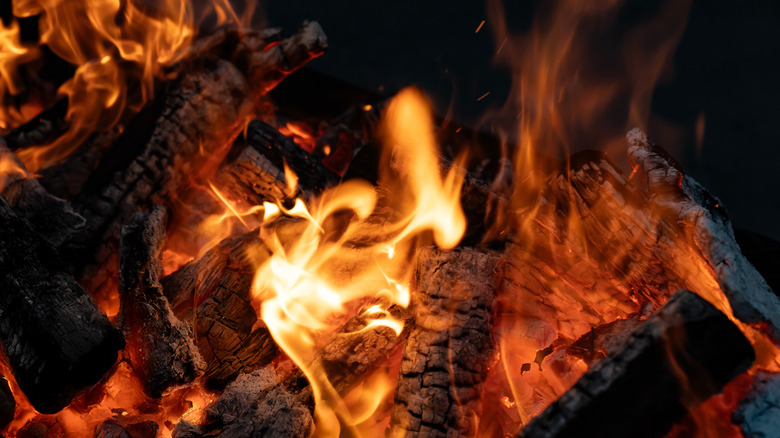
As Jeff Arnett, Jack Daniel's then master distiller, told Whisky Magazine in 2011, filtration is key to removing graininess from the alcohol and adding sweetness and smoothness. Smaller charcoal chips work better than larger pieces, so the distillery uses specially calibrated rollers to grind the wood to optimal proportions, ensuring each drop of whiskey gets properly filtered. Also, the slow pace at which the pipes deliver the alcohol to the charcoal pieces allows for uniform saturation across the filter and prevents liquid from slipping through cracks without being filtered.
Charcoal is such an effective natural filter because it's highly porous. This enables it to trap larger particles — impurities like sulfurous compounds, aldehydes, fusel oils, and esters — while letting the rest of the whiskey pass through, a process called adsorption. Additionally, through chemical alterations caused by oxidation, charcoal even dilutes some of these impurities.
While Jack Daniel's stands by the merits of the Lincoln County Process, it also recognizes that it bears responsibility for the environmental impact of its charcoal making. Thus, it's committed to sustainability, protecting and growing sugar maple trees to offset those it cuts down and ensure sufficient quantities for future whiskey crafting.