

How To Tell If Thrift Store Revere Ware Pots Are Worth Taking Home
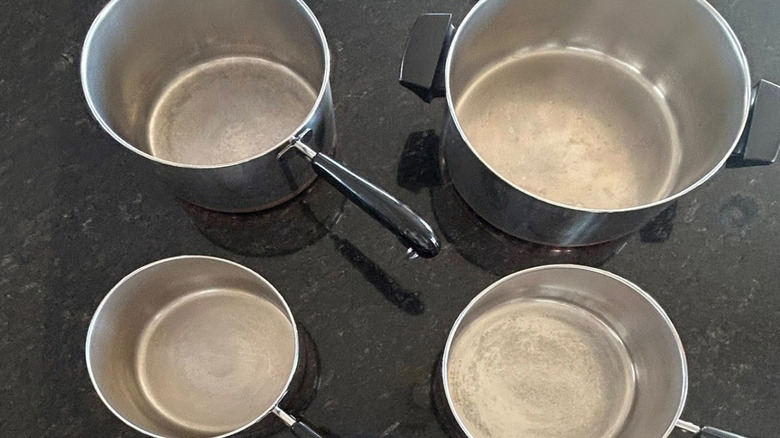
Hunting for cookware at the thrift store feels a lot like a sport. You usually have to practice a lot before you score the best gems. To the untrained eye that doesn't know the things to look out for when thrifting cookware, it can be like finding a needle in a haystack. But when it comes to Revere Ware pots, it's pretty easy to discern if it's worth taking home; just check for the stamp on the bottom. Pots made from 1946 to 1968 — which is what you want to snag — should have a distinct outline of Paul Revere facing left, making it look a bit like a coin. The year 1801 is split in half so the 18 is on the left of the face and the 01 is on the right, with Revere Ware written underneath.
These elements are enclosed inside two circles, which resellers dub as a double ring. Also orbiting inside the circles are the words copper clad on top and stainless steel on the bottom. Below the circle is information about the patent. Revere Ware pots made after 1968 shouldn't look that different, except there is no circle and the patent isn't written anywhere.
Of course, you also want copper cookware that's safe to cook with, so pots in good condition are ideal — that includes an intact lining, as copper can be toxic if ingested. Alternatively, you can get it relined or retinned. But why go through all the hassle just to buy something already used?
Why buy Revere Ware pots and where to snag them
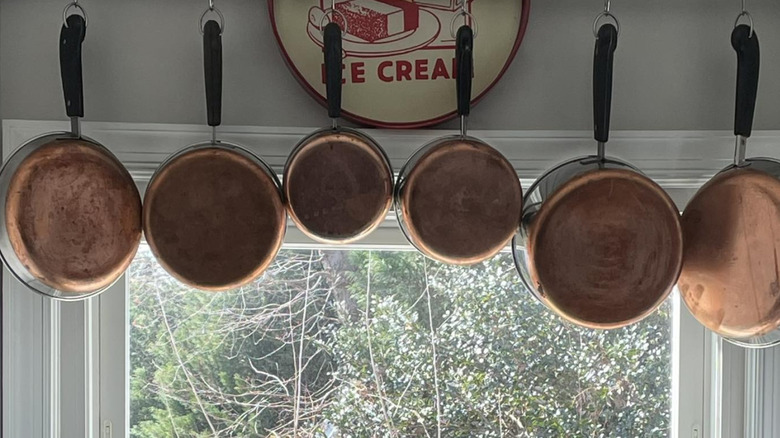
Going to secondhand stores is the cheapest way to snag copper pots like Revere Ware — but why should you? For one, there's a lot of difference in the quality between old and new ones. Vintage pieces come from the brand's heyday, when thicker materials were used, so you can expect them to last for years to come. Due to the material, you can cook your masterpieces more evenly, which is why some people prefer copper pots. They also look pretty great and can double as a display piece in your kitchen.
Vintage Revere Ware pots can also be found on sites like eBay (some collectors might tell you it's the best place), and the price range can depend on the quality, size, and even the reseller. Some pots go for $45, whereas some cost $150. You can also potentially find them at estate sales, and some flea markets might even have them. You just have to dig through the clutter, and who knows, you might find the jackpot — or not. But that's all part of the thrifting game.