

Whatever Happened To The Midwestern Beer Brand Stag?
Once, Stag beer, with its bold stylized red lettering, 12-point buck logo, and golden can, had a national footprint and was sold in 22 states across the nation. While it remains a regional staple in parts of Southern Illinois and Missouri today, it no longer has the reach it did in its 1950s heyday. At the time, it was brewed by the Griesedieck Western Brewery Co., then the 11th-largest brewer in the country, which marketed Stag as "America's finest dry beer."
Since then, the golden lager, made with malted barley, hops, and Midwestern grains, has changed ownership multiple times and fought for shelf space against larger brands. In recent years, it has also faced growing competition from hard seltzers and canned cocktails in an increasingly crowded beverage market where no one seems to be drinking beer anymore. Still, Stag remains on select store shelves thanks to its parent company, Pabst, and its loyal Midwestern customers. Its fan base is still centered around Belleville, Illinois — just across the Mississippi River from St. Louis, Missouri — where the beer was born in the 1850s, only a few decades after Yuengling, the oldest American beer still being made, opened its doors in Pennsylvania in 1829.
Stag Beer then and now
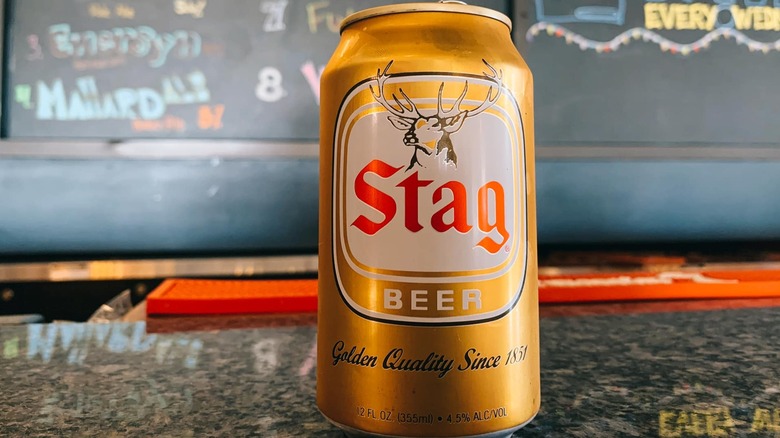
Stag beer began in Belleville, Illinois, a city that once boasted seven breweries launched by the area's many German immigrants. Founded by Philipp Neu and Peter Gintz, the Neu and Gintz Brewery began operations in the 1850s (the beer can may proudly say "Golden quality since 1851," but it seems the company was actually started as late as 1857). The brand passed through several hands and continued to grow with a second brewery in the Hyde Park neighborhood of St. Louis. Stag beer got its name in 1907 through a contest to rename the company's Kaiser beer. Germany's bellicose Kaiser Wilhelm II was fast becoming unpopular in the United States, and the owners were looking to distance themselves from the name. A 10-year-old boy won the contest and received a $25 gold piece (worth around $870 in 2026).
While Stag wasn't produced during Prohibition (1920-1933) it came back in 1933 and continued to grow in popularity. By the 1980s, the 4th-largest brewer in the world, Australia's Bond Corporation Holdings Ltd., owned Stag, but in 1988, due to the need for costly upgrades, it shut down the Belleville brewery. Pabst has owned Stag since 1999, saving it from becoming one of those beers that have disappeared for good. The company now manufactures Stag through a third-party brewery. Despite recent rumors that it's no longer being sold in kegs, it's still available in cans and bottles in the St. Louis area, Southern Illinois, and beyond — including at some Dollar General locations. It has a smaller footprint today, but maybe Stag will make a comeback.