

The Great Hot Dog Debate: Is Your Frank Legally Considered A Sandwich?
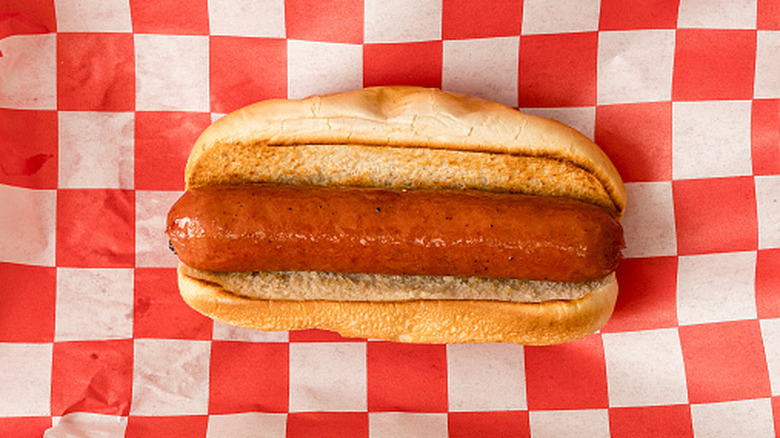
The debate of whether a hot dog is a sandwich is a fun one, but it isn't just internet nonsense or opinions for the sake of them. It is actually something that has had to be defined, specifically for tax reasons. In New York, for example, hot dogs are legally considered sandwiches, as state guidance is clear: sandwiches include "cold and hot sandwiches of every kind ... regardless of the filling" (via New York State Department of Taxation and Finance). So a sausage in a bun? Definitely a sandwich. In California, there is a similar tax law wherein hot prepared foods that are sold ready to eat, which includes hamburgers and hot dogs, are treated as sandwich-style products in certain rulings.
So this legal identification is actually nothing to do with what a chef would call a sandwich and everything to do with how the state can categorize (and therefore tax) food. However, the federal law is much less helpful. While it is an entity that regulates food safety, the USDA may not even know the definition of a sandwich in any clear or universal way. Per USDA's Food Standards and Labeling Policy Book, the agency defines closed-faced sandwiches ambiguously as "consisting of two slices of bread or the top and bottom sections of a sliced bun that enclose meat or poultry," and does not clearly state whether hot dogs fall in this category, giving further ambiguity to the debate.
Why, outside of the law, no one can agree

Outside of the legality of it all, this debate becomes even more intriguing and chaotic with The National Hot Dog and Sausage Council (yes, that's a real thing!) weighing in. It totally rejected the notion that a hot dog could ever be a sandwich. The council argues that the hot dog exists in its own right, with one coherent sense of identity and all the rituals and nostalgia that come with it. And you kind of feel like you have to agree with that. As soon as you start to consider all the many American hot dog styles, where toppings vary wildly from city to city, the structure remains somewhat the same. A hot dog is a frankfurter in a bun, it's usually topped with mustard and ketchup, eaten with your hands, and is associated with very specific contexts such as baseball games (where the hot dog is an American tradition) and cookouts. Sandwiches, on the other hand, occupy an entirely different cultural lane.
You'd think this structure alone would be enough to distinguish the two, as we think of sandwiches as being held together by two individual slices of bread whereas a hot dog has one structurally intact bun. Go to the dictionary, however, and you'll find that Merriam-Webster defines a sandwich as "two or more slices of bread or a split roll having a filling in between." So why is it that, culturally speaking, a hot dog just feels so different to a sandwich? It's hard to say for certain and it's a debate we could have forever. But in the eyes of the law, hot dogs tend to live under the sandwich umbrella — whether we agree with it or not.