

The Bizarre Trick That Might Help You Save Money At The Grocery Store
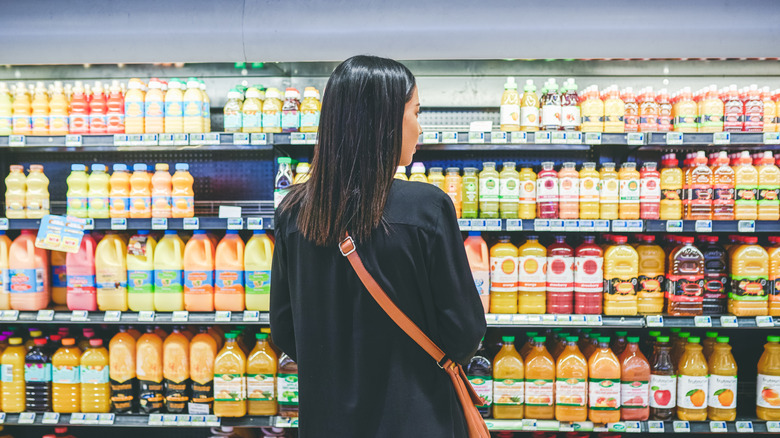
Some tips for saving money at the supermarket are pretty straightforward: For example, grocery shopping on an empty stomach can cause you to buy more, and for fairly obvious reasons, you can save money by going for generic brands and avoiding pre-prepared food.
But here's a tip that seems far less intuitive, yet scientifically, it sort of checks out: Bring some headphones and listen to your own music. Here's the rationale: There are a number of studies out there about how music influences buying decisions, typically conducted by professors or researchers in marketing, business, psychology, or some combination thereof. It's been found that certain types of music can lead consumers to buy extra items, both in supermarkets and other retail settings. So, by opting out of the supermarket's soundtrack, you're arguably protecting yourself from this subtle manipulation.
There are a couple of caveats to note here, though: Firstly, it's hard to tell the extent to which supermarkets use these musical tricks. Some supermarkets may choose to play whatever they think creates the right ambiance, while some may not play music at all to save on licensing fees. But at the same time, it would be naive to think that big supermarket chains with plenty of marketing money would totally ignore such research, too. Secondly, musical tricks may not always be effective. For example, a 2022 study published in the Journal of Marketing Research suggested they mostly work on weekdays, when customers are more exhausted and open to subliminal suggestions.
So, what kind of music encourages you to buy more or less?

It helps to know which music is linked to higher spending so you can avoid it. Firstly, choose a high BPM: One 1982 study published in The Journal of Marketing found that fast-paced music led people to walk through stores quickly, giving less time to impulse-buy, while slow music led to more purchasing. A 2011 study published in the journal Marketing Letters found another effect for minor-key music (generally sadder-sounding music): It slowed down shoppers, giving them more time to grab items. "Happier" major key music, correspondingly, made customers move faster and potentially buy less.
A 2006 study published in the Journal of Applied Psychology found that classical music was linked to higher spending; the study was conducted in a cafeteria, but the professor behind it suggested it could apply in supermarkets. He believes that classic music implies that a store sells high-quality products, seducing you into spending more. Finally, avoid music that's thematically linked to grocery store items. A 1999 study, also published in the Journal of Applied Psychology, suggested that French music led customers toward French wine, German music toward German wine, and so forth.
But be warned that opinions on these topics vary: While classical music was linked to higher spending, another consumer behavior expert suggested that nostalgic music ("golden oldies") may lift shoppers' moods, leading them to buy more. Plus, stores may use this information differently. Although classical music could lead to higher spending, some stores in Japan opt for "cheap" music (roughly speaking, cheesy, low quality tunes, a little like elevator music), as it suggests that they offer bargains. So, while there's perhaps no perfect money-saving playlist, it's still good to know how music might be influencing your shopping.