

Why You Should Consider Mineral Kitchen Floors If You Value Durability
Kitchen floors suffer a great deal of damage. Probably more than any other area in the house. This is why picking kitchen flooring options that are durable and stylish should always be a top priority, especially if your kitchen is always busy. But which one to choose? To avoid the worst kitchen flooring (that's a nightmare to clean), Michael Hartel, founder and CEO of Cabinet IQ, a Texas-based kitchen remodeling company, suggested opting for mineral core flooring, also known as MGO.
"From a kitchen designer's point of view, mineral flooring is a great choice because it's one of the few options that truly support everyday living," Hartel revealed in an exclusive conversation with Chowhound. The material consists of a variety of mineral compounds and fibers. Based on the main ingredient, mineral flooring comes in two types: MgCl2 (magnesium chloride) and MgSo4 (magnesium sulfate). Both are water and fire-resistant, free of plastic, and extremely durable.
"With people moving through the kitchen all day, splashes and dropped pans, these floors won't swell, peel, or fail the way wood or laminate can when moisture and mess are part of daily life," Hartel said. Meanwhile, Jonathan Palley, CEO of Clever Tiny Homes, a California-headquartered firm that produces high-end, cost-effective tiny homes, pointed out that mineral floors have recently been gaining a great amount of attention. "Mineral flooring is something we've been exploring as an alternative to other composites," he told Chowhound.
Downsides to consider before choosing mineral flooring
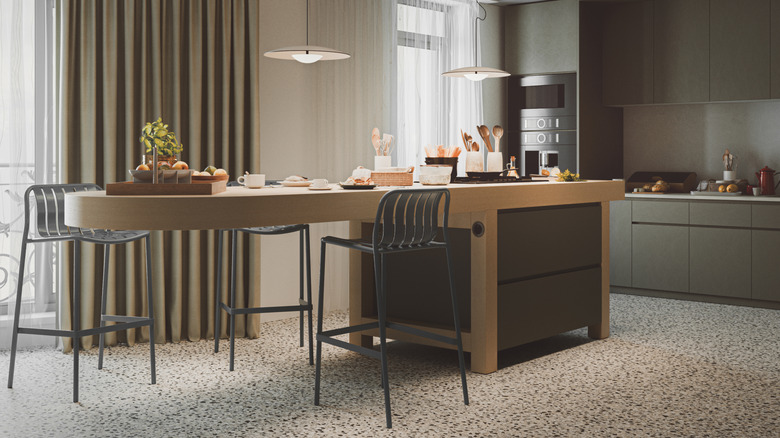
Michael Hartel, who is also a kitchen designer and remodeler, emphasized that mineral floors are eco-friendly and seamless. They don't use grout lines or joints to accumulate food and dirt. This means that you won't have to spend hours choosing the right grout color for your kitchen. He also highlighted their durability. "Mineral flooring tends to age more evenly than other materials, they tend to wear evenly instead of showing obvious damage," Michael Hartel explained.
If properly maintained, mineral floors can last for decades – sometimes even more than 30 years. "I usually steer homeowners toward mineral flooring when they want something that's easy to clean and holds up long term, even if it's not the softest option, especially in kitchens that get used every day," Hartel said. Still, the material does have its drawbacks. While easy to maintain, mineral floor repairs can be challenging once they show signs of wear. Hartel also said damaged mineral flooring can feel harder and colder underfoot. "Repairs aren't as simple as replacing a plank, so proper installation is vital," he disclosed.
Jonathan Palley also noted that mineral flooring isn't cheap. Even though it falls into a mid-level price range, like cement, it can initially cost more than traditional options. "We find that it isn't quite as cost-effective as composites," he added. "You don't get all that much durability for the money unless you're in very high-traffic environments, and it doesn't have the same 'wow' factor as natural stone, tile, [or] marble."