

Meet The Real Jack Daniel: The Runaway Behind Your Favorite Whiskey
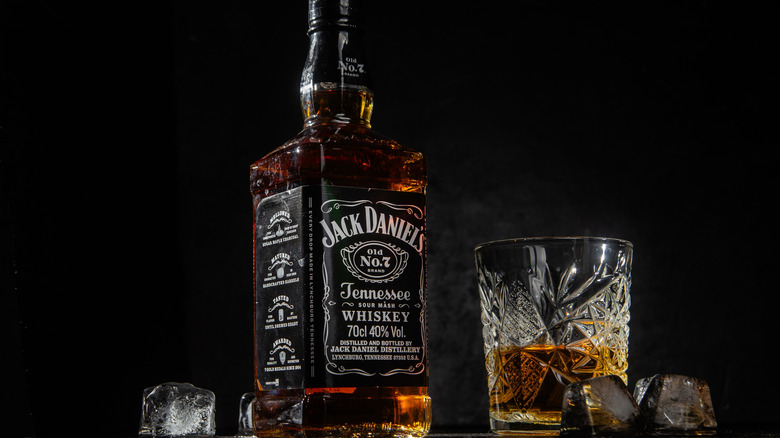
In 2024, Shaboozey's bar hopper anthem, "A Bar Song (Tipsy)" exclaimed, "Someone pour me out a double shot of whiskey. They know me and Jack Daniel's got history." In 1955, Frank Sinatra reportedly went on stage with a glass of whiskey in his hand and told the crowd, "Ladies and gentlemen, this is Jack Daniel's, and it's the nectar of the gods." According to the company, Jack Daniel's distillery was registered in 1866 (though others say 1875); but to know the real Jack Daniel, we have to go back even further — to the 1850s. His full name was Jasper Newton Daniel and he was one of ten children born to Calaway and Lucinda Daniel. Jack, as he was known, lost his mother when he was a toddler and things didn't go well for him when his father remarried. Running away was a better option, even at seven years old.
Jack found his way to the home of Lutheran minister Dan Call, who hired Jack as what was then known as a chore boy. Jack tended to the needs of the Call family farm, including feeding pigs and keeping the place clean. Besides the church and farm, Call had another side hustle: a whiskey distillery. This is where young Jack learned to make whiskey the Tennessee way. When minister Call was forced to decide between his congregation or his distillery, he sold the distillery to Jack for $25. Jack renamed the distillery after himself and in pursuit of the purest water possible, moved his operation to a distillery in Cave Spring Hollow in Lynchburg, where it remains today. This is where Old No. 7 was perfected, but that's another story.
There's one more man behind the Jack Daniel's story
For years, the story went that minister Dan Call taught young Jack everything he knew about whiskey. In 2016, the New York Times published the rest of the story. Among minister Call's distillery crew were enslaved people, and one in particular was Nathan "Nearest" Green. When introducing Green to young Jack, Call referred to him as the "best whiskey maker I know of" (via The New York Times). He also ordered Green to teach Jack everything he knew about making whiskey, including the Lincoln County process, a filtering technique using sugar maple charcoal. Although sometimes said to be invented by a Tennessean named Alfred Eaton, the filtering method could have also been adapted from slave distilling traditions. This step and this step alone is what legally differentiates Tennessee whiskey from bourbon.
Green and Daniel developed a close relationship over the years with Green becoming a mentor. The 13th Amendment of the Constitution abolished slavery in 1865 and when Jack Daniel purchased the distillery, Daniel hired two of Green's sons. Today Nathan "Nearest" Green is considered the country's first known African-American master distiller. (In 2017, a separate whiskey brand, Uncle Nearest, launched in Shelbyville, Tennessee, honoring Green's name.) Between Green's charcoal filtering method and Daniel's decision to move the distillery right to its unique water source, Jack Daniel's has an iconic taste and brand that promises to remain in American pop culture for generations — and it all began when a young runaway made his way to a church in Lynchburg.