

You Probably Eat This Radioactive Fruit Regularly, But Don't Panic
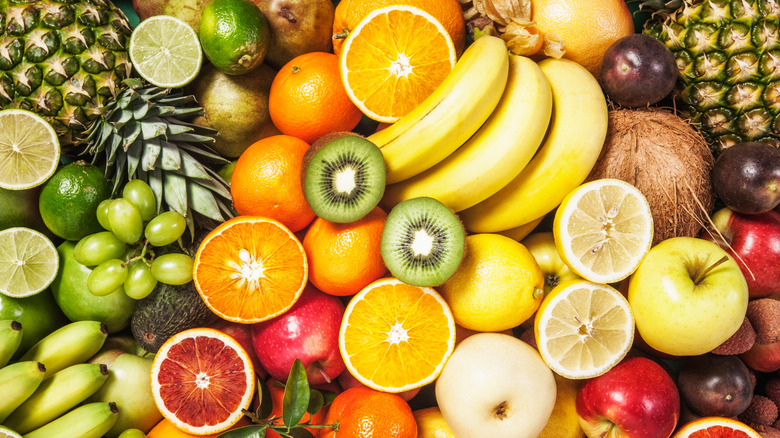
When most people hear the word "radioactive," they tend to picture nuclear disasters like Ukraine's 1986 Chernobyl catastrophe or Japan's 2011 Fukushima meltdown. But in reality, radioactivity — the release of energy caused by the breakdown of unstable atomic nuclei — is far more common than you think. In fact, it's all around us; it's in smoke detectors that contain the radioactive isotope Americium-241, watches that use small glass tubes filled with tritium gas, or ceramic tiles that can have traces of uranium and thorium. And while it might sound strange, natural radioactivity can also be found in food. That said, when was the last time you ate a banana?
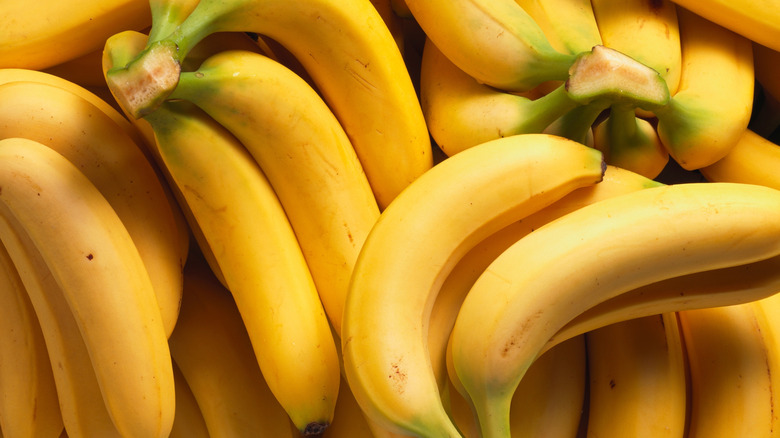
It's common knowledge that bananas are rich in potassium — the Cavendish banana, the most widely available variety around the world, contains about 358 milligrams of potassium per 100 grams of fruit. But here's where it gets interesting — what many people don't know is that a tiny fraction of that potassium (about 0.0117%) is a natural radioactive isotope known as potassium-40 (or K-40).
A 150-gram banana usually contains around 20 becquerels (a unit of radioactivity which is equivalent to one radioactive decay per second) of potassium-40. However, don't let these numbers scare you, as it poses no health risk. Potassium-40 is found not only in many other foods, but also in soil, water, and the human body. What's more, it has a half-life — the time required for half of it to decay — of over 1.25 billion years, which means that it has been around for quite a while.
Bananas are just one of several foods that are naturally radioactive
Before you swear off bananas, it's worth knowing that they're not the only naturally radioactive foods. As a matter of fact, you might be surprised to know that Brazil nuts (Bertholletia excelsa) fall into the same category as well. What's perhaps even more unexpected is that they are more radioactive than bananas. This is largely due to their extensive root systems, which have the capacity to absorb high levels of radium from deep within the soil, especially the radium-226 and radium-228 isotopes.
At the same time, butter beans (Phaseolus lunatus, also known as lima beans) have about 50% more K-40 than bananas, and also contain small amounts of radon-224. However, these radioactive isotopes haven't stopped them from becoming a Southern comfort food classic when slow-cooked with bacon and chicken broth. Beer is also radioactive, but fear not — it only contains small traces of potassium-40. The isotope itself isn't the key ingredient that makes beer bitter.
Much like bananas, potatoes also contain small concentrations of potassium-40 and are, as a result, slightly radioactive. That, unfortunately, includes french fries, regardless of if we're talking about the worst or the absolute best french fries in every U.S. state. The same applies for avocados and carrots, and peanut butter is yet another everyday kitchen staple with naturally occurring radioactive isotopes (potassium-40, radium-226, and radium-228). But as long as you don't go overboard and eat hundreds of these foods in a single day, you have nothing to worry about.