

The Pantry Staple Alton Brown Doesn't Ever Run Out Of

Alton Brown knows "Good Eats." The beloved Food Network personality, cookbook author, and scientifically minded culinary expert has guided home cooks for decades and gained quite the cult following in the process. So when he spills his kitchen preferences, people tend to listen. Luckily for us, Brown was quite apt to share his cooking habits. In an interview with EatingWell, Brown was asked about his pantry staples. According to Brown, "We don't ever run out of kosher salt, because I need my kosher salt." This choice was noted alongside mayonnaise as a staple ingredient, which he often uses as a mix-in for scrambled eggs.
Anyone with tastebuds can tell you salt is a must-have ingredient in the kitchen. It is an essential ingredient in most every dish, from sauces to roasts to breads, and even cakes and cookies. But why kosher salt over, say, table salt? After all, isn't all salt built the same? No. Not at all.
Many culinary expertsare fond of kosher salt because it is easier to use in the kitchen. Thanks to the large size and flat shape of the salt grains, you have more control in salting food and it's easier to grab in a pinch. Of course, this is only one unique aspect of kosher salt. To more fully understand why it is so beloved, we must first examine what sets it apart from regular table salt.
What sets kosher salt apart from the rest?
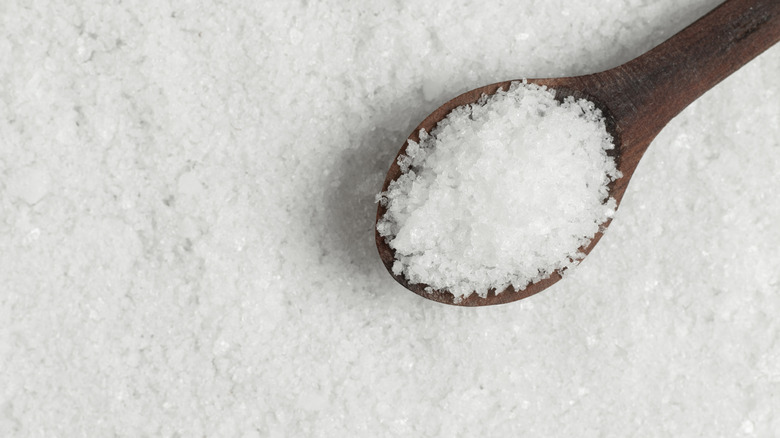
You may be thinking salt is a simple matter — the most basic, no-brainer ingredient in any given recipe. You may also think all salt is one in the same. However, that is simply not the case. It is true that all salt on the market is, at the core, chemically indistinguishable. However, different forms of salt do vary in texture, structure, and even taste. For example, your basic table salt has a cubic crystal structure, which makes it much more potent when measured by volume. Table salt is also typically treated with iodine for nutritional fortification and has anti-caking agents to prevent salt grains from clumping.
Kosher salt, on the other hand, has a larger, more irregular, flake-like structure. Some kosher salt may include anti-caking agents, but most are not treated with iodine. The use of iodine in table salt can, according to many cooks and diners alike, give food a bitter, metallic aftertaste. Because of its ease of use and lack of iodine, kosher salt is often preferred over table salt. This is perhaps why Alton Brown simply has to keep the stuff packed in his pantry. And Brown doesn't use just any kosher salt — he prefers Diamond brand.
Alton Brown's kosher salt obsession
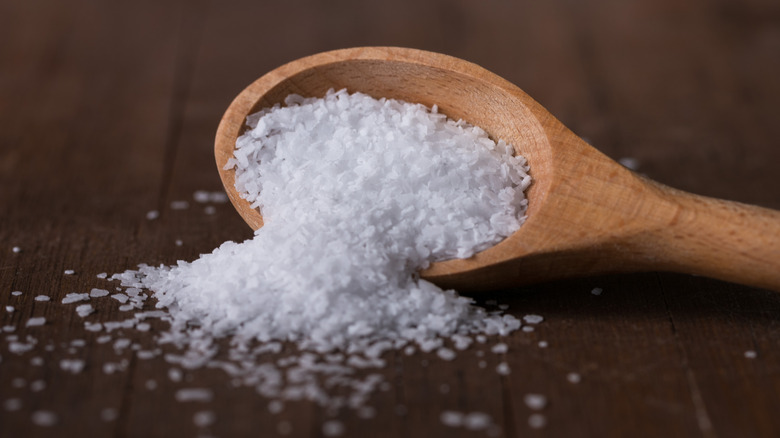
In a YouTube clip, Alton Brown praised Diamond Crystal kosher salt and described the ins and outs of the flaky flavoring, and what sets kosher salt apart from the rest. To start, Brown explained the name. While one may assume kosher salt is, well, kosher, this is actually not always the case. Rather, kosher salt comes from its use in koshering meat. It's made as most salts are, by either letting brine evaporate into salt crystals or by boiling down sea water until the salt has crystalized. Kosher salt can be sourced from either salt deposits or sea water. These crystals are then crushed to form smaller flakes.
So why does Brown prefer Diamond Crystal kosher salt? According to him, Diamond salt flakes are simply flakier than, as he put it, "the other big brand" (perhaps referring to Morton table salt). Diamond kosher salt also tends to be less concentrated or, as Brown says, "... unpleasantly dense," making the brand's salt easier to pinch, sprinkle, and add to various dishes. It's standard in the industry simply because it's easier to cook with.
Now, there is some disagreement as to using table salt or kosher salt in baked goods or in recipes that require a finer grain for more even distribution. But to this, Brown recommends throwing some kosher salt in your spice blender and get to crushing! Blending your kosher salt will make it easier to work with in these instances. So go ahead and toss that shaker out.