

How American Wagyu Beef Differs From Japanese
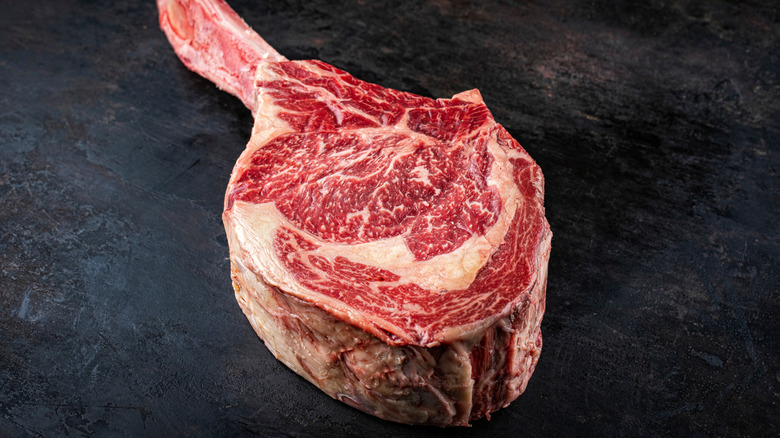
"Wagyu" is one of those buzzwords that you see everywhere when people talk about beef. It's prized, and for good reason, but a lot of us don't really understand exactly what makes wagyu, wagyu — or what makes it so special (or expensive, for that matter). Wagyu is, traditionally, Japanese — the name itself refers to a particular set of cattle native to Japan, one that's strictly controlled and protected — but seeing the word on a piece of beef's packaging doesn't necessarily mean that the steak itself is Japanese. Wagyu herds are now raised and kept all over the world, from Australia to the U.K., but some of the very best are actually American. So, what separates American and Japanese wagyu?
Wagyu normally refers to a group of Japanese cattle: four breeds specifically, the most famous of them being the Kuroge Washu, the Japanese Black. These are purebred cows, raised under very strict conditions, from a meticulously preserved lineage. They've become popular worldwide for their delicious flavor and texture — achieved by the intense marbling of fat found in the meat. American wagyu, meanwhile, and all other wagyu from outside of Japan, is the result of crossbreeding herds of those original four breeds with American cattle — most often Angus beef. All that makes for a unique blend of the very best of American and Japanese beef. While technically not purebred Kobe beef, it's still delicious (and rightfully, held in high esteem).
The main differences are in how the cattle are raised, and how they're bred
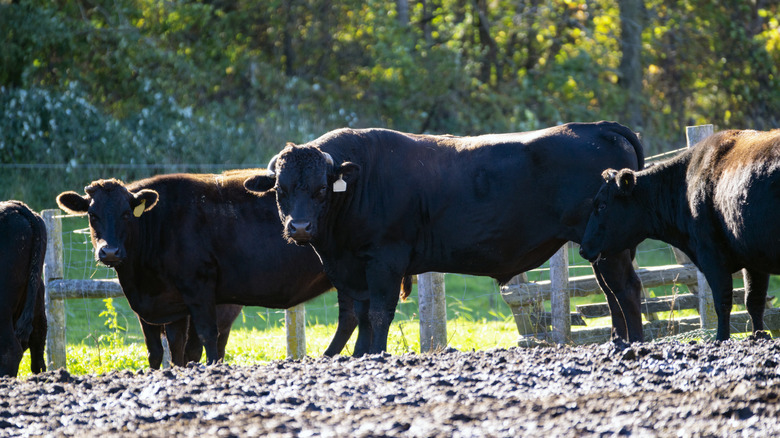
The biggest material differences between American and purebred Japanese wagyu beef is in the genetics of the cattle, and in the way in which those cows are raised. In Japan, the lineage of those four breeds of cattle — the Black, Brown, Shorthorn and Polled — are strictly protected by the Japanese government to ensure their purity. They've been protected since 1957, and are reared under specific conditions. The cows are famously raised in low-stress environments. Their stalls are kept clean, dry, and quiet. (And they're occasionally played music to relax them!) They're also frequently groomed to increase their circulation, and are fed a high-calorie diet consisting of grain, rice straw, barley, and corn to promote healthy, fattened cows.
Meanwhile, in the U.S., things are a little different. The wagyu cows are carefully crossbred with American Angus cattle, which helps to give the cows the more intense, beefier flavor that appeals to the American market. They're also raised in (while still stringent) less strict conditions than their Japanese cousins, and live for a shorter time — usually up to 450 days, compared to the 700 days that Japanese cows live. Their diets are slightly less extravagant, too — they're on a more efficient, grain-heavy diet (usually consisting mostly of corn), which also encourages that beefy flavor profile.
American and Japanese wagyu also differ in flavor and texture
Japanese and American wagyu aren't only distinguished by how they're bred and raised — they also differ in how they are categorized. The Japanese system (as you can probably guess by this point) is strictly monitored and rigorous in its classification of the beef's quality. Japanese wagyu cows are graded on two axes. The yield (which is graded A to C) refers to the amount of wagyu beef that can be butchered from the cows. The average cow has a "B" yield — with "A" being the highest, and therefore the most prized (hence why farmers will try to grow their cows as large as possible: The bigger the cow, the more useable meat).
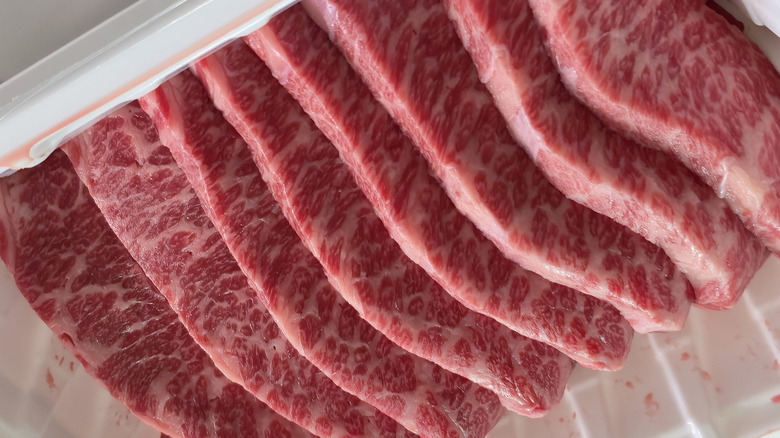
The second axis is the quality score, which runs from one to five — one being the lowest, and five the highest quality beef. If you're thinking that this all sounds familiar, it's probably because of the infamous "A5" grade — the top tier of wagyu. The American system, meanwhile, is a little different. You'll often find American beef classified using the USDA grading system (with high-quality American wagyu being classified as "prime"). Both beefs are also measured using a marbling score, which runs from one to 12 (with the highest level of marbling being a 12).
They differ in flavor, too: Japanese beef is extremely tender and has an intensely buttery flavor thanks to its intense marbling. It's more delicate than traditional steak, and is often eaten in small portions or thin slices. American wagyu, meanwhile, is still rich, but with a more intensely savory, beefy flavor and a slightly firmer texture — great for eating whole steak cuts like a ribeye or New York strip.