

'Enriched' Bread Began In The 1940s — Here's What It Means And Why It's Done
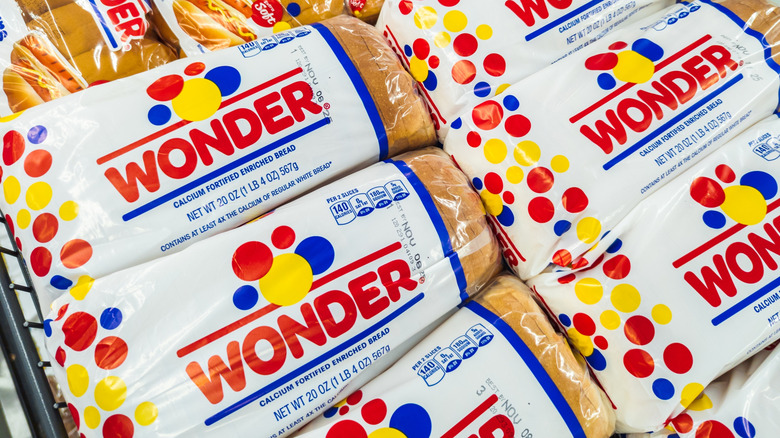
Pick up almost any store-bought loaf of white bread and you'll likely see the word "enriched" somewhere on the label. Often, it's tucked into the ingredients list as "enriched flour." But what does that actually mean? The short answer is that it features a few select added nutrients, including iron and B vitamins. The long version is that it's a public health success story that dates back to World War II.
In the early 1940s, United States health officials were alarmed at the nutritional state of the young adult men showing up to military enlistment centers. Many were deficient in iron and B vitamins, two nutrients that were removed during the industrial milling process used to give white bread its signature color and softness. Milling removed bran and germ from wheat kernels to make the bread more shelf stable, uniform in color, and lighter and fluffier. The only problem was that stripping away the bran and germ took away most of the naturally occurring vitamins and minerals too. And deficiencies in nutrients like iron and B vitamins can cause a range of health issues, including anemia and pellagra, both of which commonly afflicted Americans in the early 20th century
Concerned about nationwide nutrition, the federal government, working with bakers, millers, and health organizations, launched one of the country's first large-scale food interventions to re-add those nutrients to bread flour. By 1942, the Army announced it would only purchase enriched flour. That move pushed the industry to quickly comply with the government's initiative. If that wasn't enough incentive, a 1943 War Foods Administration order made enriching flour temporarily mandatory nationwide. Only a few years later, the Food and Drug Administration established voluntary standards and began regulating the label "enriched."
What your enriched store-bought bread actually contains
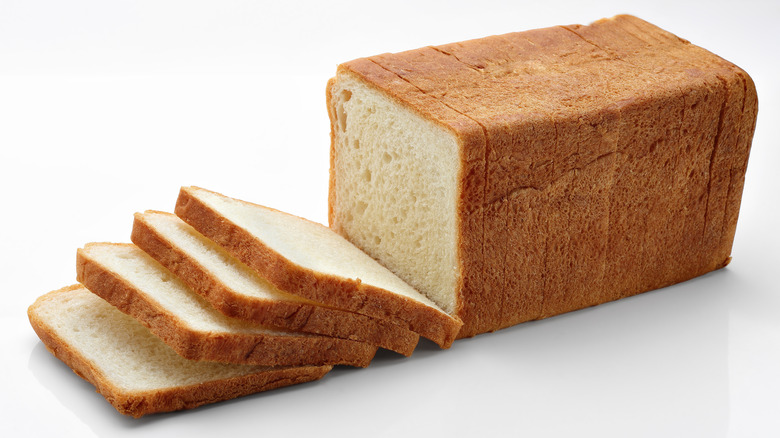
So what's actually in that enriched loaf from the grocery store today? If the packaging contains "enriched flour" on its ingredient list, federal standards require it to include iron and four B vitamins: thiamin (B1), riboflavin (B2), niacin (B3), and folic acid. Calcium may also be added, but it's optional.
Each nutrient has different health benefits. Thiamin helps your body turn food into energy and keeps your nerves working the way they should. Riboflavin helps break down fats, protein, and carbs, and it also supports healthy skin and eyes. Niacin helps with DNA repair and gives your cells the energy they need to function. Iron helps your body make red blood cells and move oxygen around, which keeps everything running smoothly. Folic acid was added to the enrichment standard in 1998 after research showed that low folate levels during pregnancy increased the risk of defects like spina bifida in babies. Since then, those birth defects have been reduced by nearly 30% in the U.S. (via the CDC).
One important distinction is that enrichment is not the same as fortification. Enrichment means the nutrients that once were naturally present but lost during processing were added back. Fortification means adding nutrients that weren't originally in the food at all. Store-bought enriched white bread falls into the first category. Instead of being enhanced, it's essentially being restored, although not necessarily to its full nutritional potential. Whole wheat bread, on the other hand, naturally retains more iron and B vitamins (among other nutrients) because the bran and germ are left intact.