

The Rubber Spatula Red Flag Too Many Of Us Ignore
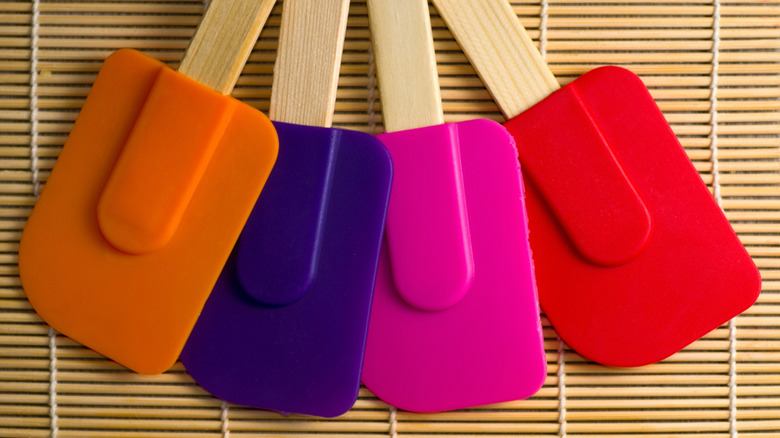
Concerned about toxins lurking in your kitchen? Consider the humble rubber spatula. Something most of us rarely, if ever, replace, but certainly have on hand. If yours has been with you since the Obama administration, it's likely picked up a series of tiny, perhaps nearly undetectable, cracks that could be harboring pathogens and introducing microscopic particles of silicone into each bowl of cake batter or batch of scrambled eggs.
The task of ridding your home of potential toxins can be overwhelming. Forever chemicals can be found throughout our kitchens, microplastics are virtually everywhere, and phthalates are in our fast food liners. While a true fix would require systemic reform, we can each do what we can to rid our kitchens of potential red flags. For rubber spatulas specifically, these tiny cracks occur in the kitchen-grade silicone after years of wear and tear scraping bowls clean, getting the last drops of brownie batter into pans, and sauteing and stirring. It can be totally impossible to clean out these tiny crevices. If the ick factor of that wasn't enough, this presents a food safety concern. Food particles can be transferred from, say, a batch of chocolate chip cookies to your burgers, or vice versa — even if the spatula was run through the dishwasher between tasks.
Bacteria aside, that silicone could be leaching into your food
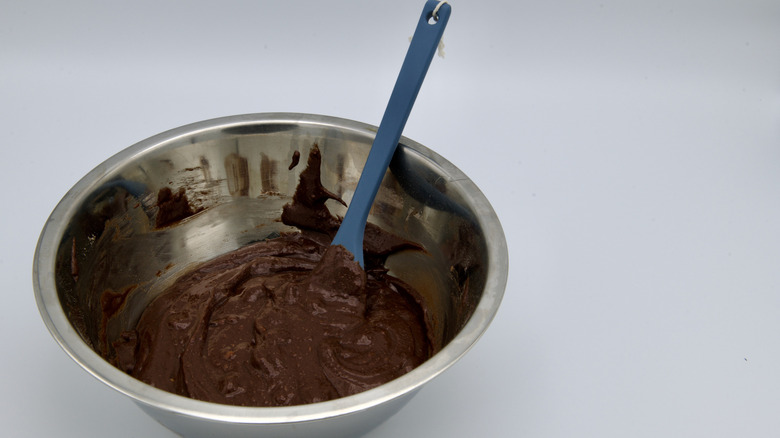
If you're attuned to the issue of microplastics, you've probably already tossed the obvious kitchen offenders — those cheap plastic utensils and ancient plastic takeout containers. Spatulas, though, tend to slip past our radar as less obviously concerning. The ones your grandma used were likely made from real rubber though today's versions are typically a heat-resistant silicone (which is derived from sand, not plastic). It's the pliable bendiness of a spatula — only possible thanks to these materials — that's its primary selling point.
However, especially if well worn, there's a risk of chemicals leaching from your spatula into that bowl of cookie dough. Cheaper materials can be less safe than higher-end silicones, and the risk of leaching only increases when utensils are exposed to high heat over time . With research on the safety of silicone still limited and riddled with caveats, this is definitely a case of better safe than sorry.
Luckily, silicone spatulas can still have a place in your kitchen; just embrace they aren't a forever investment. After all, there are few utensils more useful than a bendy spatula. Flat metal ones are great for flipping a pancake, and thin wooden options are much more eco-conscious — but neither can squeeze into the nooks and crannies like a rubber one can. Just make it a point to rotate out your spatulas every few years at max — or sooner, if you spot a crack.