

The Real Reason Your Plastic Storage Containers Still Smell Like Food After Washing
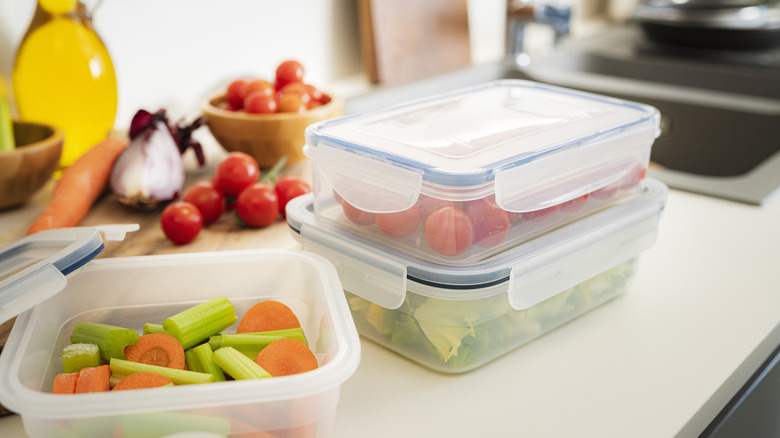
Plastic storage containers are every home cook's best friend, particularly for packing away leftovers, which can later be repurposed in genius ways. Not only are they super practical and convenient, but they're also easy to clean, whether by hand with hot, soapy water and a sponge, or on the top rack of your dishwasher. However, their main drawback is that even with thorough cleaning, they can still hold onto unpleasant smells.
This is because small molecules from food like color and odors can slip between the plastic molecules of your containers, which results in discoloration or lingering odors. According to Dr. Chris DeArmitt, fellow of the Institute of Materials, Minerals & Mining and the Royal Society of Chemistry, as well as founder of the Plastics Research Council, it all comes down to permeability (how easily certain molecules can move into a solid material). "All materials are subject to permeation of small molecules, but some more so than others," Dr. DeArmitt told Chowhound in an exclusive conversation.
Dr. DeArmitt added that common food storage plastics such as polyethylene (PE) and polypropylene (PP) are more prone to retaining smells due to their low polarity. In other words, low polarity is the reason why these plastics have properties that make them repel water and attract fat, grease, and oil. He explained that sesame oil (one of the best types of oil to cook with when using a wok) is another ingredient with fragrance molecules that permeate PP plastic. However, while such odor molecules are small and can slip through the plastic's tiny gaps, plastic molecules are far too large and therefore unable to permeate into other plastics.
Temperature and time make stubborn odors stick
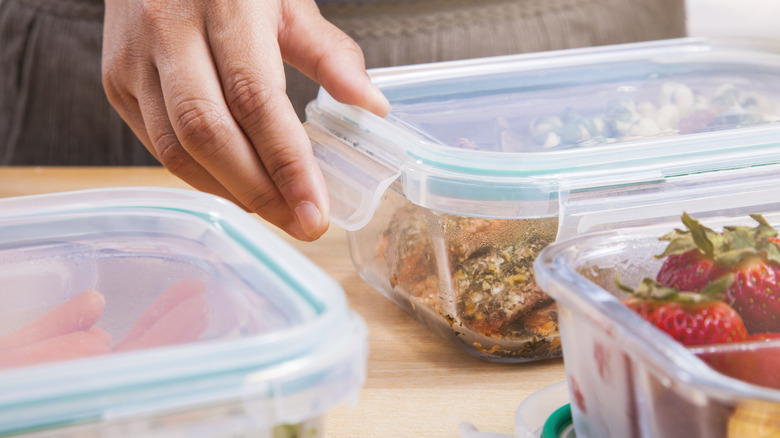
Dr. Chris DeArmitt emphasized that temperature is yet another factor that determines how molecules move, affecting how fast colors and odors penetrate the plastic. "If you were to heat Bolognese sauce in Tupperware, the material would become discolored rather rapidly," he said, adding that this is why most dishwasher interiors avoid PP plastic. "It gets stained pink when the dishwasher runs at high temperatures with leftover spaghetti sauce on the plates," Dr. DeArmitt continued.
According to the expert, permeation rate increases with time. This means that shorter exposure to strong-smelling foods results in less odor absorption. "Colors and odors can certainly enter into plastic materials, especially after long periods of time and high temperatures," he said. Thankfully, though, even when plastics do take on color or smell, the substances responsible are the same ones found in food, which means they pose no health risk.
When asked whether lingering odors mean it's time to throw out your nasty plastic food containers, Dr. DeArmitt pointed out that odor retention is a reversible process, rather than contamination or degradation. "Some people will choose to throw away perfectly functional storage containers for the excuse to buy fancy new ones, and I myself would be tempted, but we should ask ourselves if that is really the wisest choice," he concluded.