

Fresh Fish Doesn't Always Guarantee The Best Bite — What To Know About Aged Sushi
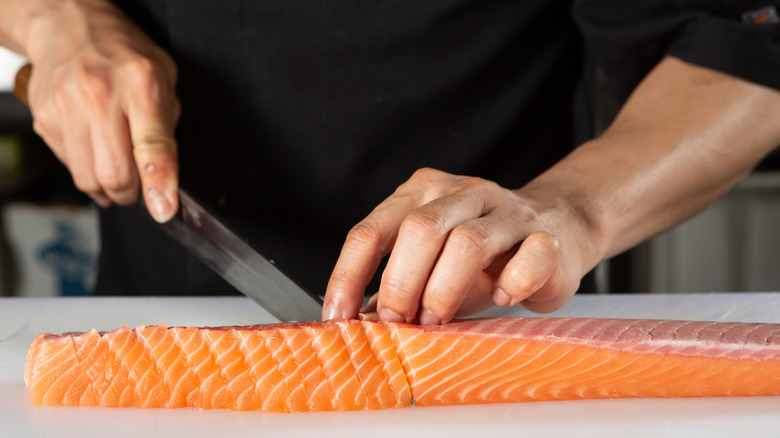
When you think about sushi, one of the first things that may come to mind is the clean taste of raw fish paired with seasoned rice. The fish used to make sushi is often handled with special care to ensure it's the freshest and safest fish to eat raw. However, there's another way to eat sushi that you might not have heard of: Sushi made with aged fish that can taste better than fresh. To make the most of your dining experience, there are a few things to know about aged sushi.
Making sushi with dry-aged fish is often the norm at upscale sushi restaurants in Japan, and is also a feature of many Japanese sushi restaurants in the United States. Originally, Southeast Asians treated fish with salt to preserve it, and in 18th-century Japan, some forms of preserved fish were made into sushi. With technological advances in cooling and storage, this curing method is no longer necessary to keep fish fresh.
So why would a chef dry-age sushi fish in the present day? The answer is to create an incredible flavor profile, especially umami, as well as a soft, creamy texture. Using the best methods to dry-age fish, restaurants maintain food safety while creating noteworthy dishes. The next time you visit a Japanese restaurant, you can enjoy ordering sushi like a pro by having additional knowledge about dry-aged fish and other facets of your dining experience.
The methods and science behind dry-aged fish
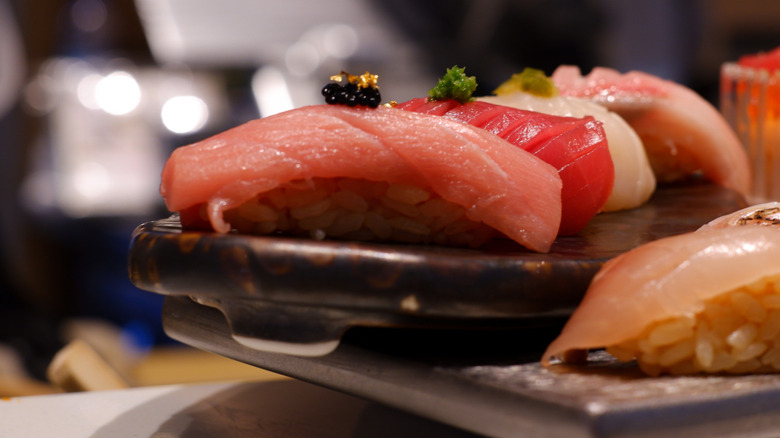
There are a number of ingredients chefs use to create umami flavor, but dry-aged fish is naturally loaded with it. Some restaurants age the fish by storing it for about a week in specially-made commercial glass-doored refrigerators, similar to those used for dry-aging beef. These units keep the relative moisture at around 70% to 80%, which prevents undesirable bacteria from multiplying so that the fish won't rot while its natural enzymes break down the flesh. Another method, rooted in Japanese culinary tradition, is to age the fish using a combination of salt, dried kelp, soy sauce, or a mixture of these ingredients, then vacuum-seal it. Both methods start with high-quality fish, though the technique can vary by species.
The reason this process works is due to the complex science of aging fish. The protein in fish flesh contains adenosine triphosphate (ATP) and adenosine diphosphate (ADP). While the fish is in storage, these break down into a compound called inosinic acid, a building block for salts that create umami flavor. When the ATP and ADP run out, hydrolysis occurs, in which one enzyme, amylase, breaks down starches into sugar, and another, protease, splits protein into amino acids, improving flavor and softening texture. One of the amino acids produced is glutamate, which creates even more umami alongside inosinic acid in dry-aged fish. Because of these unique flavors, you might enjoy aged sushi even more than the conventional variety.