

Meet New England-Style Ice Cream: The Frozen, Chewy Treat You Need Your Teeth To Eat
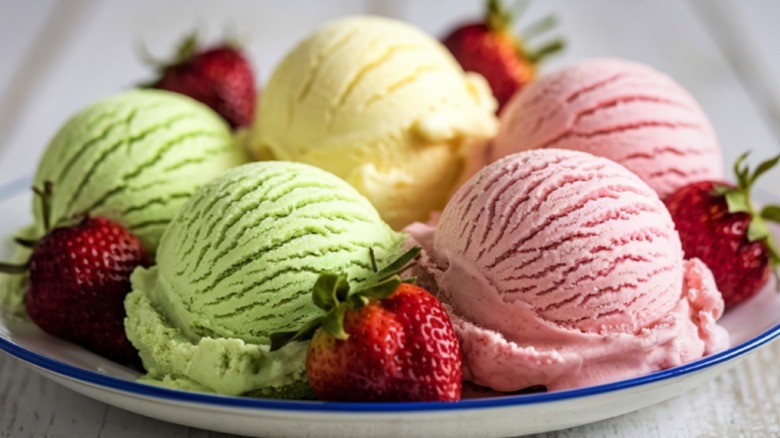
At its core, ice cream is cream, milk, sugar, flavoring, and sometimes eggs whipped into a cold, creamy delight. But minor changes to ingredients and technique can fundamentally change your ice cream-eating experience. On the other side of the spectrum from the uniquely airy Philadelphia-style ice cream is the chewy, taffy-like New England style.
From Herrell's Ice Cream to Hood, there are many mom-and-pop shops and a small faction of commercial manufacturers in the region, each with their own recipe. But New England-style ice cream has a few key features. For one, the ice cream is churned at a slower rate, resulting in a low overrun, meaning the ice cream base has less air with smaller, more closely packed air pockets, helping to maintain a thick, dense texture. This texture is a perfect base for a heaping of mix-ins like cookies, brownies, and candy.
New England-style ice cream also tends to be higher in fat. For example, Judy Herrell, the current owner of Herrell's, told Serious Eats the ice cream shop uses a 14% butterfat base, which is well above the 10% to 12% used in standard ice creams. This contributes to a richer, denser texture. It also results in a slower melting speed, as fat wraps around and protects all those tiny air molecules and ice crystals. This thick, fat-rich texture is the perfect base for an ice cream chock-full of fillings, as many New England scoops are.
Where to find a scoop of New England-style ice cream
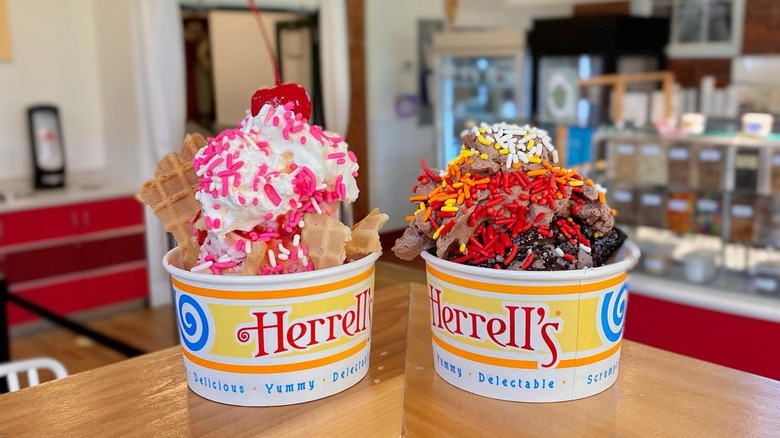
So you're all in on finding your perfect New England scoop but are stumped as to where to start. Well, you're in luck, because there are quite a few key New England ice cream shops to try for the perfect chew.
An essential spot for anyone wanting a true scoop of the region's sweet treat, Herrell's comes up in conjunction with this topic for good reason. It's a Massachusetts icon with two locations in Northampton and Amherst. Well known for its thick, mix-in-forward ice cream that comes in flavors like black raspberry mudpie and cookie combustion, the shop's been highlighted in publications from Bon Appétit to USA Today. Herrell's is deeply rooted in the lore of New England ice cream, as its founder, Steve Herrell, pioneered the region's beloved ice cream style in 1973 and created the concept of ice cream mix-ins, which he called and eventually trademarked as smoosh-ins). In fact, Herrell is said to have influenced Ben & Jerry's own filling-rich ice cream brand.
Now, if you're interested in digging into a dense scoop, you can always buy a pint of Hood's New England Creamery Ice Cream. It's a classic New England brand with a deep history in the region, and this product line is advertised as its creamiest ice cream to date. Or, if you want to try your hand at the customizable marble slab "mix-in" preparation method popular in the region, stop by a Cold Stone Creamery. You can also try your hand at making it yourself if you're feeling crafty, though you might have to pull that multi-purpose ice cream maker out of your pantry.
Making New England-style ice cream at home
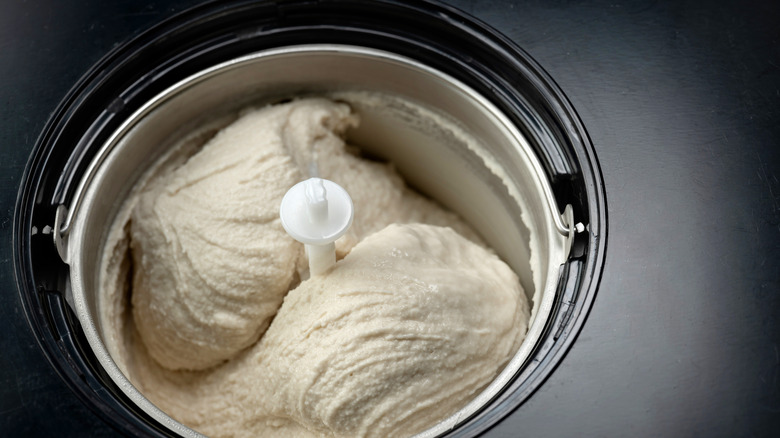
There's no definitive recipe for New England-style ice cream, as so many of the region's creameries and shops make the dessert using their own recipes and based on individual preferences. Accordingly, there are many ways to make the dense, taffy-like ice cream of your dreams. One important aspect of achieving an optimal texture is by lowering the speed of your churn in order to prevent too high an overrun. Whipping too much air into your ice cream will produce too fluffy a scoop. So, if you can slow the churn speed on your ice cream maker, make sure to keep it at a lower speed setting.
If you have an ice cream maker that works at a single speed, there are other ways to compensate. Adding stabilizers can help keep your ice cream thick. The Hood New England Creamery uses guar gum and locust bean gum as thickening agents. If you can't find these stabilizers, you can use arrowroot or xanthan gum.
As for those ice cream mix-ins? Well, that's a whole other can of worms (or nuts or chocolate chunks). You can either add your mix-ins towards the end of the churning process or afterward, either by layering them into your ice cream container or working them together on a cold surface, marble slab-style. Just make sure that your mix-ins are chopped small enough and pre-chilled so they don't impact your ice cream's texture. Or, if you're feeling flavorfully fickle, you can always opt for toppings rather than mix-ins.