

Pot Roast Turns Out Juicy Without A Dutch Oven When You Use One Simple Swap
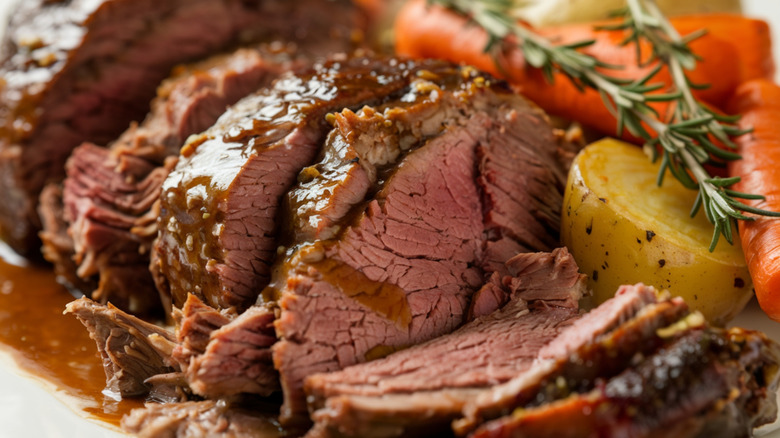
During the throes of winter, there's one comfort meal that helps us power through: pot roast. In the words of Angela Komis, chef instructor at Auguste Escoffier School of Culinary Arts and disciple of Les Disciples of Escoffier International, "It's cold outside, and the time of year to make the quintessential pot roast." A simple dish on the surface, there are plenty of mistakes everyone makes when making pot roast for the first time. It presents even more challenges for cooks who lack a slow cooker or a Dutch oven, and are wondering if they truly need to invest in one.
Thankfully, according to Komis, it's totally possible to braise a roast without a Dutch oven. You can even cook a beautifully browned, juicy pot roast in a basic pot without a properly fitting lid, though it will require an additional tweak. "If you do not have a lid, you can still create a braising environment by cutting parchment paper to the size of the pot and pressing it down directly on the meat and liquid, keeping the moisture in," Komis explains. This isn't just a haphazard fix, either — it's actually the basis of a French cooking method and is called a cartouche. "For an added layer of protection, you can then cover the entire pot tightly with foil as an airtight seal," Komis adds. "This will ultimately preserve the moisture that defines a masterful braise."
The importance of heat and moisture control
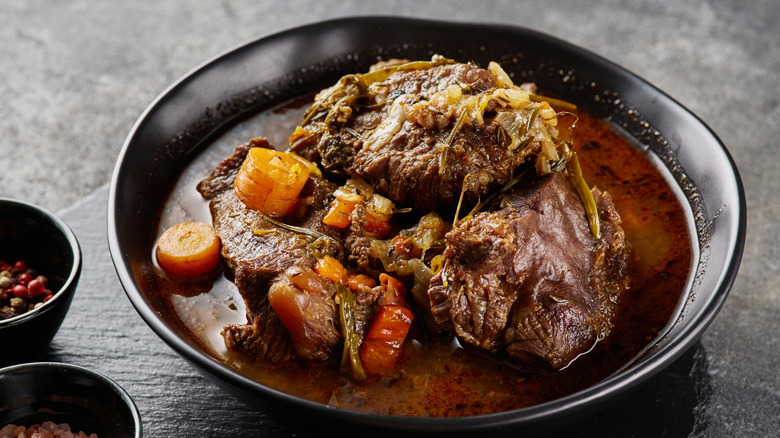
As chef Angela Komis tells us, you don't have to have a Dutch oven, slow cooker, or even a pot with a lid to make a succulent roast. But you do have to properly control the heat and moisture levels of your cooking environment, which is easier to do with the right tools. Heat control starts with getting a proper sear on your meat to create a golden brown crust and deglazing the pan to create depth of flavor. Then, Komis says, "cooking the roast at a slow simmer until the pot roast is tender is the main objective." Look for "gentle bubbles," as rapid boiling shocks the muscle fibers and creates a "dry, stringy texture," she says.
Proper braising also requires the right amount of moisture and subsequent pressure, which is where having the proper size pan and a tight fitting lid (or a parchment and tin foil cover) becomes key. "Your roast should fit snugly but there should be room for the liquid and other ingredients," Komis says. You want the roast to stay partially submerged in liquid without extra room for it to spread out and evaporate.
Similarly, if the lid is not tight enough, the liquid will evaporate and condense. A tight-fitting lid traps moisture, resulting in condensation that "bastes" the roast and converts to steam, which creates pressure. "This is not as much pressure as a pressure cooker, but it is enough pressure to break down the protein and create a tender and juicy pot roast," Komis says.