

10 Types Of Chocolate Cake From Around The World, Explained
Chocolate has been a part of human diets for thousands of years. It's been used in everything from ancient ceremonies to cheap treats, and it's now many people's top favorite flavors. For centuries, chocolate was used as a beverage only, and people would use a chocolate paste to make their drinks. In 1828, Coenraad van Houten figured out a way to turn cacao beans into powder that you could mix with water, and in 1847, the first chocolate bar was created. By 1876, milk chocolate had arrived on the scene.
Europeans started making chocolate cakes like the Sachertorte in the mid-1800s. However, the U.S. version of "chocolate cake" in the 1800s was a piece of cake that didn't contain any chocolate, which you ate while drinking chocolate. Think of it as the coffee cake of its day; the cake isn't coffee-flavored, but rather meant to accompany a cup of coffee. Chocolate and cocoa powder gradually made their way into foods like icing, and by the late 1800s, recipes for cakes that included a little bit of chocolate had appeared in U.S. cookbooks.
However, the use of more chocolate in cake soon became standard. Devil's food cake first appeared in 1902, and by the 1940s, Hershey was promoting its chocolate baking recipes. Chocolate cakes that use a lot of cocoa and chocolate are now common in many cuisines, with several countries known for specific types, such as these delicious chocolate cakes from around the world.
1. Devil's food (United States)
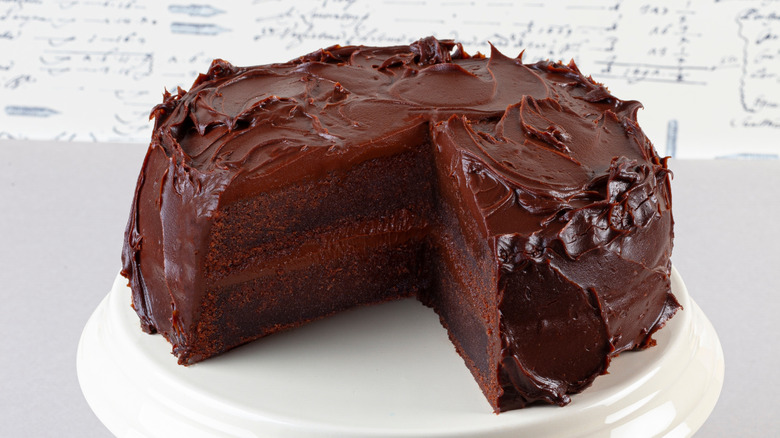
This is the classic representation of the rich, indulgent chocolate baked good, not to mention an endless source of "heavenly," "sinfully," and "devilishly" puns. The first known recipe for the cake appeared in 1902, and a common origin story for its name is that devil's food was named to contrast with the white, spongy angel food cake that was so popular. Another common origin story for the name is that the cake was so rich that it was "sinful." No matter how it got its name, devil's food cake quickly became a favorite.
Devil's food cake differs from plain chocolate cake. Plain chocolate cake uses chocolate or a mix of chocolate and cocoa powder, while devil's food uses either cocoa powder or cocoa powder and coffee, along with hot water. Devil's food also uses more baking soda and usually has an acid ingredient like buttermilk.
Devil's food cake is sometimes linked to the origin of red velvet cake. Modern red velvet cakes use food coloring to get a bright red interior, but older recipes used the reaction between unprocessed cocoa and an acid ingredient to create a chocolate cake with a dark interior that had a reddish hue. There were also Southern versions of devil's food cake that used beets and cocoa. As a result, you'll still occasionally see the names "devil's food" and "red velvet" used interchangeably for red velvet cake.
2. Chocolate mud cake (Australia)
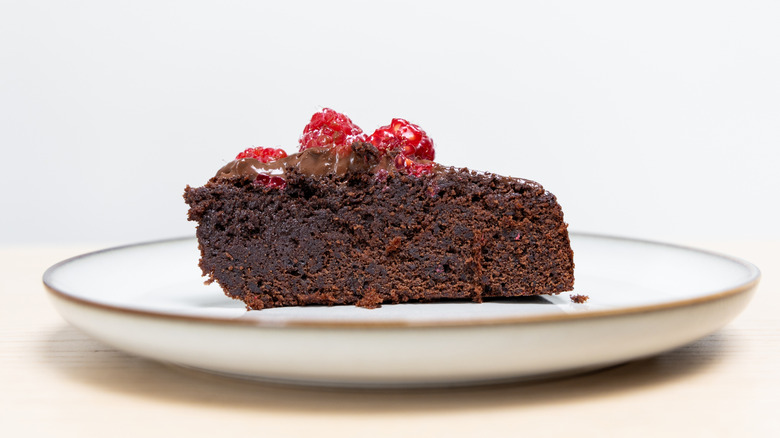
Australia's mud cake uses lots of fat and melted chocolate, plus a longer baking time at a lower temperature, to produce a fudgy cake that's just on this side of the line dividing cakes from brownies. The typical mud cake is a single layer topped with a luscious layer of ganache. Homemade recipes can vary; you'll find some that use butter while others use oil, although butter is recommended. You'll find some that use only melted chocolate, while others are similar to devil's food cake in their use of coffee and hot water, along with cocoa powder and melted chocolate.
The exact year that the mud cake recipe came into existence isn't known, but they became popular supermarket cakes by the early 2000s, especially at Coles and Woolworth's, or Woolies. The classic mud cake is chocolate, but Woolies has released limited-edition mud cakes in flavors like chocolate chip and pumpkin spice. The two markets' mud cakes are slightly different and frequently compared, with some deciding that Coles' cake has better mouthfeel and Woolies' cake has a stronger chocolate taste. The mud cakes from those two stores are so beloved in Australia that there was outrage when there was a possibility of shrinkflation showing up in Woolies' cakes.
3. Schwarzwälder kirschtorte/black forest cake (Germany)
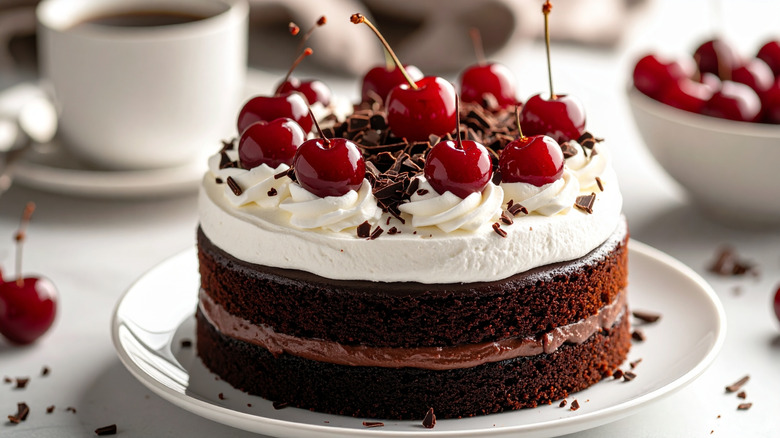
Schwarzwälder kirschtorte, or black forest cake, has a couple of different possible origins. One is that the cake somehow came to be in the 1500s in the Black Forest region of Germany. However, chocolate was still a drink at that point; chocolate cakes or tortes didn't appear (at least on record) until the Sachertorte in 1832. Another possible origin, and the one that's usually treated as the official one, is that the cake was an invention of a German chef in the early 1900s.
Most credit usually goes to pastry chef Josef Keller, who in 1915 whipped up a chocolate dessert covered in cherries and cream for some guests. He reportedly refined the recipe after he opened his own cafe, coming up with the classic recipe that he then passed to August Schäfer, who later served the cake at his own cafe. Another name often associated with the cake is Erwin Hildebrand, who supposedly invented the cake in 1930. Regardless of who invented it, the black forest cake has become a favorite worldwide.
What sets the cake apart from other chocolate cakes, other than its lovely balance of cake, cream, chocolate shavings, and both sour and maraschino cherries, is the use of Kirschwasser, or cherry schnapps. However, if you don't want any alcohol in your food, you can make the cake without it. The cake can be two, three, or four layers, depending on who you ask.
4. Bûche de Noël/Yule log (France)
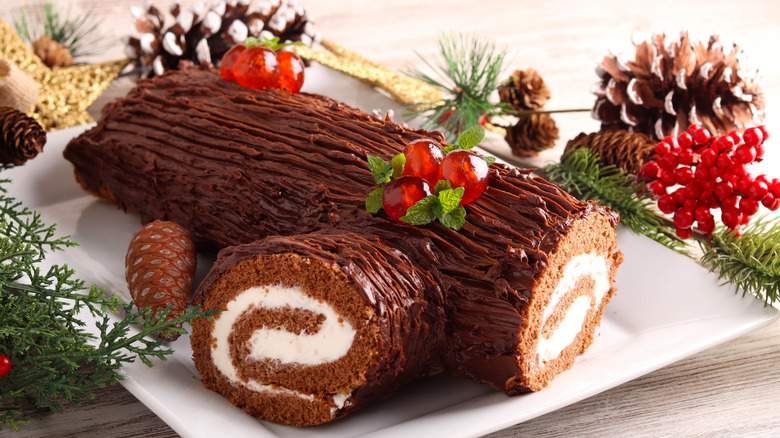
Bûche de Noël doesn't have to use chocolate cake, and you'll often find vanilla or another flavor of cake rolled up under that frosting. But the traditional cake flavor is a chocolate chiffon or sponge, covered with cream filling and rolled up into a spiral log, covered with chocolate frosting that's been raked with a fork into bark-like patterns, and topped with other garnishes that make the cake look like the Christmas treat it's supposed to be.
Like other older cakes, the origin is murky, but one story says that families in France made this cake to look like a Yule log after Napoleon Bonaparte required homes to close their chimneys one winter, apparently out of concern about illness. With the chimneys closed, no one could burn anything in the fireplace, which meant no Yule logs. Another story simply states that people either got tired of lugging huge Yule logs around or found burning them in the city impractical, and Paris bakeries made Yule log cakes as a substitute. The first published recipe appeared in 1890, by Pierre Lacam.
Yule log decorations vary. Many people don't decorate the cakes or add just a few piped-frosting holly leaves, while others go all the way in the opposite direction, adding meringue mushrooms and marzipan shapes to create an entire woodland scene. The frosting is plain old buttercream, which holds those fork marks better than ganache or other softer frostings.
5. Chocoflan/impossible cake (Mexico)
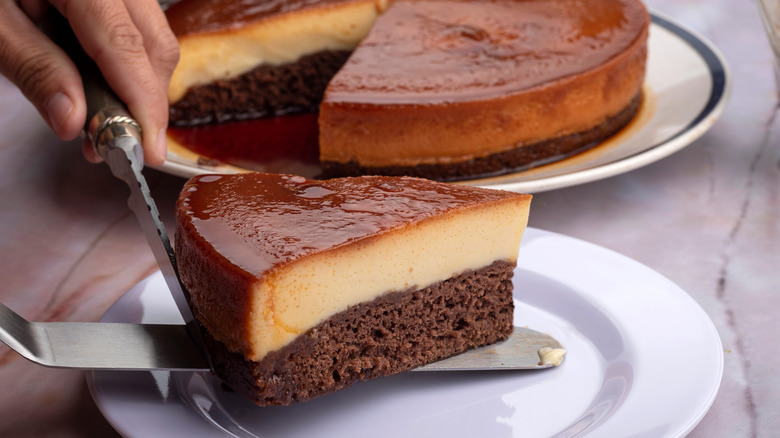
If you order chocoflan, the name tells you exactly what you'll get: a layer of chocolate cake under a layer of flan. However, it's the cake's other names that give you a clue as to why this cake is so much fun to make. It's also known as impossible cake, or "pastel imposible" in Spanish. The name comes from the fact that when you make it, you make it backwards, placing the cake batter in the pan and the flan mixture on top.
When you flip the cake pan over, what emerges is not the cake-topped flan you expect. Instead, the two switch. You have a cake base with a flan top. It actually has to do with how the cake batter becomes lighter than the flan as each bake, so the cake rises up, while the flan drops down.
The cake has been around for at least a couple of decades, but no one has stepped forward to say they or a family member were the original creators. Meanwhile, chocoflan has become so popular that you'll find recipe after recipe online. Some have you make the cake from scratch, while others rely on those trusty boxes of mix.
6. Sachertorte (Austria)
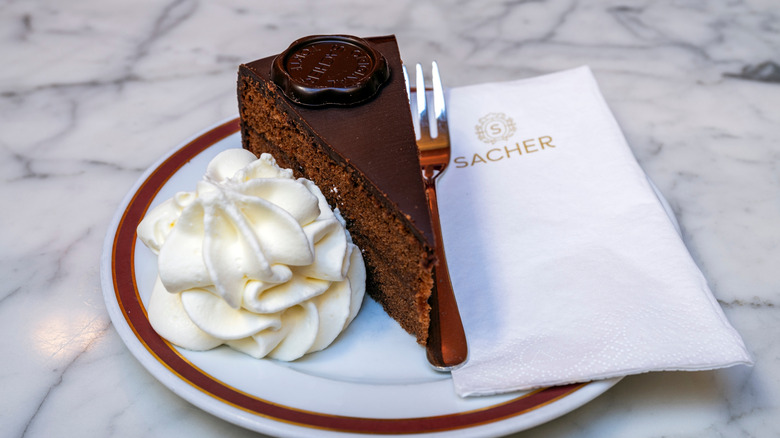
The classic Sachertorte is a very dense, two-layer cake with apricot jam in the middle, plus a smooth chocolate glaze on the top and sides. Though, the original recipe is a secret.
The Sachertorte is named after Franz Sacher, who created the cake in 1832. Sacher was a 16-year-old apprentice in a royal court, and he made the torte while filling in for a sick chef. Sacher's son, Eduard Sacher, opened the Hotel Sacher in Vienna and continued to serve the torte. Its official Hotel Sacher name is Original Sacher-Torte, but you'll find the single-word name used all over the place. The Sachertorte generally is considered the oldest known chocolate cake. While it's very possible that families or smaller bakeries were making chocolate cakes earlier than that, the Sachertorte was apparently the first confirmed chocolate cake.
The Sachertorte was the subject of a legal battle between Eduard Sacher and another bakery called Demel. The problem was that the torte was the invention of Eduard's father, and Eduard refined the recipe. But he did so while employed at Demel. That's not all: Eduard's son, also Eduard, worked at Demel, too, after the hotel declared bankruptcy. Both the bankrupt hotel and Demel sold Sachertorte, and Demel contested the hotel's right to sell the cake. The outcome was that each would continue selling the torte, just under slightly different names.
7. Flourless chocolate cake (Italy)
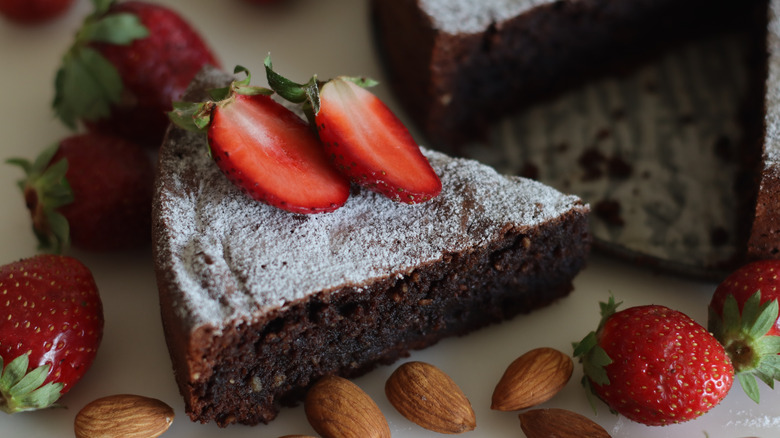
Flourless chocolate cakes, meaning no wheat flour, have been a staple of gluten-free baking for years. But the cakes that you think of as just gluten-free versions of chocolate cake actually have roots in Italy, descending from a few different regional cakes.
Torta tenerina or tacolenta is from the Bologna region, especially Ferrara. This cake can have a tiny bit of wheat flour in it, depending on the recipe. Other recipes use potato starch, instead, along with eggs, sugar, and chocolate. Torta tenerina is sometimes called Queen of Montenegro after its supposed origin (1900, when Italian and Montenegrin royal houses united in marriage). The cake has a crisp exterior and creamy interior, it's baked for 18 minutes regardless of recipe, and it's served cold.
Torta barozzi is from Vignola in Modena and combines eggs, sugar, butter, coffee grounds, and chopped almonds and peanuts. The first known recipe came from Pasticceria Gollini in 1886. The recipe is secret, so any homemade recipes you find might not give you the same cake that you'd get at the shop.
Finally, there's torta caprese, from Capri. Its two main competing origin stories are that the woman making it either forgot the flour, or terrified because she was baking it for a gang, and she left out the flour. A third theory states it was a copycat of a Sachertorte using almond flour. The cake contains almond or hazelnut flour, chocolate, and a lot of butter, sugar, and eggs.
8. Reine de Saba (France)
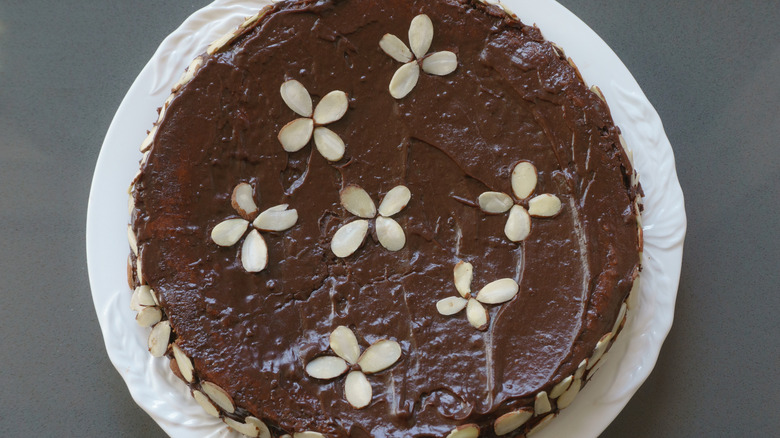
Reine de Saba is also known as Queen of Sheba cake, and Julia Child called it "the best chocolate cake you ever put in your mouth." It's not clear when it was first made, but it was reportedly the first cake Child had after moving to France. That means it's been around since at least the late 1940s. This is a single-layer cake that's incredibly rich and dense, made in a cake pan that's only 1½ inches high. Child's recipe uses cake flour, but other recipes use ground almonds and all-purpose flour, to create a dense cake that's flavored with rum and chocolate, covered with a buttery chocolate icing, and garnished with almonds.
You can totally make this cake at home, of course, but let the experience of a curator with the National Museum of American History be a warning. You can make this recipe the easy way, beating egg whites with an electric mixer, or you can do it the old-fashioned way, beating them into peaks by hand. The curator attempted to make this cake for a colleague's birthday the old-fashioned way. If you're not used to beating egg whites into stiff peaks by hand, start early. She wrote that her attempts to beat the egg whites exhausted her and delayed finishing the baking until late into the night. Julia Child would encourage you to try by hand, but if you don't have a lot of time, we recommend using the electric mixer!
9. Molten cakes (France/United States)
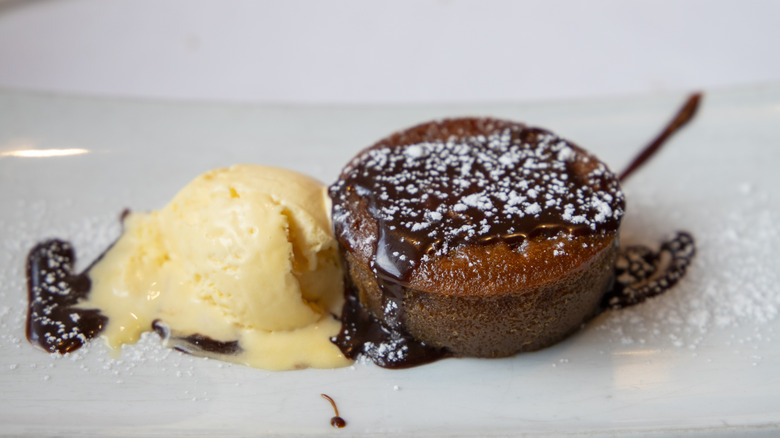
Molten cakes are those that have a relatively solid exterior but a molten interior. You may know them better by the names fondant au chocolat, coulant au chocolat, and lava cake. Some accounts have drawn a line from lava cakes all the way back to Pillsbury's Tunnel of Fudge cake from 1966, but the cakes' histories are actually a little more recent. Michel Bras is generally credited with inventing coulant au chocolat in 1981, which he said he dreamed up after a ski trip and then took two years to perfect. Fondant and coulant are different terms for the same cake, which has a firm exterior and a softer middle that comes from melted ganache. It's a finicky dessert that requires a lot of attention.
Lava cakes are different; these are cakes that you underbake so that the center remains runny. The invention of the lava cake is officially credited to Jean-Georges Vongerichten in 1987, who claims he was baking cakes (some accounts say a sponge cake, while others say it was several cupcakes) that didn't bake through. The story goes that he was initially appalled at the mistake, but somehow, people loved it.
The relative simplicity of lava cakes helped propel them to the top of the American dessert menu in the 1990s. Both coulant/fondant and lava cakes have remained immensely popular, although lava cakes have developed a bit of a reputation as being boring now that supermarkets sell frozen versions.
10. German chocolate cake (United States)
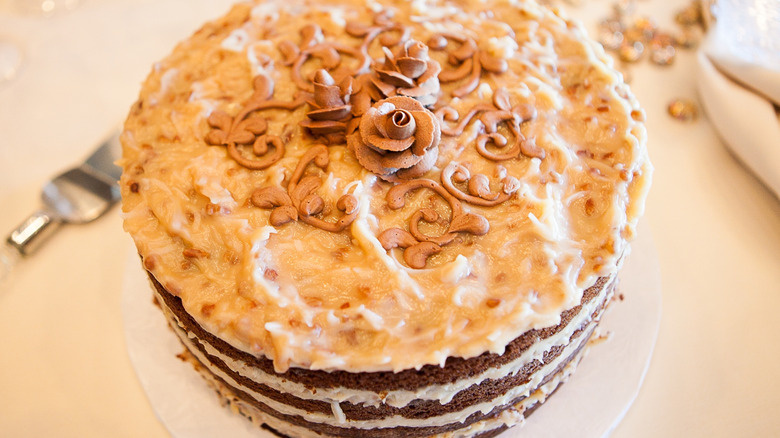
German chocolate cake is a three-layer buttermilk chocolate cake with a coconut-pecan frosting. If those ingredients sound decidedly non-German and very Southern, there's a reason for that: They are Southern. The cake first gained attention when a homemaker named Mrs. George Clay sent the recipe into The Dallas Morning News' Recipe of the Day column in 1957. Mrs. Clay's recipe used an ingredient known as German's Sweet Chocolate, hence the cake's original name of "German's Sweet Chocolate Cake."
German's Sweet Chocolate was created for the Baker's Chocolate company by a man named Sam German, and the company marketed his product as Baker's German's Sweet Chocolate. While we're on the subject of misunderstood name origins, Baker's Chocolate wasn't named after bakers. It was named for the founding family, whose name was Baker. Anyway, Mrs. Clay's recipe was a hit. But somewhere along the way, people changed "German's" to "German."
The fact that this cake isn't German isn't a secret. You can find information on its origin with a quick search. But somehow, many, many people still don't realize that it's an American cake from Texas. Searching for terms like "German chocolate cake TIL Reddit" brings up page after page of posts — we stopped counting after 22 posts — describing how the original poster had no idea that the cake wasn't really German. Even President Lyndon B. Johnson apparently didn't know as he reportedly served the cake to the German chancellor in 1963.
Static Media owns and operates Tasting Table and Chowhound.