

Why American 'Feta' Would Be Illegal In Europe
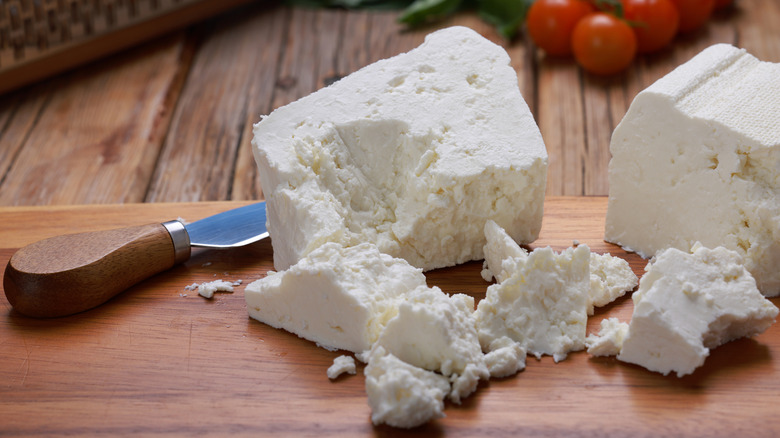
There are many things in life we can be grateful for, and for many foodies, cheese holds a rightful place on this list. One of the things that make cheese so wonderful is the fact that there are practically endless varieties that range from hard to soft and everything in between. When it comes to soft cheeses, you've got plenty of choices like chèvre and feta (which, by the way, are definitely not the same), but feta has a unique distinction. Its name is actually hotly contested and heavily protected in some places.
Feta was originally created in Greece and in its 2,000-plus year history, it has become one of the most iconic foods of the country's cuisine. Without it, a classic Greek salad would be, well, boring. But as this cheese's history and popularity has unfolded, so too has Greece's pride in feta. In fact, in 2002, feta became classified as a PDO (Protected Designation of Origin) in Europe, meaning that it is a product that is made in a specific geographic area according to specific criteria.
In the case of feta, the European law that designates it as a PDO requires any cheese called feta to be produced within certain geographical regions of Greece using milk from native breeds of sheep and goat who graze on plants within those regions. The milk, which has to contain at least 6% milk fat, must be collected seasonally, and each step of the production process from the way the milk is strained to the way the cheese is aged has to follow specific steps and guidelines. What this all boils down to is that any "feta" cheese made outside of Greece, such as that made in the United States, can't be legally called feta in Greece.
But what about feta produced outside of Greece?
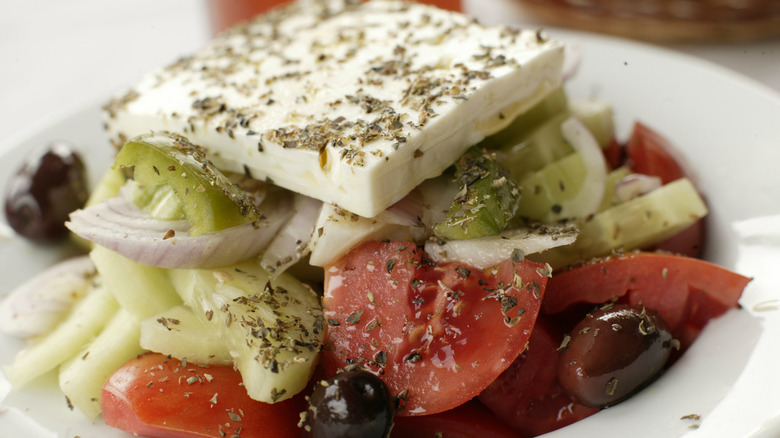
Feta is packed full of protein (21.3 grams per cup) and important vitamins and minerals (like zinc, manganese, and vitamin B6), so its popularity isn't surprising. Neither is the fact that many other countries produce this type of cheese, or at least a version of it. While Greece was the top producer in 2025, it's also made in places like France, Germany, Italy, Denmark, Bulgaria, and, of course, the United States.
Ultimately, though, according to EU law, the only true feta is feta that comes from Greece, and any feta made outside of Greece should technically be labeled "feta-style" cheese, but they are often labeled as simply "feta." Greek feta is known for its salty and tangy yet rich and creamy flavor, which comes from the sheep or goat milk used along with the brining process, but American feta can be made from milk that comes from either sheep, goats, or cows. The difference results in a cheese that is tangy, as feta should be, but more crumbly than creamy — and a cheese that wouldn't be able to be sold as "feta" on the Greek market.
Feta is a hallmark of Greece's culinary culture, but a block of this cheese can be used to add Mediterranean flavor to many foods. It can bring some added tang to dishes like a colorful shakshuka and add a Greek-inspired twist to a classic American hamburger. Feta's versatility allows it to be used just about any way imaginable — you can crumble it, cube it, or slice it (the name literally means slice), and you can bake it, fry it, make a dip with it, or even wrap it in foil and toss it on the grill for a hot, melty treat.