

The US States Where People Spend The Most On Groceries
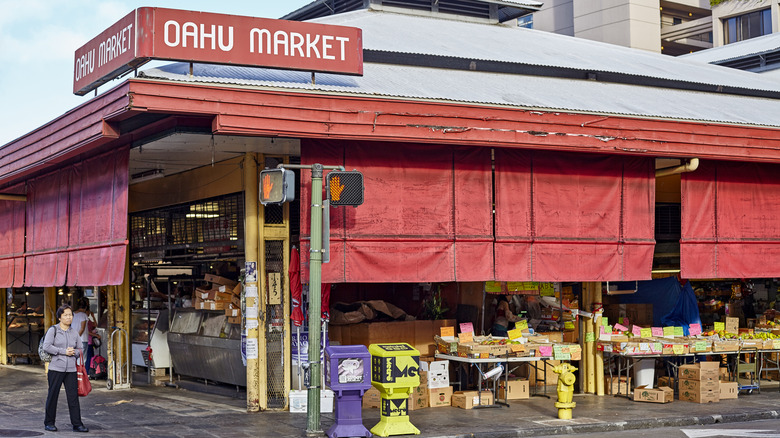
If you're feeling squeezed at the supermarket checkout in the continental United States, know that things could be worse. You could live in Hawaii or Alaska, the two U.S. states where residents spend the most (on average) on groceries each week. According to analyses based on Bureau of Labor Statistics data (published by Visual Capitalist), both states pay well above the national average of $118 per week, with Hawaii the most expensive at $157 followed by Alaska at $152. They're also well ahead of the next most expensive state, California ($127 per week).
The general reason for this is geography. Hawaii imports the vast majority of its food (around 90%), which means that most supermarket goods must travel thousands of miles by ship, adding hefty freight costs. It's hardly surprising. When we looked back in 2023, Hawaii also had the most expensive groceries in the U.S. It's also why you won't find a Chipotle in Hawaii or Alaska, which faces similar challenges, particularly in remote communities that rely heavily on barges or air transport for food deliveries. In the Land of the Midnight Sun, prices like $9 for bread and $10 for orange juice are normal (cities like Anchorage are more affordable, but still well above the national average). Alaska is also not a great place to grow food, so most is imported, although Alaskans can still grow a limited set of cold-weather produce like potatoes, carrots, and barley.
After Hawaii and Alaska, the mainland states with the highest grocery bills are West Coast states such as California and Washington, although at $127 and $126 per week, respectively, they're closer to the national average (Oregon is somewhat cheaper at $122). The high bills there are likely for different reasons than Hawaii's and Alaska's. While these mild-climate states have robust agricultural sectors, they're also expensive places to live, so supermarkets face a mix of higher labor costs, real estate expenses, and operating costs.
The other most expensive states (and the cheapest)
It's easy to understand how high-cost-of-living and noncontiguous states have the highest average grocery spends in pure dollar amounts. But there's another, perhaps more instructive, way to consider this: Who pays more of their income on groceries?
Using Bureau of Labor Statistics data, GOBankingRates deduced that residents of Mississippi and West Virginia pay a higher percentage of their income on groceries, with residents paying an average of 10.57% and 10.11%, respectively. The site doesn't provide a national average, but the median expenditure is around 8%. There's one big factor that explains this: Both of these states have relatively low average incomes. So even though their weekly spend is below the national average ($112 in Mississippi and $113 in West Virginia), low incomes mean even these "affordable" prices take a bigger bite out of paychecks. For comparison, Alaskans pay 8.83% of their income on groceries, Hawaii pays 8.29%, and California and Washington just below 7%.
And what about the cheapest places for groceries? Arkansas, Iowa, and Oklahoma all have the lowest average spending at $111 per week each, and most Midwestern and Southern states in general hover around the $111 to $117 range. This is likely due to a mix of reasons, for example, they're close to large-scale agricultural production (particularly Iowa), resulting in lower transportation costs, and states with generally lower costs of living and cheaper labor also tend to have lower prices. Meanwhile, New Jersey and Massachusetts spend the lowest proportion of their incomes on groceries at a little over 6%, even though their average weekly expenditure is a touch above the national average, likely due to these states' relatively high incomes.