

Don't Be Afraid To Choose Fish With Edible Bones For Less Hassle
We may receive a commission on purchases made from links.
If you've eaten salmon as a child, you may remember the adults in your vicinity admonishing you to "chew carefully, there might be bones." And while most of the time, swallowing fish bones may not cause major issues, some fish have more edible bones that can minimize a lot of that worry. Chowhound spoke with chef Maricel Gentile, owner of Maricel's Kitchen and author of "Maricel's Simply Asian Cookbook," and chef Andrew Zimmern, TV personality and co-author of "The Blue Food Cookbook," to get their advice on how to eat fish with edible bones.
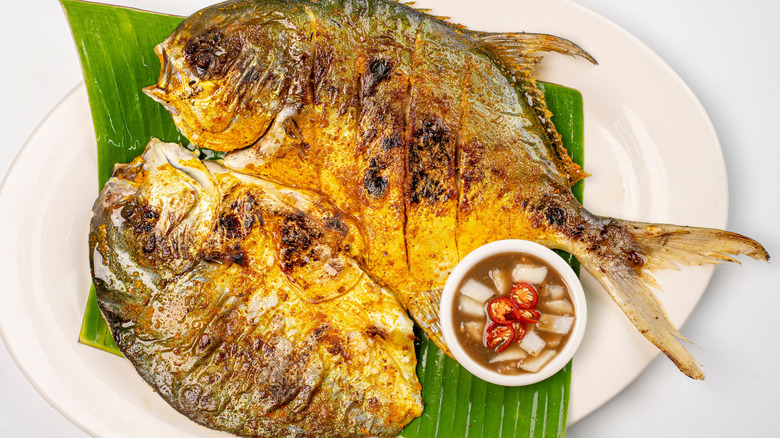
The first step, of course, is to select the right kind of fish. "With fresh fish, the key is size and structure," says Gentile. "Small fish have fine bones that can soften or become almost unnoticeable with the right cooking." Her recommendations include milkfish (or bangus) as well as small sardines, anchovies, and smelt (yes, you can eat smelt fish bones). Zimmern agrees, differentiating between small and oily types of fish like anchovies and smelt as a starting point; fish with bony skeletons that soften when braised or pickled, like herring and alewives; and fish that are commonly eaten whole (with bones) when cooked, like the Japanese ayu. In fact, Zimmern says that in some regions, certain fish bones are cooked separately to the fish, as their own type of delicacy.
On the other hand, "Avoid large fish with thick pin bones or heavy rib bones, like snapper, cod, halibut, grouper, etc.," Zimmern says. "Those bones do not soften in any pleasant way and are not worth testing your dental insurance on."
Preparing and eating your fish
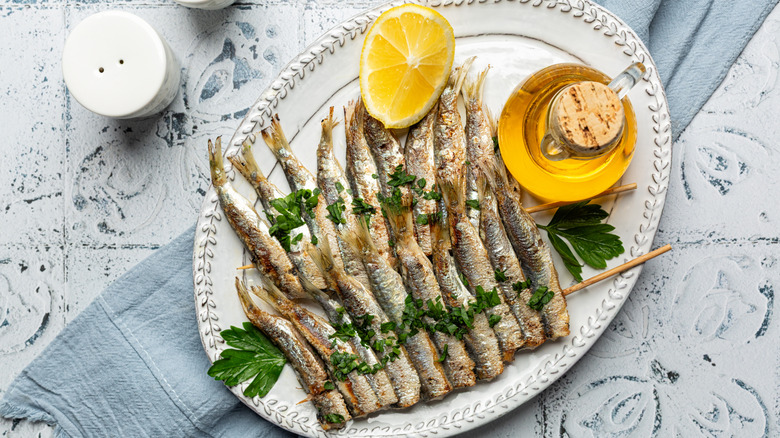
Once you've selected your fish, it's time to get cooking. Certain methods of cooking work better than others. "Frying is the most reliable method," says Maricel Gentile. "When fish is fried hot and properly, the bones dry out and turn brittle. They become crisp and almost blend into the texture of the fish." Andrew Zimmern concurs, saying methods involving high heat, like deep frying, or long cook times are the way to go.
Gentler cooking methods can be hit or miss, depending on which you use. Both chefs recommend steering clear of poaching or steaming, quicker cooking methods that "leaves you with flexible, needle-like bones that feel like a prank," Zimmern describes. Gentler methods that do properly soften fish bones include pickling, pressure cooking, braising, confit-style cooking, and escabeche. However, "If someone wants confidence, frying is the place to start," says Gentile.
If you're feeling nervous about your first foray into eating fish bones, there are a few things you can do to mitigate those fears. The key, according to both chefs, is to keep things as familiar as possible, and opt for a crispy preparation. "Fried smelt, white bait fritters, or whole fried sardines are nearly foolproof and familiar in flavor," says Zimmern. "Tinned fish warmed and folded into pasta or spread on toast is also a confidence builder." Gentile favors fried bangus, or fried sardines accompanied by rice and a dipping sauce. "Once you try these, you will realize it is not scary," she concludes.