

'Fresh' Seafood At Restaurants May Actually Be Frozen: What To Know
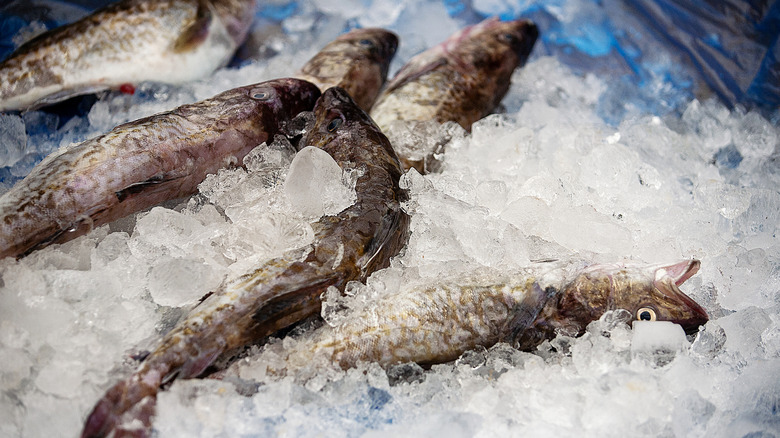
When you see the word "fresh" on a seafood menu, you can safely ignore it — it doesn't really hold any weight in terms of quality. There are a lot of nuances behind seafood terms, and if you've found yourself confused in the grocery aisles by different jargon — fresh frozen, never frozen, etc. — it can be quite intimidating to shop. To get a good grasp of the lingo and find out what "fresh" actually means, Chowhound spoke exclusively with Bryan Szeliga, owner of Fishtown Seafood, a wholesale supplier to Michelin-star restaurants. "Seafood language is notoriously ambiguous... Freshness should describe decomposition — not temperature," he said. That distinction helps explain why restaurants often serve frozen seafood, and why it's usually not an issue. Frozen fish can be superior to fresh, after all.
According to Szeliga, terms like "fresh frozen" are essentially catchy buzzwords meant to entice, and aren't actually a reliable basis for quality. "Previously frozen," on the other hand, means exactly what it sounds like: seafood that was frozen, thawed, and packaged as chilled. If you see "fresh" on the label, don't rely on it entirely. It's better to pick the freshest seafood by looking at the packaging, not the fine print. However, Szeliga further notes, "What matters more than the word 'fresh' is: How the product was frozen, when it was frozen, why it was frozen, and the quality and condition of the seafood before freezing."
The magic of frozen seafood
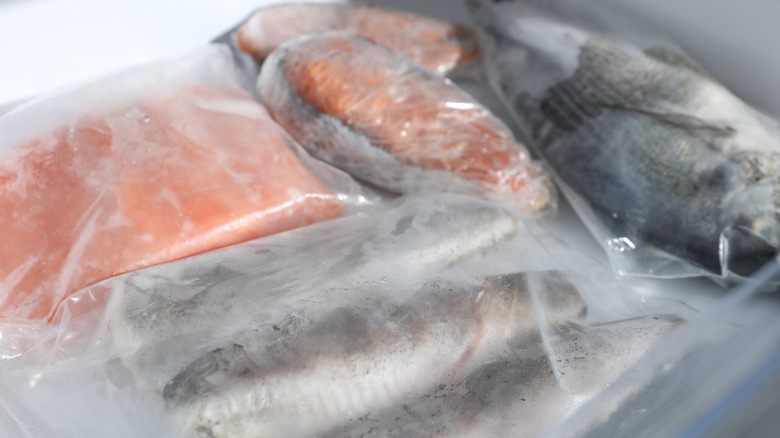
"When the right product is frozen for the right reasons with the right technology, frozen seafood can outperform never-frozen seafood," Bryan Szeliga informs us. "When the wrong product is frozen with older technology, it can be terrible." In some cases, seafood undergoes a process called flash freezing, which is where it is frozen expeditiously at around minus 22 to minus 58 degrees Fahrenheit. Flash freezing straight out of the boat helps maintain its integrity. When seafood is stored correctly throughout the distribution chain, it can taste just as fresh as a newly caught fish when it reaches your table. Some frozen seafood products go a step further, using super-frozen or proton frozen methods to deliver even higher quality. Super freezing refers to seafood frozen at temperatures between minus 40 and minus 76 degrees Fahrenheit right after the fish is caught. Proton freezing uses specialized technology to stabilize water molecules and maintain texture and flavor.
Surprisingly, upscale restaurants and counter-serve spots aren't that different in their approach to frozen fish. "Both high-end restaurants and casual chains use more frozen seafood than they'll ever admit to their customers," Szeliga said. "The difference usually isn't whether they use frozen product[s]; it's whether they're using high-quality frozen or commodity frozen." So, at the end of the day, the quality of the freezing process is really what matters, meaning properly frozen seafood can taste just as fresh as never-frozen options.