

The Common Misconception About Aldi And Lidl We're Finally Putting To Rest
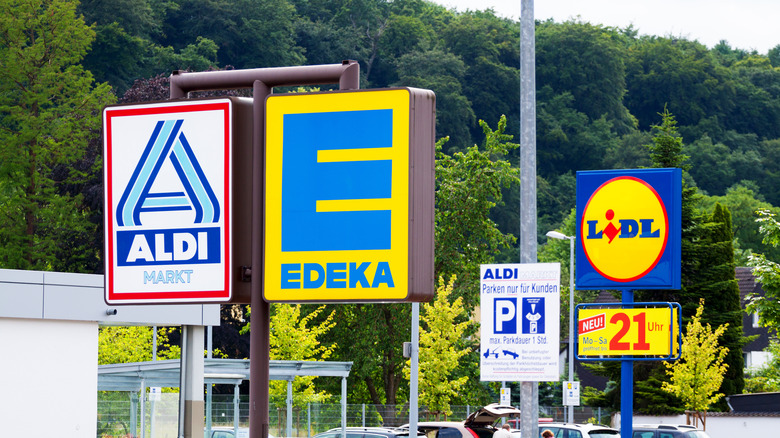
If you've ever thought Aldi and Lidl were somehow connected, you're not alone. Many people actually believe that the two chains are a family-run business. Still, before you get pulled into some kind of Mandela Effect moment, let's clear things up: This info is nothing but a mere myth. In fact, apart from shared discount models, similar names, and German roots, there are some notable differences you need to know before checkout, starting with the fact that these two grocery giants are not related in any way.
To break it all down, it was Aldi that was founded by two brothers, Karl and Theo Albrecht, in 1948. The pair took over their mother's small grocery shop and opened branches in three more locations. Driven by the challenges in post-war Germany, Karl and Theo grew their business into a discount powerhouse aimed at easing daily life for lower-income families. They built a business model focusing on low prices, decent quality, and private-label products. Once the company flourished to about 300 stores in Germany and Austria in the 1960s, its original name, Albrecht Discount (Albrecht Diskont in German), was shortened to the now-popular Aldi.
The business was split into two separate firms in 1966 (called Aldi Nord and Aldi Süd), after the founders argued over whether to sell cigarettes. Just a decade later, Aldi opened its first U.S. store in Iowa. There are currently more than 13,000 Aldi stores worldwide, 2,625 of which are based in the States. Lidl, on the other hand, emerged much later and largely copied the Albrecht brothers' discount model.
Lidl isn't part of the Aldi family
Lidl might have by far the best grocery store bakery that Reddit raves about, but it only appeared on the market in 1973. Its roots, however, trace back to the 1930s, when a man called Josef Schwarz entered the fruit wholesaling business. That business had originally been established by Schwarz's partner, Anton Lidl, but was later rebranded as Lidl & Schwarz KG in order to expand into general food wholesaling.
Years later, in the 1970s, inspired by Aldi's success, Schwarz's son Dieter decided to enter the discount grocery market. Nonetheless, using his own last name was not an option, as "Schwarz Markt" literally translates to "black market" in German, so he quickly ruled it out. Instead, he legally purchased the Lidl name for 1,000 German Marks (now worth about $600) from a retired school teacher named Ludwig Lidl, thus giving the chain its now-familiar characters.
After he took over the business, Dieter opened the first store in Ludwigshafen, located nearly 200 miles from Essen, where the first Aldi shop was launched. That original Lidl location employed not more than three people and stocked around 500 products. Today, Lidl manages more than 12,500 stores around the world. However, unlike its fellow German competitor, it is still relatively unknown to U.S. shoppers, as it runs just 197 stores across the country. Its U.S. debut didn't arrive until 2017, when the discount grocery chain opened its first stores in Virginia, North Carolina, and South Carolina.