

America's First Bottled Bourbon Brand Is Still At Liquor Stores Today
Bourbon is, arguably, one of America's most distinctive products. If you frequent bars at all, there's a good chance you're familiar with at least a few of the brown bottles on the shelves, even if you don't drink bourbon. But there's one bottle that holds the esteemed distinction of being the oldest continuously bottled bourbon in the nation. Sure, it might not be as popular as Maker's Mark or as award-winning as bourbons like Blanton's, but Old Forester holds its own as not just the oldest, but the only bourbon that has been sold uninterrupted by the same company even during Prohibition. And what's even cooler is that you can still spot it in bars and on liquor store shelves today.
Yes, despite the whiskey industry facing difficulties in modern times, Old Forester has literally survived all of its previous ups and downs. First introduced back in the late 1800s, bottles of Old Forester have been churned out from its Kentucky distillery for over 150 years now. Sure, the distillery itself and its products look a little different now than when things first got going, but the next time you spot a bottle of Old Forester, just know that you're looking at a brand that has truly withstood the test of time. But if you really want to impress your fellow bargoers with your trivia knowledge, it's worth brushing up on how Old Forester got started and which of its bourbons today is the closest to the original.
How Old Forester Bourbon got its start
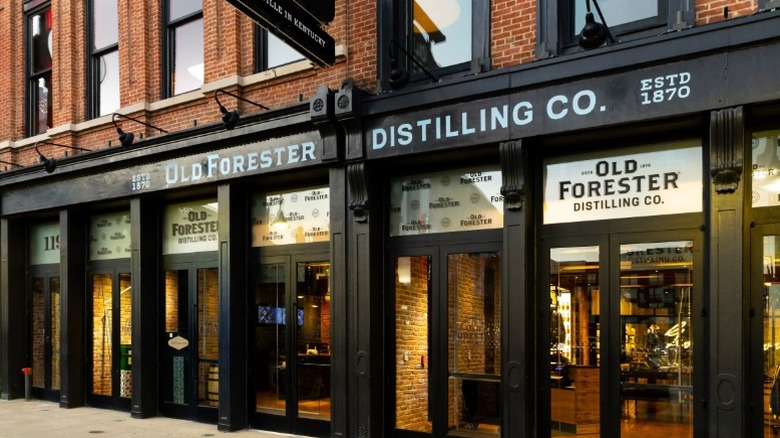
If you visit Louisville, Kentucky's famous Whiskey Row, you'll find Old Forester right in the heart of it with "1870" painted right at the top of the building. That's because George Garvin Brown first produced Old Forester in 1870, after sourcing bourbon barrels from three different distilleries close by (Mattingly, Mellwood, and the now-closed Atherton) and blended it all together. He batched it at 90 proof in glass bottles instead of selling it out of barrels, which was the norm at the time. Brown continued making 90 proof Old Forester bottles until 1897, when the U.S. Bottled in Bond Act prompted him to increase it to 100 proof. For those wondering, Brown named his bourbon after Dr. William Forrester, a Civil War surgeon; according to Whiskey University, Brown dropped the extra "r" for easier marketing.
During Prohibition, Old Forester was one of just six American distillers that successfully obtained a permit to continue making spirits, thanks to labeling its whiskey as medicinal. While the distillery has developed a variety of other whiskeys over the years, the original is still available. To create as close of a taste to the original bourbon as possible, today's Old Forester distillers follow a very similar batching process for their 1870 Original Batch bottles. While they don't source barrels from other distilleries like Brown did, they do still select barrels from three different warehouses and merge them together to create 1870 Original Batch Old Forester.
The different kinds of Old Forester whiskey available today
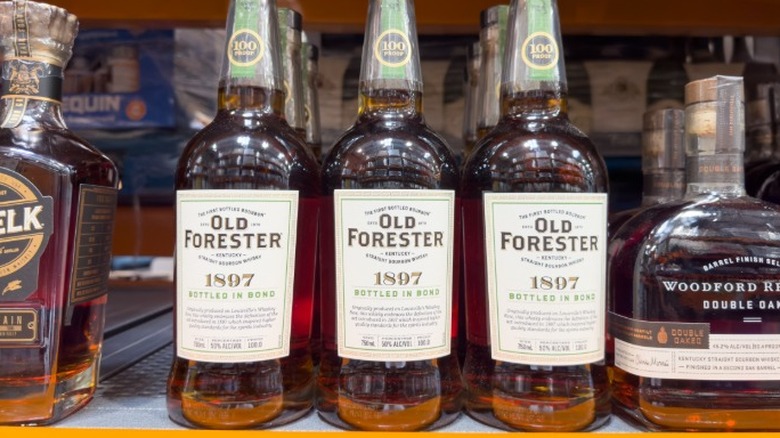
As noted, you'll want to try the 1870 Original Batch Old Forester to taste what America's original bottled bourbon was like. But if you're a fan, you may want to sample some of the other Old Forester whiskeys available today. As of January 2026 there are 17 different whiskeys listed on the Old Forester website, though some may be more difficult to find than others. One of the most prevalent bottles you'll see is the 86 proof Old Forester (not uncommon in cocktail bar wells), which is likely because it's the most affordable one. Still, some would say that this is one bottom shelf whiskey that is definitely worth the buy.
There's also the 100 proof, which is similar to the 1870 Original Batch but does not follow the exact same batching process. Speaking of the 1870, though, there are several different types of Old Forester named after different years — not because they were made in those specific years, but because they nod to certain distilling techniques or flavor profiles of those time periods. For example, the 1910 version undergoes a second barreling for a smoother, cleaner profile that mimics whiskey that resulted from a 1910 fire on Old Forester's bottling line. The distillery also occasionally does special releases in honor of certain events, which can be the toughest-to-get bottles due to their limited quantities.