

Why Alex Guarnaschelli Always Has These 2 Types Of Salt In Her Kitchen

When you think salt, table salt might be the first that comes to mind. However, most chefs would agree that table salt, which is often iodized and has a metallic flavor, has no place in the kitchen. You can stock your pantry with plenty of salts, but Food Network chef Alex Guarnaschelli revealed she only ever has two salt types in her kitchen: kosher salt and sea salt.
Guarnaschelli uses different salts at different times. In a TikTok video, she referred to kosher salt as her "heavy lifting" salt that she uses "when I'm doing cheaper stuff, like seasoning pasta water and I'm going to use a handful." Guarnaschelli's kosher salt is finer than the sea salt she keeps in the house. She uses the latter as a finishing salt or when she needs to season something with a long cook time since the thicker, coarser sea salt flakes hold up better over time than the finer kosher salt (just be aware that, depending on the kind you buy, kosher salt isn't always finer than sea salt).
What's the difference between kosher and sea salt?
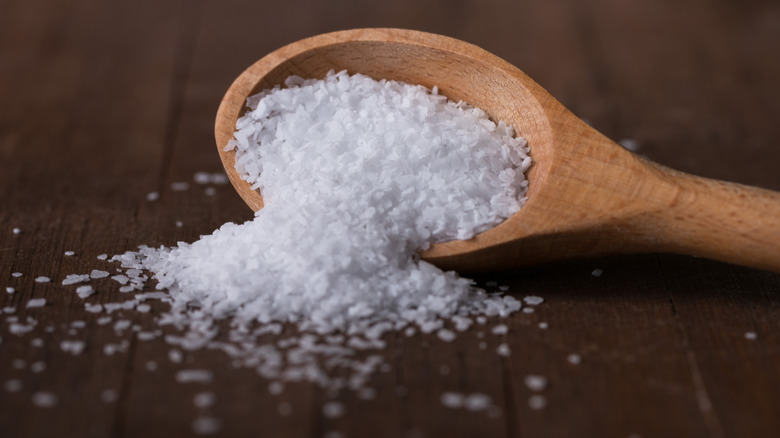
Alex Guarnaschelli uses kosher salt in large quantities and coarse sea salt for long cook times, but is there a true difference between the two? The simple answer is yes. Sea salt, as its name suggests, comes from the sea. It's made when salt water fully evaporates, leaving the crystals behind. It tends to be more expensive than kosher salt due to its mining process, which is why it's not often used in large quantities. Instead, it's usually used as a finishing salt over a dish, such as over meat or chocolate.
Kosher salt can come from rock deposits, which keeps it generally at a lower price tag because it's easier to harvest than sea salt. You've probably seen some popular brands, such as Morton and Diamond Crystal, on store shelves. Kosher salt can be coarse or fine, though it's not as fine as table salt. In general, the flavors of kosher and sea salt are similar, though sea salt is thought to have a flakier texture, which is why some prefer it over kosher. If you're not so familiar with either one, then the noticeable differences are minimal.