

Why Vinegar Is Key To Defrosting Meat In A Pinch

Defrosting meat can take hours, testing your patience. If you're wondering how long it takes to thaw frozen meat in the fridge, the average rate is 24 hours per 5 pounds. And even though you might briefly consider leaving your meat at room temperature on your kitchen's countertop, that's actually the worst way to thaw food. This is because leaving meat out for more than an hour promotes the growth of harmful bacteria, such as Salmonella, Escherichia coli, or Campylobacter. Since these microorganisms multiply fast when temperatures reach 40 to 140 degrees Fahrenheit, a range commonly referred to as the "Danger Zone," the meat can quickly become unsafe to eat. Still, even when you're short on time, there's no need to stress about getting those pork chops defrosted and ready before your guests arrive. There's a very simple thawing method that relies on a common pantry staple: vinegar.
When paired with a pinch of salt, vinegar (which is essentially a diluted acetic acid solution) can significantly speed up defrosting and thaw frozen meat in as little as five minutes. This acidic, salty combination lowers the meat's freezing point, allowing ice crystals to break down much faster than they would in plain cold water. Meanwhile, combining the vinegar-salt solution with warm water (not hot – it's a mistake to thaw meat using the hot water method), slowly raises the meat's temperature without actually kickstarting the cooking process or affecting its texture.
How to use vinegar and salt to thaw frozen meat in minutes
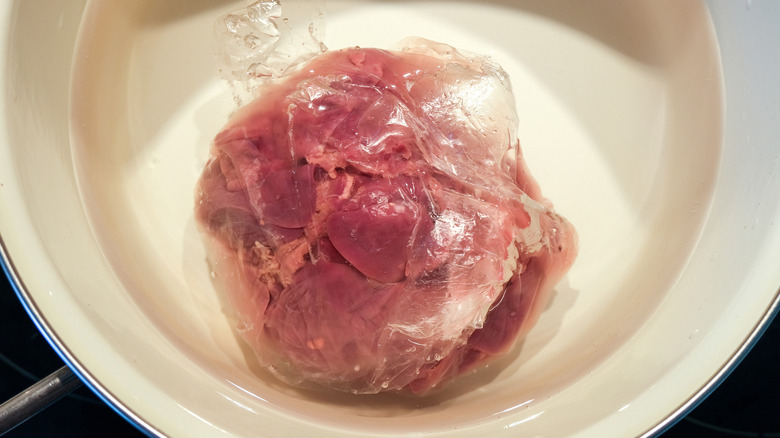
If you're unsure about what to do if you need to thaw frozen steak fast, this easy hack is incredibly effective. The best part about it is it doesn't call for much kitchen equipment aside from a plastic bag and simple bowl. That said, once you have your bowl ready on the counter, the first thing you need to do is to fill it with warm water. Then add some vinegar (either apple cider or white) and a bit of salt. Stir the mixture well until the salt dissolves in the water.
When that's done, remove your meat from the freezer and place it in a tightly sealed plastic bag before soaking it in the solution. This prevents it from coming into contact with the mix's ingredients. If the meat is store-packaged and airtight, feel free to submerge it in the water bath as is. In addition, make sure to move the meat around in the water to help distribute the warmth evenly, and don't hesitate to flip it a few times if needed. After about five minutes, take the bag out of the bowl and put it on a dry surface. The meat should be completely defrosted, although don't forget thicker cuts may need a little extra time to fully thaw. With defrosting out of the way, all that's left to do is prepare the meat however you'd like, cook it, and dig in.