

We Finally Learned The Lore Behind The 'Aldi' Name
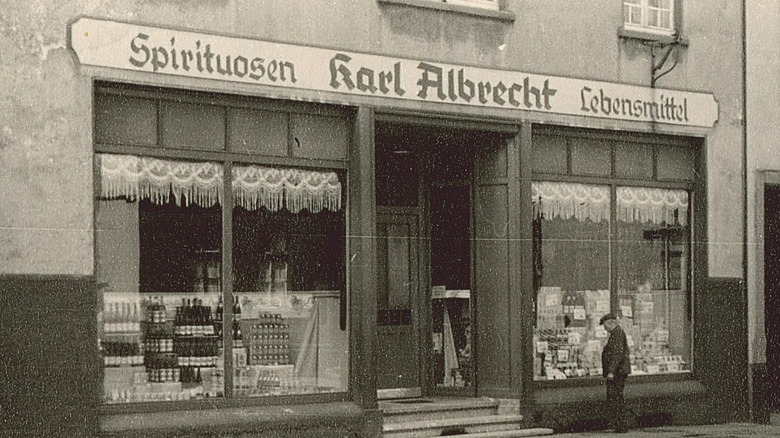
We always assumed that the Aldi name was a German word the chain didn't bother to translate when it arrived in the U.S. — turns out, we were wrong. The German discount grocery chain's moniker is a shortened version of Albrecht Discount (or Albrecht Diskont, in German). That was the store's original name when it was opened by Anna Albrecht in Essen, Germany, in 1913. Grab your bags and your quarter (don't worry, you don't actually have to pay for a cart), and let's take a look at everything you need to know about how Aldi got started.
The Albrecht family truly built the store from the ground up, initially opening in a low-income neighborhood in Germany in 1913. While the shop served local, budget-conscious shoppers from the start, Aldi's modern discount identity truly took shape after World War II. Anna Albrecht's sons Karl (born in 1920) and Theo (born in 1922) fully took over the store in 1948. They added three new stores, and in 1954, the brothers created the first self-service grocery store in Germany. But after a disagreement over whether to sell cigarettes in 1960, Karl and Theo split the chain: Theo ran Aldi Nord (which would eventually become Trader Joe's) in northern Germany and other European markets, while Karl ran Aldi Süd in southern Germany and the U.S. Even as separate businesses, they agreed to continue operating under the same name. Then in 1962, the brothers officially shortened the name to Aldi, and by the late 1960s, the chain had grown to over 200 locations.
How Aldi grew into the global discount grocery giant it is today

Today, Aldi employs more than 200,000 people and operates more than 12,000 discount grocery stores around the world. To focus on its customers, Aldi runs on a fairly simple business model: It skips big advertising budgets and fancy displays, and pays close attention to what sells, stocking only the items it knows will be hits. While Aldi stores today sell perishable items and fresh produce, the chain's early stores run by Theo and Karl sold only nonperishables — a move that helped cut waste, maximize profits, and lay the groundwork for the simple, efficient business model Aldi still follows today.
If you're outside of the U.S., you're in luck — you can shop Aldi's aisle of dreams (or shame, depending on who you ask) in ten different countries. Thanks to its focus on efficiency and stocking only what sells, the chain grew quickly across Germany and beyond. It went international in 1967, opening a chain in Austria, followed by an expansion into the Netherlands six years later. Aldi arrived in the United States in 1976, opening its first store in Iowa. Today, Aldi is the second-largest supermarket chain in the United States, with more than 2,500 stores, and has announced big plans for further expansion in the coming years.