

An Outsider's Look Into America's Enduring Obsession With Ranch
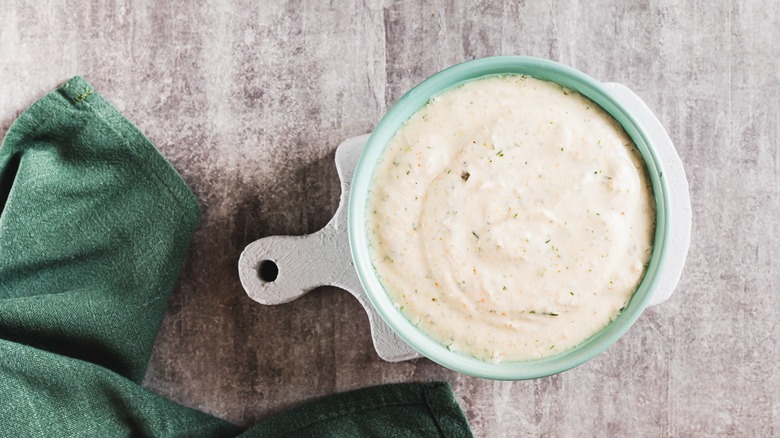
The first time I really clocked America's obsession with ranch was during my time in the States this year, but it was gradual realisation rather than a sudden moment. I first noticed it when I was handed ranch with my fries without asking for it when eating out. I wasn't given ketchup or mayo (or even a choice), just ranch. And then I got it on a sandwich, then on a salad, and then suddenly ranch felt less like an option and more like a constant presence. As a British person, it surprised me, because back home ranch doesn't really exist as a condiment in its own right. You'll sometimes spot a bottle among the dressings or perhaps in the "American" section of a big supermarket, but it's seen as a novelty rather than something people really use day to day.
But over in the U.S., ranch isn't a dressing you opt into, in many ways it's the default. There are so many brands of store-bought ranch lining grocery store shelves that the American condiment aisle alone shows how embedded the dressing is in everyday eating. And this isn't just volume we're talking about; there is a deep emotional attachment too. Americans talk about ranch in kind of the same way Brits talk about gravy: with loyalty and strong opinions. Some people swear by the bottled versions while others insist on homemade ranch, and the fact that both approaches exist is part of what makes ranch feel like a real American infrastructure. After all, per a 2017 study conducted by the Association for Dressings and Sauces, almost half of Americans say ranch is their favorite dressing (via The New York Times).
Why ranch never really landed in the U.K. (and why I wish it would)
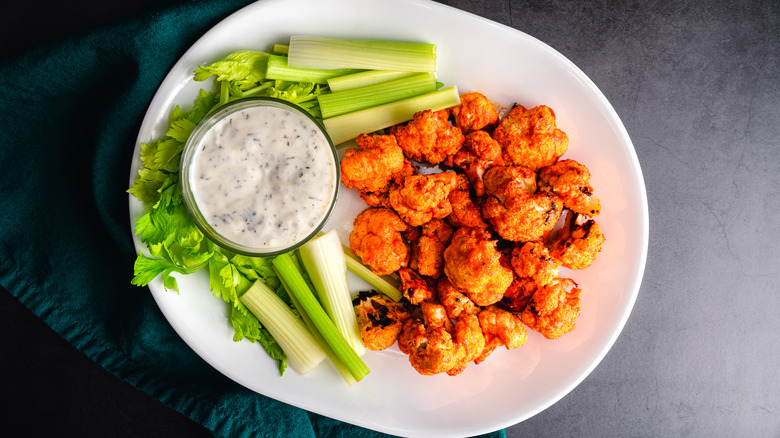
Once you start really paying attention to how ranch is perceived in the U.S., it becomes a little clearer why it hasn't quite landed for us Brits. British condiments, generally speaking, tend to have much more fixed roles. Ketchup for chips, mayo for sandwiches, mint sauce for a roast, and brown sauce for a fry up or a bacon roll (and salad cream I think is only still around thanks to pure nostalgia). These condiments are familiar, they're British, but they're also boxed in.
The differences between ranch, salad cream, and mayo, for example, actually really matters in this discussion. Ranch isn't neutral in the way mayo and salad cream are, it's herby, tangy, savory, and undeniably "ranch." And that is quite incredible given the wide variety of dishes Americans will slather it on. After spending time eating in the States, I now find myself craving ranch in a very practical way. It's a sauce that fills a gap we don't really acknowledge exists in the U.K. — something more flavorsome than mayo, less aggressive than mustard, and more versatile than ketchup. Sadly, I don't know if ranch will ever become truly mainstream across the pond; the Brits have tastebuds that shift slowly and food loyalties that run deep. But once you understand how ranch actually works — not as a gimmick, but as an everyday tool — it's difficult not to wonder why it never earned a proper place here. Maybe I'll start the British Ranch Revolution myself.