

Why Hotel Silver Is The Rare Thrift Find Everyone Wants To Get Their Hands On
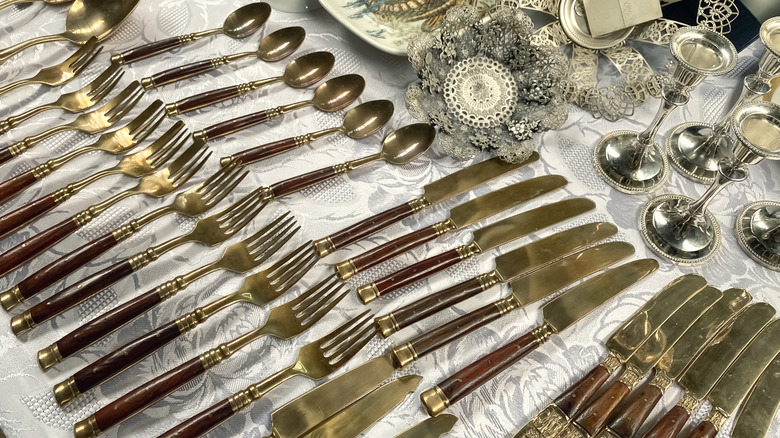
Some thrift store finds can trigger a dopamine burst, whether old or new. Secondhand vintage Pyrex always seems like a score, particularly now that many pieces have multiplied in value. Gold-lined glassware is also an obvious treasure at the resale shop. The fact that both of these items share expensive connotations is not a coincidence. More everyday tools like forks, knives, and serving trays might not seem as exciting, but they obviously become more attractive (perhaps literally and figuratively) when they're made of a precious metal like silver. Stamp it with some iconic hotel brand, and it's even more appealing.
In a truly romantic scenario, you'd find said silver items sourced from some grand locale where you made precious memories. Maybe a whole cutlery set reminiscent of a long-ago honeymoon at Miami's Fontainebleau, or an ashtray from NYC's Waldorf Astoria, where a probate twist made you rich. And even outside of these precise events, travel souvenirs just always feel uniquely enchanting. Even if it's just a single teaspoon, you might find yourself clinking it around a cup, wondering what glamorous figure from the past might have done the same. It's just a lot more interesting than some ostensibly shiny thing repackaged from a big box store of more recent manufacturing.
Spotting hotel silver in the wild
Real silver might literally be marked with its metal percentage, and obviously anything approaching 100% is pretty decent. But those old impressions can fade and become obscured over time. Silver is also famously not magnetic, so if it sticks to the refrigerator variety, you're probably dealing with some other material. Neither of these methods are foolproof, of course; the former could be counterfeit and the latter could be silverplated.
Any purported provenance should be marked, engraved, or otherwise etched in some fashion that actually signals its origin. You probably wouldn't have noticed it as anything special, if it isn't. Some combination of the appearance of real silver, plus an indicator of its genesis, should be enough to make you leap to the register, provided it's also tagged with a thrift-appropriate price. You should consult with an expert on anything that's even approaching expensive, lest you find yourself buttering your toast with a spendy piece of stainless steel that's never seen a room service cart in its life. You can make your old silver look good as new by soaking it in a mix of baking soda and vinegar.