

Why Your Homemade Eggnog Curdled (And How To Prevent It From Happening Again)
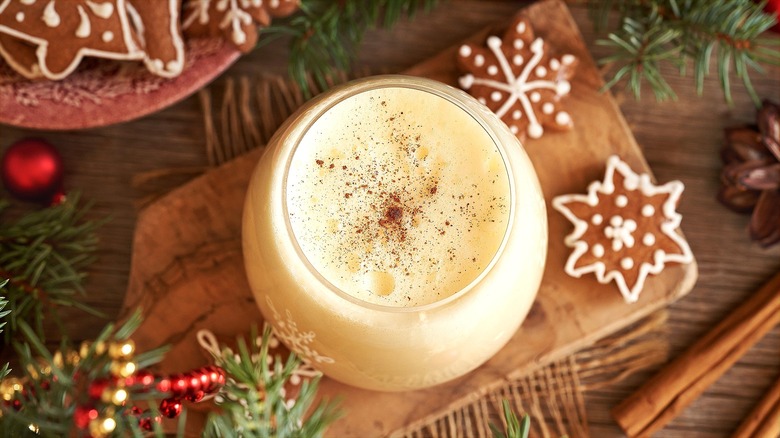
As the holiday season approaches, you may be ready to give up all the good and bad store-bought eggnog brands to perfect your own recipe at home. However, incidents past may be preventing you from fully taking the plunge, especially if last year's batches curdled during preparation. Thankfully, though, you can prevent future mishaps by monitoring the temperature of your ingredients more carefully.
More than likely, your definitive eggnog recipe previously failed because of a minor mistake made during the tempering process. In this regard, tempering is the process of gradually warming raw eggs without overcooking or scrambling them.
As you know, eggnog is made by first whisking raw egg yolks with sugar, heating a base mixture of milk, cream, and spices over your stove, and then slowly combining the raw egg yolks and hot milk. Yet, if you introduce raw egg yolks to warm milk too fast, or if the temperature of your ingredients is too hot or cold when combining, this may cause your nog to curdle.
In order to prevent this from happening, first make sure your milk mixture doesn't exceed 170 degrees Fahrenheit before tempering your egg yolks and sugar. Then, when the time comes, gradually add a few spoonfuls of the hot milk mixture to your egg yolks as you whisk continuously. While carefully tempering your eggs is a step in the right direction, there are even more ways to prevent curdled eggnog in the future.
More useful ways to ensure perfectly creamy eggnog this holiday season
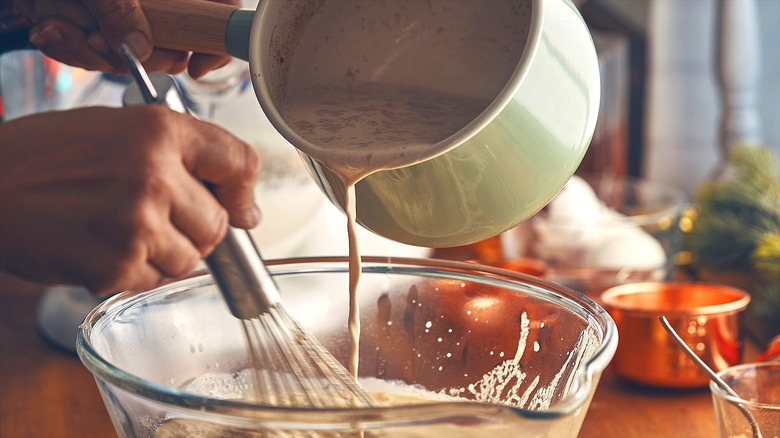
Once you've successfully completed the tempering process, heat and stir your eggnog over the stove until it's about 160 degrees Fahrenheit. So your eggnog doesn't overcook, use a digital thermometer for better accuracy. If, by chance, you do see a few small curds along the way, this can be mitigated by straining your eggnog after heating.
Apart from keeping the temperature of your eggnog stable, you can also keep your nog curd-free by waiting to add extra ingredients until after cooking. While the best alcohol to put in your holiday eggnog includes brandy, whisky, and rum, incorporating these spirits at the right time guarantees a smooth and ultra-silky beverage. Since alcohol is quite acidic, adding it to your milk mixture during the heating process can disrupt the pH of your milk and cause certain proteins to coagulate. That being said, if you do plan on spiking your eggnog, make sure to use full-fat milk and real cream. Low-fat milk products tend to have more casein proteins, which can increase the chances of coagulation.
To guarantee your spiked nog has little to no separation, add your alcohol of choice toward the end of the cooking process. Do this once your eggnog has cooled and the vanilla extract has been incorporated. Or, add individual amounts of alcohol to each glass before serving. With all these anti-curdling tips, your eggnog is almost guaranteed to turn out as it should.