

'80s Parents Begged Their Kids Not To Drink This One Soda, And We Can See Why
We may receive a commission on purchases made from links.
Families have long enjoyed soda, and Southerners like to pair cola with Moon Pies. It's also no secret cola giants like PepsiCo and Coca-Cola target kids in its marketing, which has caused parents to attempt limiting their children's consumption of sugary drinks. This was an issue even in the 1980s when it was found Jolt Cola had controversial sugar and caffeine levels. Over time, Jolt faced ups and downs, even rebranding to overcome its obstacles to remain marketable. Following its discontinuation, the resilient energy drink later found a partner in the health and fitness industry, helping it make another comeback in 2024.
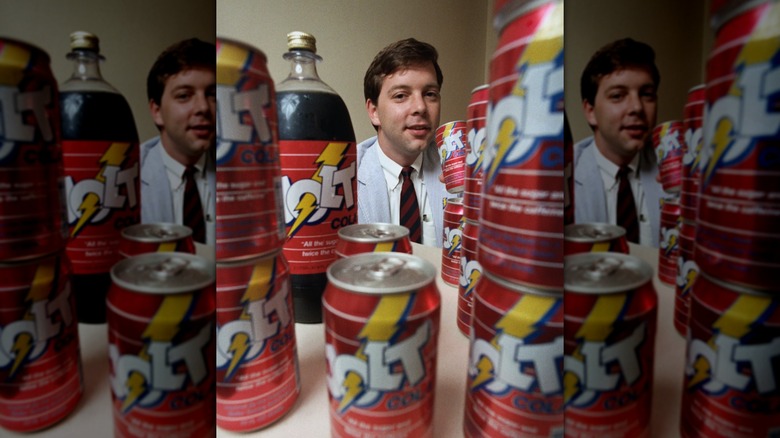
Jolt Cola was created in 1985 by Joseph and C.J. Rapp, inspired because major soda players were reformulating products to have fewer calories and artificial sweeteners (notably, one was New Coke, which failed spectacularly). This caused Jolt to market itself from the opposite end and claimed to contain "all the sugar and twice the caffeine." Since nutritional labels didn't appear until 1994, it's difficult to confirm how much sugar an average soda had in the '80s. However, Jolt contained 70 milligrams of caffeine per 12 ounces of cola, causing some controversy upon its debut (that's more than twice the amount of today's average 8-ounce soda). At the time, concerned parents banned their children from consuming it; publications like New York Magazine criticized it as a "worst bet," and experts claimed its excessive sugar and caffeine put kids' health at risk.
Following two failed returns, Jolt attempts another comeback
By 2006, Jolt made the fitting transition into the energy drink industry, rebranding itself as Jolt Energy. It was offered in three sizes: 8.4, 16, and 23.5 ounces, the latter of which was designed to resemble a battery, with a resealable top that helped preserve its carbonation. Jolt's flavors included original, cherry, lemon-lime, blue raspberry, and one with zero carbs and calories. By 2009, Jolt Energy declared bankruptcy due to the recession, leaving it unable to pay its bottle manufacturer, Rexam, for 90 million resealable battery cans. Jolt disappeared in 2011 and reappeared in 2017, when it briefly returned under its original Jolt Cola branding and sold at Dollar General. However, Jolt vanished again by 2019.
Now, Jolt has reemerged yet again as an energy drink, partnering with Redcon1 — an award-winning supplement company that produces a high-protein item found at Dollar Tree: MRE Protein Shakes. Available on Amazon, Jolt now comes in cola and root beer flavors and is packaged in 16-ounce cans. While Jolt is currently sugar-free, fans of the beverage may be interested to know about its 200 milligrams of caffeine, up from the alleged 189.2 milligrams in its previous largest battery can. Considering Redcon1 already has a successful reputation in the energy and fitness market, time will tell if Jolt's latest return will be sustainable in the already crowded energy drink market. In any case, it's certainly exciting for Jolt fans to know the beloved beverage is still accessible and continues to endure.