

2 Simple Tricks To Fix Broken Hollandaise Sauce
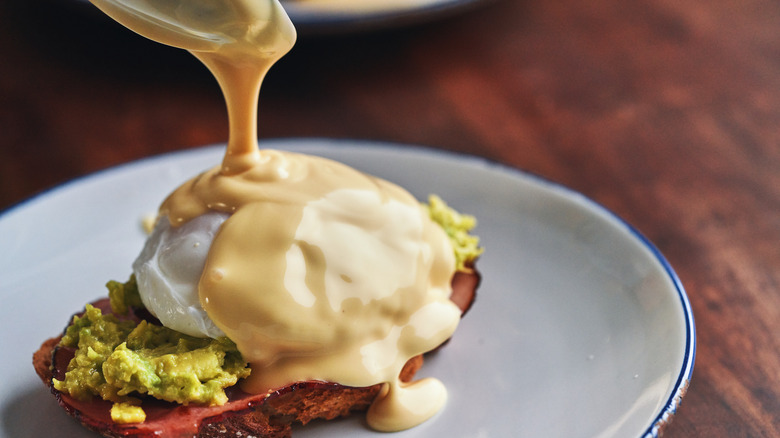
Whether smothering eggs Benedict or drizzled over seasonal vegetables, hollandaise — a French mother sauce made with butter, egg yolks, lemon juice, and pepper — is easy to love, coating each bite in creamy, citrusy goodness. However, it's also tough to get right — especially because it can congeal if it cools too much and split or break (and even curdle) if it's too hot. While it can be tricky to achieve the perfect consistency, luckily, if you miss the mark, Russian Tea Room head chef Carlos Zhagui has not just one, but two suggestions for how to recover broken hollandaise.
He says to first determine whether too much heat or a lack of it is the culprit, based on whether it's thin and separated, or overly thick. Then you can choose the right path to fix it. Hollandaise is an emulsion sauce of fat (butter) and water (via the lemon juice), and breaking is often caused by over-evaporation. So, adding water can help smooth everything out again, no matter which temperature issue you're facing. "If the sauce is damaged because it was too hot, you can add an ice cube and whisk until the sauce comes back together," Zhagui told Chowhound exclusively. And if it's too cold? "Gradually whisking in a tablespoon of hot water will help re-emulsify the sauce," he said. The temperature adjustment, the added liquid, and the motion of the whisk all work together to re-emulsify your hollandaise.
Other expert tips for the perfect hollandaise
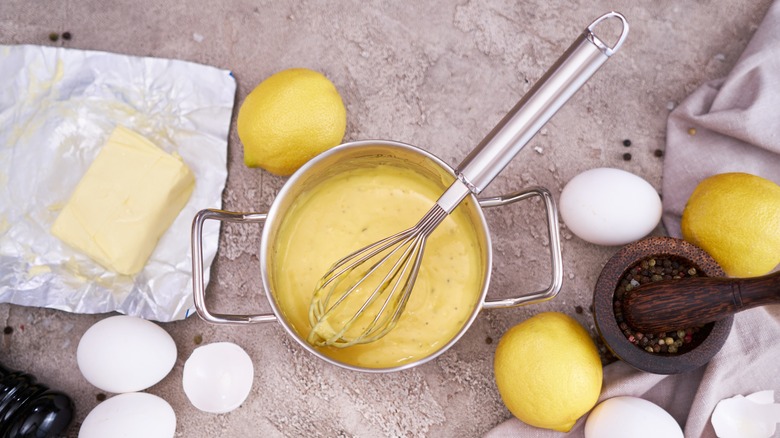
If you've ever tried fruitlessly to cook the perfect scrambled eggs, you know they can be temperamental to changes in heat. So, how can home chefs find that stovetop temperature sweet spot? After all, even if a broken sauce is fixable, it's always preferable to avoid fixes entirely. Carlos Zhagui says that the key to success lies in the double boiler, a set of vertically stackable saucepans. When you use a double-boiler (also known as a bain-marie) to make hollandaise, the bottom saucepan is filled with water, while the top holds your sauce, making the transfer of heat from your stovetop, which happens via steam, gentler and more evenly distributed. But it's still important to keep an eye on the lower pan's temperature. "Make sure that the water is always hot, but not at a rolling boil in the bain-marie," Zhagui stresses.
And water isn't the only ingredient whose temperature matters. Zhagui also recommends letting your eggs come to room temperature before cooking. Once your hollandaise is prepared, you should also keep the bain-marie water warm while you spoon it onto your plate to make sure it doesn't stiffen before you're done serving all of your guests. If it's your first time making the iconic sauce and you want something tried-and-true, super buttery eggs Benedict is classic for a reason. Beyond eggs, you can use your expertly emulsified hollandaise to serve your hollandaise with more unexpected dishes, from artichokes to lobster, and more.