

Rhubarb Cake Always Soggy? Here's The Mistake You're Probably Making (And How To Fix It)
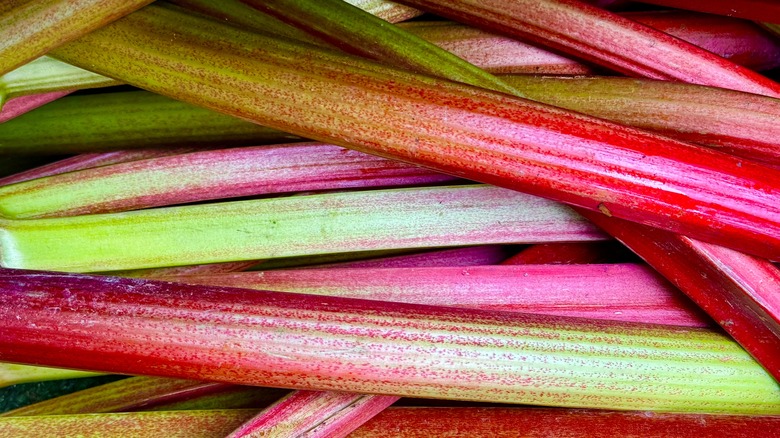
Rhubarb is a quirky ingredient. These vibrant, pinkish-red stalks are most often used in sweet preparation, like jams, pies, and cakes. Its taste is tart and somewhat sharp, but becomes pleasant with the addition of sugar. Precisely because it is normally used in desserts, it is legally classified as a fruit for tax purposes in the United States, but scientifically, it is actually a vegetable. A quick note for those unfamiliar, you should not eat the leaves, which contain high levels of oxalic acid and can make you quite sick. Handling rhubarb takes a bit of a deft hand, as the biggest mistake home bakers often make — particularly in cakes — is not treating it prior to incorporating it in the batter. To understand how to best handle these crunchy when raw stalks, Chowhound spoke with Edmund McCormick, food science consultant at Cape Crystal Brands.
As an expert in chemistry, ingredient functionality, and baking science, McCormick is intimately familiar with how various ingredients react during the baking process. He exclusively shares, "Rhubarb is very high in water — over 90% — and this water quickly releases when heat is added to it. When the dough isn't formulated to take this moisture, or if it is added to large amounts of raw rhubarb, the dough becomes waterlogged and produces a dense or chewy texture." McCormick also added that "underbaking makes this condition worse, because now, the center never gets any time to reach its solid state and firm up."
How to use rhubarb effectively in baking
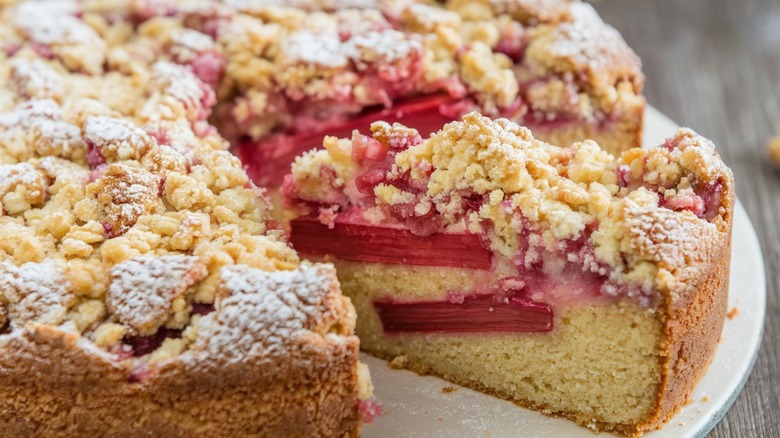
Edmund McCormick enumerates two very trustworthy methods for combatting excess rhubarb cake moisture. The first is macerating, where "sliced rhubarb is tossed with sugar and allowed to stand for 10 to 15 minutes," says McCormick. "The excess liquid is drawn out by the sugar and can be poured out." Without getting too technical about it, the simple act of mixing the pieces of raw rhubarb with sugar enables the abundance of water within the stalks to leech out through its cell wall in a process called osmosis.
Alternately, McCormick offers that you can try roasting. "A quick roast will remove moisture and intensify flavors," he says. "It is also important to blot away any moisture from the rhubarb after using any of these techniques to improve the texture in the final cake."
Once your rhubarb has been properly prepped, McCormick offers up three additional tidbits for rhubarb dessert success. These include adding a small amount of extra flour or cornstarch to firm up the mixture, not using too much rhubarb, and making sure the ingredients are at room temperature so everything is evenly distributed. If all else fails, he adds that you can increase the bake time at the end. Or, "if it is completely baked but is still soggy, you can slice it into pieces and toast it to give it a firmer texture," McCormick says. "Some bakers also use this wet rhubarb cake to make a parfait out of it, which perfectly conceals all its wetness."