

Science Explains Why Milk And Cookies Are A Match Made In Flavor Heaven
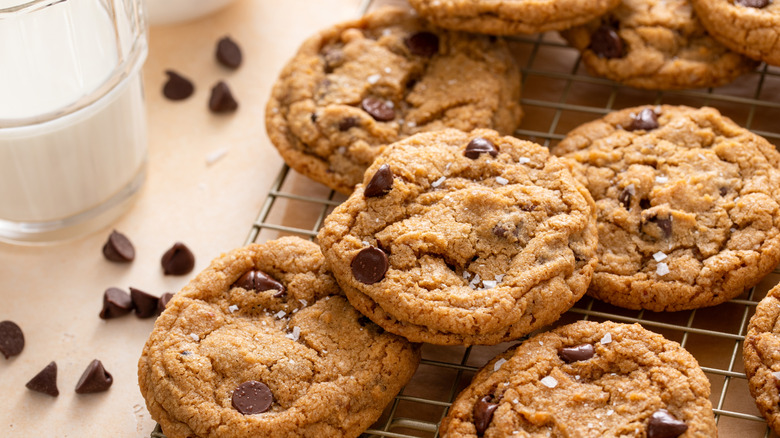
Whether enjoyed right after a satisfying, delicious lunch or as a late-night treat before bedtime, cookies are the ultimate comfort food that almost everyone has a soft spot for. Even Santa can't resist a few of them on Christmas Eve. Pair cookies with a cold glass of milk, and it's a match made in heaven.
Milk contains emulsifiers, such as phospholipids, and proteins, such as casein and whey. These natural substances not only prevent fat and water molecules from separating by binding them together, but also help dissolve and remove fat-soluble compounds that can often linger in the mouth. This makes milk an effective palate cleanser. You might have noticed how easily it sweeps chocolate, salted caramel, or fruit jam right off your palate. And considering how it is made up of about 87% water, it also naturally works as a thirst quencher.
The secret to a softer chocolate chip cookie might be a simple flour swap, but milk's complex composition (it's essentially made of protein, fat, lactose, enzymes, and water) also affects a cookie's texture. You've probably noticed that when you dip a warm cookie into milk, it immediately starts soaking into the dough. When this happens, the emulsifiers present in the milk start reacting with the cookie's butter and sugars. This ultimately softens the cookie's texture, making it more enjoyable, and smooths out its dryness and the sharp crunch.
Why dipping cookies into milk is so nostalgic

Dipping biscuits in tea, among other food and drink combinations, has been around for ages, but the art of dipping cookies into milk wasn't perfected until the 20th century. When refrigerators became a kitchen staple in the U.S., people quickly discovered that cold milk kept at 40 degrees Fahrenheit or below balances the sweetness of freshly baked, extra-chewy chocolate chip cookies far better than coffee or tea.
In addition, milk makes a cookie's flavor and aroma stronger than when you eat it plain. The reason for this is that the emulsifiers hold onto the cookie's flavor until the volatile compounds — the aromas that make cookies so hard to resist — reach your olfactory receptors. Certain smells and flavors can also trigger emotional responses, and for many people, milk and cookies bring back fond childhood memories.
With that said, you can make new memories by switching up the type of cookies and milk you use. For instance, you can try dipping oatmeal cookies in oat milk, and white chocolate chip cookies might pair even better with macadamia nut milk than you'd expect. And if you've just baked a fresh batch of gingersnap cookies, the easiest cookies to bake for beginners, a glass of coconut milk might just take them to a whole new level.