

The World War II Soft Drink That Coca-Cola Doesn't Talk About
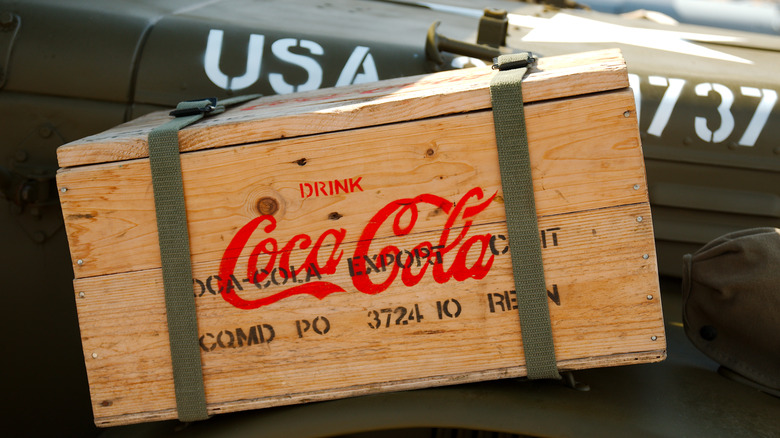
When a company like Coca-Cola has existed for well over a century, there are bound to be many notable events throughout its history. Whether they're mishaps, like the spectacular failure that was New Coke or the time Coke attempted to create a soda that oddly targeted Gen Xers, or feats, like the fact that Coca-Cola was the world's most popular soft drink in 2025, there have been plenty of memorable moments. Of course, in that same vein, certain facts have gone overlooked, particularly when it comes to Fanta, one of Coca-Cola's subsidiaries. As it turns out, the carbonated fruit-flavored beverage's origins are tied to World War II and Nazi Germany. With it being among the most prominent controversies in soda history, Fanta's chapter in Coca-Cola's story deserves discussion.
The history behind Fanta's birth is complex, so it's simplest to focus on the key moments that led to it. During World War II, after Coca-Cola had established itself as a global brand, the United States imposed a total trade embargo on Nazi Germany following the attack on Pearl Harbor through the 1917 Trading with the Enemy Act. Among other things, the Trading with the Enemy Act blocked exports like Coke's formulated syrup base. As this meant that the American-based company would have to pause the soda's production, Max Keith, then head of Coca-Cola's German operations, acted swiftly to keep the factory operational. Using what was available in Germany, Keith had his team create a new soda made from whey, a byproduct of cheese, apple fibers, and whatever seasonal fruits were obtainable. The resulting beverage, which appeared similar in color to ginger ale, marked Fanta's initial phase.
Fanta's controversy lies in Coke's indifference toward Nazi Germany
Although Coca-Cola had ceased exporting products from the United States to Germany during the war, Max Keith did what he needed to keep his end of the business profitable. Keith's alleged connections within the Third Reich allowed him to maintain control over Coca-Cola GmbH, the company's German branch, and avoid certain measures like sugar rationing. This allowed for Fanta's appealingly sweet flavor, helping the drink became popular in Germany, not only as a beverage but also as a cooking additive. It's worth noting that while Keith never officially joined the Nazi Party, he found ways to appeal to its cause and leader, such as by providing rationed Coca-Cola to its military and even adopting a mustache similar to Adolf Hitler's. This was in addition to Coca-Cola GmbH honoring Hitler's 50th birthday with a mass Sieg Heil salute at a party.
What's interesting is Coca-Cola's indifference toward its associated business practices with the Nazi Party during this time, even attempting to disregard them to this day. Perhaps this was simply a moment when a company trusted an employee to maintain its operations during the war. However, Coca-Cola is aware of the controversy at some level, having pulled and issued an apology for a German Fanta commercial in 2015. Most notably, the Fanta ad referred to its early days in the 1940s as the "good old times" (via CBS News). In an apology, a Coca-Cola spokesperson said the ad "was meant to evoke a sense of childhood," and that "the brand had no association with Hitler or the Nazi Party" (via the Daily Express).
Fanta evolved into an international sensation
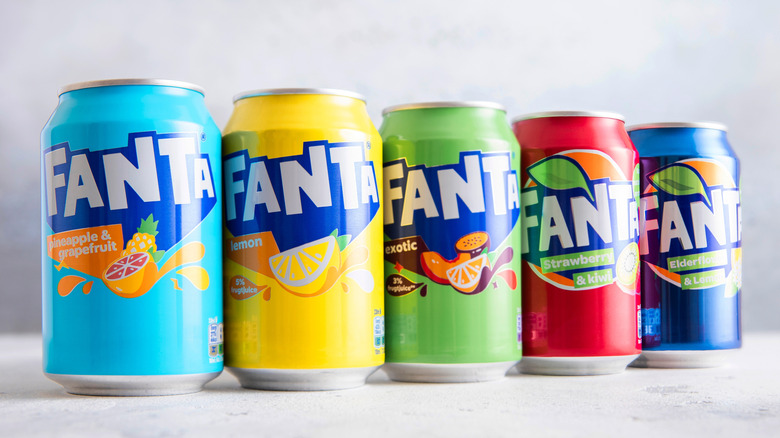
Max Keith's loyalty to Coca-Cola was solidified after World War II when the company regained control of its German operations and continued Fanta's production until 1949. The reasons behind it being discontinued are unknown, but Coke did reintroduce Fanta in 1955 when PepsiCo released several new flavored beverages to the masses. Today, Fanta has moved on from its original taste, which is said to have varied greatly but was mostly apple-centric, to Fanta Orange, which is considered the modern flagship flavor.
Following its return to market in 1955, Fanta gained international fame around the world, prompting the brand to create a variety of regional flavors. Although it's not stated, it's interesting how many are representative of the countries each hails from, as if paying homage to Keith cobbling together Germany's resources. For instance, Fanta Orange was created in Italy where the fruit is a major natural resource. While this may not be the same for all of Fanta's regional flavors, others are representative of the areas where they are often found, either by their ingredients' production or popularity. For example, Fanta Guarana in Brazil features guarana seeds, a beloved energizing ingredient that's primarily sourced in the Amazon; Yogurt Rush Melon Mix originated in Japan where both of its inspirational flavors, melon and pineapple, are widely popular; and Fanta Shokata infuses the original Orange flavor with Romanian socata, an infusion of lemon and elderflower that's popular in Eastern Europe.