

What You Should Know Before Installing Dark Kitchen Countertops
Replacing the countertops in your kitchen is a huge, complex process. It's also an opportunity to infuse your space with some fresh style and personality, whether you're remodeling the kitchen in your new home or replacing the counters in a home you've loved for decades. Of course, since this is a fairly intrusive and expensive upgrade, it's important to consider all the pros and cons of your first choice — especially if it happens to be dark-colored or black countertops.
Some believe choosing dark countertops is one of the worst kitchen design choices you can make, but this really depends on the rest of your space and how you actually use your kitchen. Dark countertops have a lot of pros, from giving your kitchen a sophisticated, dramatic, modern feel to easily hiding stains, scuffs, and scratches. This means your kitchen looks tidy and spotless for longer between cleanings, an advantage if you have little ones who love to "help" make dinner by banging spoons on the counter.
Of course, hiding spills and stains can also be a disadvantage. An accidentally neglected puddle of apple juice can dry into a sticky mess that attracts ants, which are often hard to spot against a dark counter. Dark counters can also make your space feel heavy or unbalanced, particularly if you fall prey to the biggest mistake you can make with kitchen cabinets by choosing based on trends rather than what balances out your countertops.
Effortlessly blending black countertops into any space
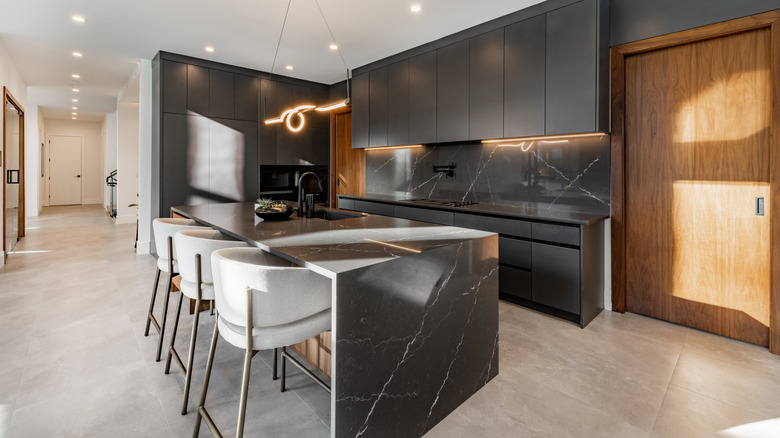
The key to adding black or other dark countertops to any kitchen is understanding how to blend them into your decor. For instance, if you're renovating a relatively small kitchen, choosing lighter colored cabinets helps the space feel cozy and comfortable rather than cramped and depressing. Same goes for the backsplash. A light-colored tile with a dark design helps tie the contrasting surfaces together without making the space under your cabinets look like a boundless void. Bringing in brushed metallics also helps brighten darker countertops by reflecting ambient light.
This advice aligns nicely with some of Martha Stewart's best tips for designing your kitchen since she suggests choosing a color scheme that works for you. Just as lighter colors are the general preference for small kitchens, darker colors and high contrast can help larger spaces feel cozier and less cavernous. This is often accomplished by creating more shadows around the edges of the kitchen and breaking up long swaths of wall with different colors and textures. Pairing charcoal gray countertops with cobalt blue cabinets, for instance, creates dramatic visual interest that distracts from how large the space actually is.
Most spaces also look great with a two-tone color scheme between counters and cabinets. For instance, deep malachite green countertops would look beautiful with pale, celery green cabinets. Meanwhile, ivory shaker cabinets might match perfectly with dark brown marble countertops. Add touches of these colors to your wall treatments and decor to keep the space cohesively beautiful.