

The Cultural Dining Cue That Americans Often Miss When Eating In China
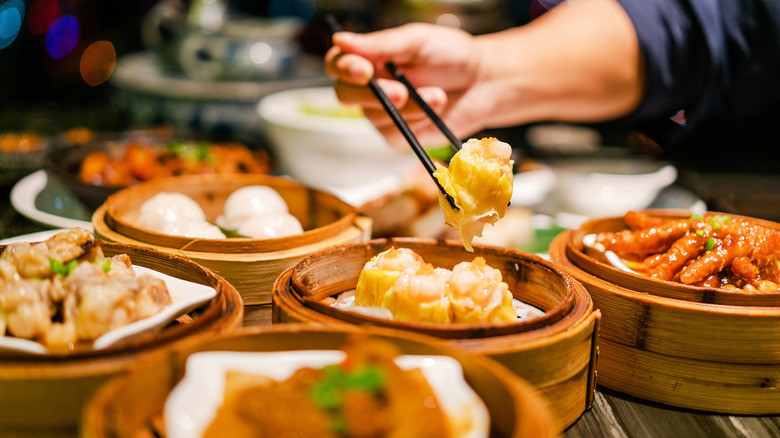
Traveling is exciting, especially when it involves exploring cuisine of an unfamiliar culture. But the experience isn't just about discovering new ingredients and new flavors — it's also about learning new cultural dining etiquette. While nobody wants to commit a faux pas, it's easy to make a misstep when you don't know the rules.
If you're heading to China, it's worth brushing up on the country's dining dos and don'ts so you're prepared for the incredible meals you're going to enjoy there. Peter He, former executive chef of the Michelin-starred Café China and executive chef at two New York City restaurants, Chili in Midtown and Meili in Williamsburg, spoke to Chowhound about the biggest cue Americans miss when sitting down to a meal in China.
According to He, many Americans don't wait for the host or elder members of their dining party to begin eating. "In China, meals are as much about respect and harmony as they are about flavors," He explained. "Whether you're at a family dinner or a banquet, no one picks up their chopsticks until the host signals the start of the meal." It's customary for the host or elders to either invite the rest of the group to start eating or simply start eating, communicating a nonverbal cue that everyone is welcome to dig in.
Dining habits are often rooted in culture
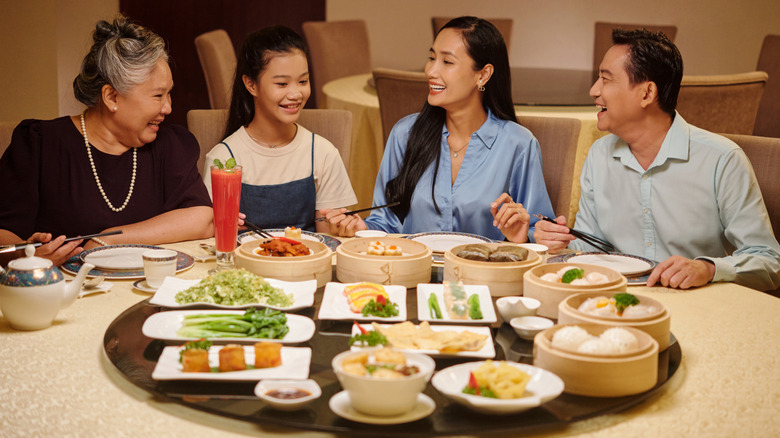
Dining habits vary greatly by culture. In countries like Greece and Spain, meals are unrushed social experiences where food and company is savored. While dining in an Ethiopian restaurant, whether in Adis Ababa or America, it is standard to use spongy bread (known as injera, which is different than bread and wraps) in place of a fork, eat with your right hand, and let someone else feed you, if they desire — it is actually a symbol of friendship. Understanding the culture of a country often helps in appreciating the culinary traditions of that country. Such is the case with eating in China, where showing respect, particularly for elders, is deeply rooted in society and dates all the way back to the teachings of Confucianism.
In Chinese culture, it is important to observe the virtue of patience and honor when dining in a group as a means of showing respect for elders, as well as for the host. In his New York eateries, Peter He frequently sees diners dig in as soon as the food is delivered. "But in China," he noted, "meals are a choreography of cues, hierarchy, and courtesy. Waiting for the host to start shows respect, and it also sets the tone for the whole table and how the meal unfolds."
If you've flubbed your dining etiquette, all hope is not lost

It's wise to teach yourself the rules of fine dining etiquette, but they aren't exactly universal. What is considered proper etiquette in one country can be very different from another. And as hard as we try, mistakes happen. Sometimes, that's the best way to learn the ins and outs of a culture — and its cuisine. So, if you find yourself at a delicious meal in China and realize you've made a mistake, there is no need to panic.
"Chinese dining etiquette is meant to create harmony and also ensuring guests are enjoying the experience, not stress," Peter He explained. "If you start eating early, reach too fast, or accidentally dig for a favorite piece, the most polite response is simple: Give a small, warm acknowledgment ('My apologies for my mistake') without calling too much attention to yourself." Foreign diners actually get a bit of a pass, according to He, because no one expects them to be perfect. "What people appreciate most is humility, willingness to adapt, and the intention to respect the table," he said.
The same can easily be said about any cuisine — and any culture. "At the end of the day, etiquette isn't necessarily all about rules, it's about showing care to the people that you're sharing a meal with," He noted. "If that intention is there, you're already doing well, and again for everyone to have a convivial enjoyable meal together, that's what is most important."